Get Full Government Meeting Transcripts, Videos, & Alerts Forever!
Get email alerts on the Public Defender Staffing Caseloads topic
No spam. Unsubscribe anytime.
Alaska public defender cites staffing losses, data burdens and trial delays as top challenges
Summary
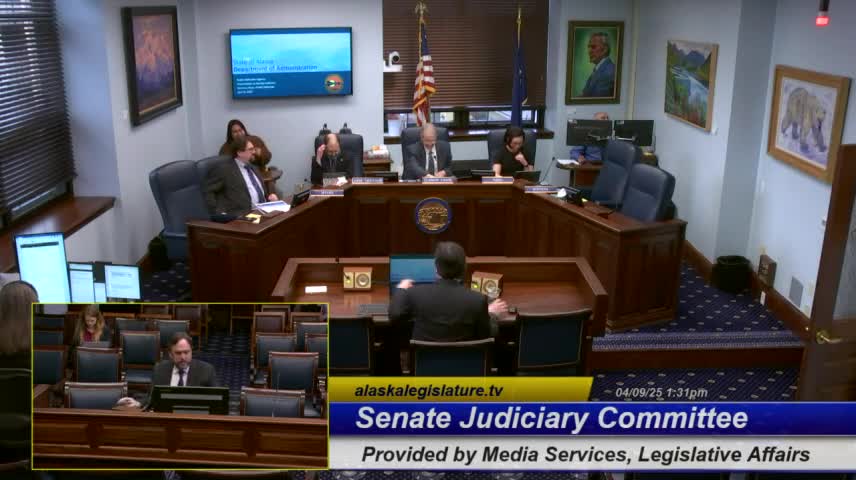
Terrence Haas, the appointed public defender for the State of Alaska and director of the Public Defender Agency, told the Senate Judiciary Committee in Juneau on April 9 that recent hiring and salary increases have reduced the agency’s backlog but that the office still faces a wave of retirements, growing discovery burdens and persistent pretrial delays.
Terrence Haas, the appointed public defender for the State of Alaska and director of the Public Defender Agency, told the Senate Judiciary Committee in Juneau on April 9 that recent hiring and salary increases have reduced the agency’s backlog but that the office still faces a wave of retirements, growing discovery burdens and persistent pretrial delays.
Haas told the committee, “Our mission ... is to provide constitutionally mandated legal representation to indigent clients appointed by the court,” and outlined the agency’s structure, caseload data and a series of initiatives intended to recruit, train and retain lawyers across the state.
The nut of Haas’s presentation: the agency’s caseload metrics show improvement but long-term problems remain. Appointments to the agency, which peaked around 22,000 in 2020, had fallen to just under 17,000 in 2024, and the agency reported 8,936 open and active cases on Jan. 1 of the year presented. Disposition rates—cases closed compared with cases received—rose from roughly 91% in 2020–21 to a projected roughly 110% in 2025, a level Haas said would shrink the overall caseload if sustained. Vacancy rates have dropped to about 8% after reaching about 14% in 2022.
Haas gave a breakdown of lawyers by subject area: about 90 lawyers in criminal litigation, about 20 in parent/family and mental-health (civil) defense, about 15 in appellate and post-conviction work, and roughly five assigned primarily to administration. He said roughly 83%–85% of appointments go to the Public Defender Agency.
At the same time, Haas warned the committee the agency faces near-term losses of experienced attorneys, including employees nearing retirement who were in defined-benefit plans. He described that mid-level cohort as the “life of the organization,” whose departure reduces on-the-job supervision for newly hired lawyers and increases implementation risk for trials of serious cases. “I have to have lawyers,” he said, describing recruitment and training as the essential fix to trial delay.
Haas described Alaska’s geographic staffing challenges, citing persistent difficulty recruiting attorneys for rural posts such as Utqiagvik, and noted larger offices in Anchorage and Fairbanks. He said some listed attorney PCNs (position control numbers) are filled, some are newly hired but not yet arrived, and others remain open and recruiting; he reported the system-wide total of PCNs in recruiting status was 11 with seven hires confirmed.
On child-welfare work, Haas said many Alaska child-in-need-of-aid matters are governed by the federal Indian Child Welfare Act (ICWA). He told senators the agency tries to coordinate with tribes and ICWA workers, and described “holistic defense” initiatives that pair legal representation with nonlegal supports to address poverty and other drivers of involvement with child-protective systems. “Sometimes we’re aligned with tribes and sometimes we’re not aligned with tribes,” he said, explaining alignment depends on the client’s position.
Haas also highlighted three operational problems the agency must address: (1) the surge in digital discovery, which produces “many gigabytes” of data that are time-consuming and costly to store and review; (2) pretrial delay driven both by pandemic-era interruption of trials and by loss of experienced trial attorneys; and (3) administrative friction created by conflicts between the Public Defender Agency and the Office of Public Advocacy (OPA) when cases must move between the two systems.
On discovery, Haas said police and prosecutors currently upload recordings and other digital evidence into systems that the agency then copies to separate servers, producing duplicated data flows that waste time, bandwidth and storage. He described talks with the Department of Law to reduce redundant copying and to coordinate storage to save attorney time and infrastructure costs.
To address training and caseload balance, Haas described a proposed misdemeanor training unit that would be conflict-screened from the rest of the agency and designed to give newly hired lawyers court experience without overwhelming them. The plan envisions eight permanent and four nonpermanent PCNs for the unit. Haas said the municipal contract with the City of Anchorage would fund an initial FY2025 increment of about $785,000 and could cost about $1.6 million a year going forward if case levels remain within roughly 25% of current levels; receipt authority to accept city funds has not yet been added to the agency’s budget.
Haas told the committee he is pursuing receipt authority through the executive-branch budget processes and is not requesting a supplemental appropriation. He also discussed recruitment and retention tools the agency is using or seeking, including salary increases (which he said have helped recruitment), the creation of a deputy for training and development, unpaid and potential paid internships/fellowships, and possibilities such as loan-forgiveness incentives and retirement-benefit considerations.
Senators pressed on implementation details. Senator Myers asked whether taking on municipal cases in Anchorage would worsen caseloads; Haas said training opportunities and the need for misdemeanor work to teach new lawyers can be essential to reducing long-term trial delay. Senator Tobin asked about ICWA coordination and about paid internships; Haas said the agency routinely communicates with tribes but operates only in state courts under its enabling statute, and that paid internships or fellowships could be useful recruitment tools. Vice Chair Kiel and others asked how the Alaska Supreme Court’s order limiting continuances will be applied; Haas said judges’ local application of the new continuance standards will matter and that orders alone will not eliminate the need for experienced trial attorneys.
Haas gave conflict-rate figures: 3,803 conflicts in fiscal 2021 and a projected 2,904 conflicts for 2025. He described the conflict-screened misdemeanor unit as a way to reduce friction and late-declared conflicts that delay proceedings. He said the agency aims to demonstrate an in-house, conflict-screened process that preserves statewide agency benefits while reducing duplication with OPA.
Ending note: Haas emphasized recruitment, training and coordination with other agencies as the path to long-term improvement. He told the committee the agency has made “great strides” but that continuing to hire, train and retain experienced attorneys is essential to move trials and maintain constitutional representation across Alaska.
(There were no formal motions or votes on this agenda; the hearing was a presentation and Q&A.)