Get Full Government Meeting Transcripts, Videos, & Alerts Forever!
Get email alerts on the Alaska Lng Project Glenfarn Divestiture topic
No spam. Unsubscribe anytime.
AGDC says it divested 75% of Alaska LNG project company to private developer; lawmakers press for unredacted agreements and timeline
Summary
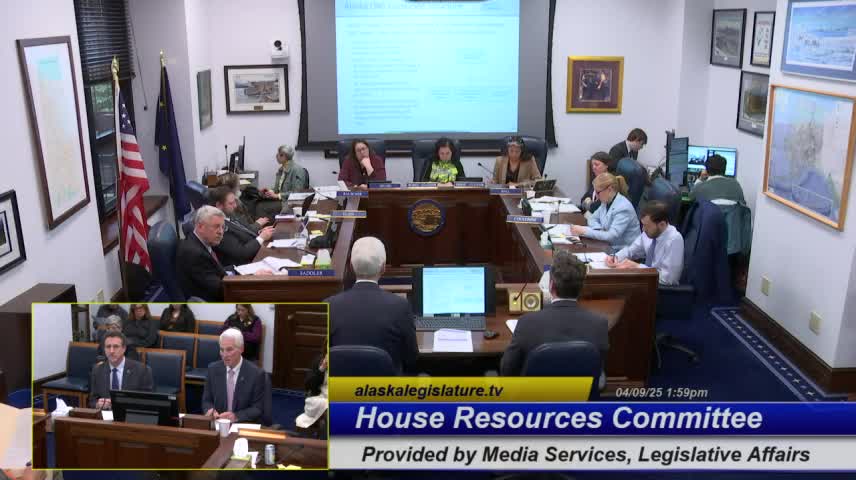
ANCHORAGE — The Alaska Gasline Development Corporation told the Alaska House Resources Committee on April 9 that it has signed definitive agreements transferring 75% ownership of the project company that holds the Alaska LNG permits and designs to a private developer, and that the developer will fund the next‑stage engineering work.
ANCHORAGE — The Alaska Gasline Development Corporation told the Alaska House Resources Committee on April 9 that it has signed definitive agreements transferring 75% ownership of the project company that holds the Alaska LNG permits and designs to a private developer, and that the developer will fund the next-stage engineering work.
For the record, Frank Richards, president of the Alaska Gas Line Development Corporation, told the committee: "in signing of definitive agreements, we divested 75% ownership of what is a wholly owned subsidiary that has been advancing the Alaska LNG project, and we divested it to a group called the Lehi Farm Group." The committee hearing took place in Capitol Room 124.
The transfer affects 8 Star Alaska, the AGDC-created project company that holds the permits and design work for the integrated Alaska LNG project. AGDC officials said the private developer (referred to in testimony as Glenfarn or Lehi Farm Group) has committed to financing the FEED work estimated by AGDC as roughly $150,000,000 to carry the project to a final investment decision (FID). "Yes. They have committed and in fact, as we go through these slides, you'll see in February, we laid out what we are endeavoring to do at our board meeting," said Matt Kissinger, AGDC’s venture development and commercial negotiations lead.
Why it matters: the transaction moves the state from a project‑developer role toward a minority, carried ownership position while private capital and a named developer assume the immediate financial risk of engineering and permitting. The project AGDC described remains large: officials cited a $43.8 billion full‑project estimate (2023 dollars) that includes an 807‑mile pipeline, two major plants (a North Slope gas‑treatment/CO2 capture plant and a Nikiski liquefaction plant) and a 20 million‑ton‑per‑year LNG facility. AGDC said a phased approach — building an in‑state pipeline (phase 1) before full liquefaction — reduces near‑term state costs and improves feasibility.
Key technical and financial details presented to the committee
- Project scale and scope: AGDC described the integrated Alaska LNG project as a roughly $43.8 billion program (2023 estimate), including an 807‑mile mainline, a 42‑inch pipeline in the permitted design, a North Slope gas treatment plant (AGDC cited roughly $10 billion), and a Nikiski liquefaction facility (AGDC cited roughly $20 billion). Phase 1 — the in‑state pipeline delivering gas to Southcentral and Fairbanks — was described as a roughly $10.8 billion construction package.
- Flows and offtakes: AGDC said initial pipeline throughput leaving Prudhoe Bay would be about 3,000,000,000 standard cubic feet per day (scfd) and that roughly 2,700,000,000 scfd would flow into the liquefaction train when required. AGDC also described off‑take points for Fairbanks, the Matanuska‑Susitna area and the Kenai Peninsula. AGDC told the committee the project design reserves up to 500,000,000 scfd of priority capacity for in‑state customers, compared with current in‑state consumption AGDC cited at roughly 200,000,000 scfd.
- Cost comparison and benefits: AGDC reported a Wood Mackenzie independent review, which AGDC said found phase 1 could deliver North Slope gas to Alaskans at a lower cost than imported LNG in most modeled cases (Wood Mackenzie’s illustrative mid case cited a delivered cost in the low‑to‑mid teens per MMBtu versus higher imported costs). AGDC also cited economic benefits from building and operating the pipeline: the presentation gave an illustrative economic benefit of roughly $16.6 billion (construction and savings combined) versus relying on imported LNG.
- Financing and structure: AGDC said the private developer will fund FEED and that the top‑level project company (8 Star Alaska) was structured so investors can take interests in the three subprojects (gas treatment/carbon capture, pipeline, liquefaction). AGDC said it retains a 25% carried interest in 8 Star Alaska; the private lead developer takes a 75% ownership interest. AGDC described a governance package including negative approval rights for certain contracts and rights intended to protect Alaska’s interests (AGDC said those protections exist in the negotiated agreements but that portions of the definitive agreements remain confidential).
Points of friction raised by legislators
- Confidentiality and access to contracts: multiple legislators asked for unredacted definitive agreements, term sheets and side letters. Representative David Fields (R) asked, "can you provide the full unredacted text of the definitive agreement between Glenfarren and AGDC, including term sheets, side letters, or amendments to clarify the exact obligations, equity transfers, and development rights assigned under this project, theoretical project you're describing?" AGDC witnesses repeatedly said the commercial agreements contain confidential terms and that some details cannot be publicly released; they offered to consider NDAs with lawmakers.
- Due diligence and competition: lawmakers asked whether other companies were considered and how the lead developer was chosen. Janet Weese, AGDC board vice chair, told the committee: "We were provided the, the full agreements and, we were also provided, lots of explanation about these agreements. And, so, and and time to review all of the agreements. So I, and our duty is to review those and sign off." AGDC also said it relied on a screening process run with Goldman Sachs and used outside counsel and advisors for final diligence.
- State protections and future investment decisions: lawmakers pressed AGDC on how the state would protect its interests as a minority owner, whether the state would be required to invest at FID, and what remedies exist if the private developer pauses or withdraws after FEED. AGDC said the state retains negative approval rights on certain actions and that the state’s 25% interest in the top company is a carried, in‑perpetuity interest; AGDC also said provisions exist to address a developer decision not to proceed, but AGDC characterized some contract provisions as confidential.
Other notable details from testimony
- Consultations: AGDC reported it consulted with the Department of Revenue, Department of Natural Resources and the Attorney General’s Office before signing agreements, and said the AG’s office issued a certificate of compliance that laws were followed.
- Federal loan guarantees and other federal support: AGDC noted federal loan guarantee authority (authorized and inflation‑adjusted under recent federal law) as an important credit support tool; AGDC said the guaranteed pool has grown to just over $30 billion and that guarantees reduce the project’s cost of capital.
- International interest and offtake: AGDC and the developer said they secured nonbinding letters of intent and large expressions of interest in Asia during a recent trade mission (AGDC referenced discussions with buyers in Taiwan, Thailand, Japan and Korea). AGDC said those conversations are at early commercial stages (LOIs and heads of agreement) and remain subject to price, contract terms and regulation.
- Workforce and Alaska advantage: AGDC said the agreed developer has included Alaska‑preference commitments (a preference for Alaska hire and supply chain participation) and training provisions, but AGDC said the agreements do not specify a numeric Alaska native‑hire percentage; the company committed to build an Alaskan workforce presence.
What the committee asked AGDC to provide next
Lawmakers asked AGDC to return to committee with more detail and named several specific follow‑ups AGDC agreed to consider: (1) the revenue‑to‑the‑state slides and a confirmation of the Department of Revenue estimate of annual revenues (AGDC cited an estimate up to about $600 million per year in some scenarios), (2) more detail on governance protections and the specific milestones in the developer agreement (some characterized confidential by AGDC), and (3) an offer to explore NDAs so legislators can review redacted material. Multiple members requested AGDC bring the commissioners of DOR and DNR and outside advisors (Goldman Sachs) back for another hearing.
Ending
AGDC presented the transfer of a 75% owner interest in 8 Star Alaska to a private developer and described a plan under which that developer would fund FEED to FID while the state retains a carried 25% interest. Committee members pressed AGDC repeatedly for unredacted agreements, clearer milestone dates and tighter definitions of Alaska’s legal protections; AGDC said much of the commercial detail remains confidential but offered to return with more material and to consider NDAs.
(Reporting is based on the April 9, 2025 House Resources Committee hearing and direct statements in committee testimony by Frank Richards, Matt Kissinger, Janet Weese and members of the House Resources Committee.)