
ACPE outlines changes to Alaska Performance Scholarship, grants and loan options at lunchtime briefing
Get AI-powered insights, summaries, and transcripts
Sign Up Free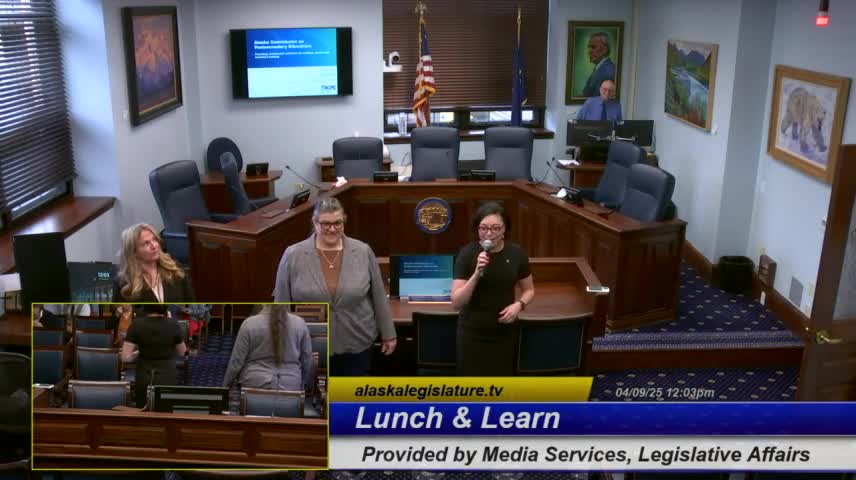
Summary
Alaska Commission on Postsecondary Education officials briefed attendees on expanded Alaska Performance Scholarship eligibility and awards after passage of HB 148, described need-based Alaska Education Grant limits, and reviewed ACPE loan products and outreach tools, with questions from students about eligibility and registration holds.
Senator Lukey Gail Tobin hosted a lunchtime presentation featuring officials from the Alaska Commission on Postsecondary Education, who summarized recent changes to the Alaska Performance Scholarship and described the commission's grant, loan and outreach programs.
The presentation, led by Carrie Thomas, acting executive director of the Alaska Commission on Postsecondary Education (ACPE), and Kate Hillenbrand, ACPE director of communications and outreach, covered program rules, recent legislative changes enacted by HB 148, and ACPE services for students and families. Thomas said the agency's “mission is to provide sustainable solutions for college, career, and technical training.”
ACPE highlighted two state-funded awards: the Alaska Education Grant (AEG), a need-based award that ranges from $500 to $4,000 per academic year depending on FAFSA-determined need, and the merit-based Alaska Performance Scholarship (APS). Kate Hillenbrand said APS now provides up to $28,000 across eight semesters and may be used within eight years of high school graduation. She described major changes from HB 148, including expanded rigorous curriculum options, removal of a required test score so students may qualify by meeting either a minimum GPA or a minimum test score, increased award levels, earlier preliminary eligibility notification to districts in the middle of students’ junior year, and a new “step up” provision that can raise a continuing student's award level if they meet GPA and enrollment criteria.
Hillenbrand presented APS outcomes showing a marked increase in eligibility after implementation: 2,180 students were eligible for APS Level 1 in the class of 2024 versus 642 in the class of 2022, and overall APS eligibility for the class of 2024 was 45 percent compared with 17 percent for the classes of 2022 and 2023. ACPE staff said the program has awarded more than $126,000,000 since its inception in 2011.
Thomas explained the relationship between ACPE and the Alaska Student Loan Corporation, a statutorily created financing entity that funds ACPE loan programs. ACPE offers three primary loan products: a supplemental student loan, a family education loan and a refinance loan. The agency also offers specialty loan options tied to specific fields of study (described in the presentation as fisheries-related programming, the WWAMI medical exchange program, and the WICHE professional student exchange program). Thomas said ACPE's in-school loans generally have lower interest rates than private lenders and currently are lower than the federal Parent PLUS rate; she added the commission has safeguards intended to prevent overborrowing and estimated borrowers may save “upwards of $15,000” compared with private lenders.
The presenters described ACPE planning and outreach services including Kids2Careers (grades 5–12 curriculum and family guidance), the Alaska Career Information System (AKCIS) online portal, the Alaska College and Career Advising Consortium (ACAC) for training school and community advisors, and a Success Center providing one-on-one help with FAFSA, applications and financial planning. Thomas stressed FAFSA submission is a requirement to receive AEG or APS funds and highlighted ACPE's Alaska FAFSA Completion Initiative to boost completion rates.
On institutional oversight, Hillenbrand described ACPE's institutional authorization and consumer protection responsibilities, noting the University of Alaska system is exempt from ACPE authorization under statute and that student complaints about nonexempt institutions may be handled through ACPE's authorization and complaint process.
During a question-and-answer period, a student from the University of Alaska Fairbanks asked whether students already in college who missed required test dates could receive APS under the new rules; Thomas replied, “The changes to eligibility only affect the class of 2024 and beyond,” and said peers who graduated earlier remain subject to previous eligibility rules. Another attendee asked whether financial holds that block registration are routed to ACPE; presenters advised students to contact their campus financial aid office for institution-specific holds and options. When asked whether AEG faces the same funding shortfall as AEG, Thomas replied, “Currently we fund all Alaska Performance Scholarship eligible students in the state and, we still have some additional funding,” and that AEG demand does exceed available funding.
ACPE materials, the agency's Alaska Higher Education Almanac and the annual APS outcomes report were noted as available online. Senator Tobin invited attendees to the quarterly ACPE board meeting scheduled for the next day at 10:00 a.m.
The presentation consisted of a program overview and a brief question-and-answer session; no formal votes or policy actions were taken at the event.