Get Full Government Meeting Transcripts, Videos, & Alerts Forever!
Get email alerts on the Land Use Redevelopment topic
No spam. Unsubscribe anytime.
Coventry holds joint workshop on Johnson's Pond redevelopment; consultants outline outreach, financing options
Summary
At a joint workshop, GZA presented a draft process for a Johnson's Pond redevelopment plan that the town and its redevelopment agency expect to finish in early 2026. Discussion focused on community engagement, short-term access options, and potential financing tools including tax increment financing.
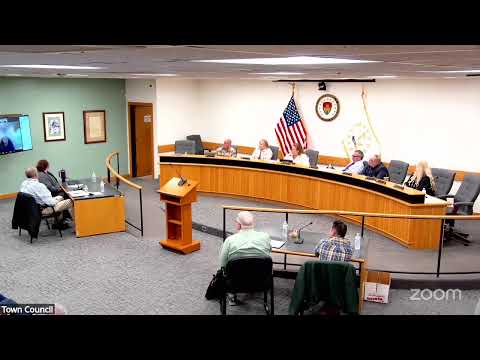
At a joint workshop of the Coventry Town Council and the Coventry Redevelopment Agency, planners from GZA outlined a schedule and public‑engagement strategy for a redevelopment plan for Johnson’s Pond and discussed potential funding approaches including tax increment financing.
The meeting matters because the plan will shape how the town uses newly acquired shoreline and dam‑related property and because speakers pressed for near‑term public access as the long‑range plan is developed.
GZA senior planner Sarah Sklar told the council the firm expects to begin work in April 2025 and aims to deliver a final redevelopment plan in “early 2026.” She said the scope is a planning framework, not detailed design work, and described steps including site reconnaissance, mapping and a series of public workshops and hearings. “This is a collaborative process,” Sklar said, adding that the project website and targeted outreach would be launched early in the process.
Town solicitor Angel and redevelopment advisers described the agency’s limits and possible funding paths. Attorney Tom Moses, of the law firm Moses Ryan, advised the bodies to consider making the redevelopment district large enough to generate meaningful tax increment revenues, saying a TIF depends on capturing increases in assessed value, not a base tax. “You need a district that’s fairly significant to be able to do that,” Moses said. He and others noted construction on waterfront sites can be costly and that multiple revenue “layers” — grants, bonds, municipal contributions and TIF proceeds — are often required.
Council members and agency members pressed for two parallel approaches: (1) a long‑term redevelopment plan led by GZA and the redevelopment agency, and (2) short‑term, lower‑permit improvements to provide access now. Councilman Pasqua and others suggested modest early steps such as improved parking and a basic boat ramp; Pasqua also suggested the town-owned 429 feet of shoreline by the bike path could be opened with limited work to provide near‑term access. Solicitor Angel and GZA cautioned that even small improvements often require permits from the Rhode Island Department of Environmental Management (DEM).
Members also discussed a previously existing marina near Indian Trail; speakers said docks and some infrastructure remain and that a town‑run marina or slip rentals could be an option if the final plan supports it. GZA said operational and cost analyses at this stage would be order‑of‑magnitude only, not full business plans.
Resident Steve Riley, whose earlier written submission the council accepted into the record by motion, raised concerns about prior legal and financial steps taken around the pond and asked how the planning team would evaluate public uses and impacts on property owners. GZA said the first step is mapping property, ownership and use patterns so options can be developed with public input.
The workshop produced no land‑use decisions or binding financing commitments. Instead, the council and the redevelopment agency agreed to proceed with GZA’s outreach and mapping work and to seek short‑term ways to provide access where permitted.
Votes at a glance: A council motion to accept Steve Riley’s written submissions into the record passed on a roll call (Vice President Verducci moved; Councilwoman Capaldi seconded; recorded yes votes: Councilmember Pasqua, Councilmember Capaldi, Vice President Verducci, President Lima; tally recorded 4–0). The Redevelopment Agency approved its February 26, 2025 minutes in a separate vote (motion and second on the record; recorded yes votes by RDA members present; tally recorded 4–0). The council later moved to adjourn by voice vote.
What happens next: GZA representatives said they will draft a public outreach plan and present website mockups and other recommendations to the agency and council in the coming weeks and report back at the council’s April meeting. The presentation materials and the mapping phase will be used to identify short‑term access opportunities and to craft the formal redevelopment area boundary and the final plan, which will be subject to public hearings and submission to the Rhode Island Department of Administration.
Ending: Council and agency leaders emphasized transparency and sustained public engagement as the process unfolds and said they expect tradeoffs between near‑term access and longer‑term infrastructure, financing and permitting realities.