Get Full Government Meeting Transcripts, Videos, & Alerts Forever!
Get email alerts on the Transportation Impact Fees topic
No spam. Unsubscribe anytime.
Monroe council advances transportation impact-fee overhaul; staff says average increase ~76%
Summary
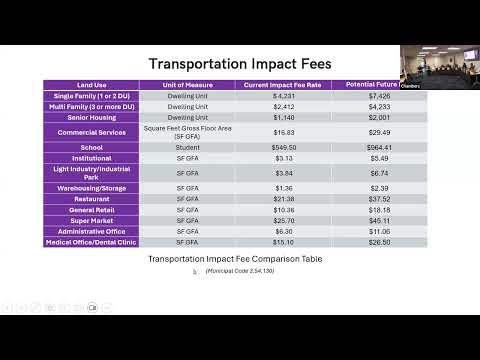
Monroe City Council accepted first reading of Ordinance No. 4 of 2025 on April 8, advancing a comprehensive update to transportation impact fees that staff said averages a roughly 76% increase and sets a per-unit fee for a typical single-family home at $7,426.
Monroe City Council accepted first reading of Ordinance No. 4 of 2025 on April 8, advancing a comprehensive update to the city's transportation impact-fee methodology and schedule that staff said would raise average fees by about 76 percent and set a per-unit fee for a typical single-family home at $7,426.
City staff told councilors the update stems from a 20-year capital plan that lists roughly $99 million in transportation projects; staff said about $47 million of that total was assigned as the proportional responsibility of future development and would be funded in part by impact fees and other sources. "We estimate about $99,000,000 worth of capital, street projects and of that about $47,000,000 we figured was gonna be the responsibility of future development," a city presenter said, summarizing the study and attachments in the meeting packet.
Why it matters: Impact fees are charged to new development to pay its share of systemwide transportation improvements. The proposed increase would change the per-application charge the city assesses when issuing permits; council members said the change could affect housing costs, the attractiveness of Monroe for builders, and the city's development strategy.
Key details from staff and council discussion:
- Basis and timing: The presenter told the council the new fee schedule would go into effect when the ordinance is adopted; it would not phase in over 20 years. In response to a council question about timing, the presenter said, "This will go into effect as soon as the ordinance is adopted. That will be the new rate we would assess future applications."
- Fee levels and examples: Staff provided a comparison table showing existing and proposed rates by land-use category. The presentation stated a typical single-family residential unit would be assessed $7,426 under the proposed schedule. Staff also said the proposal reflects a new multimodal analysis that counts sidewalks and bicycle facilities as part of the city's transportation needs.
- Council concerns: Several council members pressed on policy trade-offs. Council Member Gamble framed the matter as a conscious policy choice, noting prior council decisions intentionally kept Monroe's fees below peers to attract development: "We wanted to be just below the mid. Because we felt if we were below the mid, that it would make us attractive and we would get growth," Gamble said. He warned a large increase could slow growth or shift investment to neighboring cities.
- Regional context: A council member noted recent state legislation requires cities to consider multimodal travel when identifying transportation projects, increasing the scope and cost of projects that impact-fee studies must account for. Staff said other nearby cities are making similar recalculations and that Monroe would still be lower than some neighbors on several land-use categories.
Council action: Council Member Hanford moved to accept the ordinance as first reading, stating the motion on the record to: "accept as first reading, ordinance number fourtwenty 25, amending chapter 3.54.130 MMC, transportation impact fees, updating and revising the city's methodology, rate structure and schedule for imposing transportation impact fees upon certain development activity effecting various housekeeping amendments, providing for severability and establishing an effective date." Council Member Gamble seconded. The council voted 7-0 to advance the ordinance to a future meeting for final reading and adoption.
What comes next: Staff said the council will return for final reading and formal adoption at a subsequent meeting after the public-notice and adoption steps required by city code. The agenda packet contains the detailed study and the proposed rate table for council and public review.
Ending: With the first reading approved, the proposed fees are scheduled for final consideration at a later council meeting where the council may adopt, amend, or reject the ordinance.