Get Full Government Meeting Transcripts, Videos, & Alerts Forever!
Get email alerts on the Public Safety Police Staffing topic
No spam. Unsubscribe anytime.
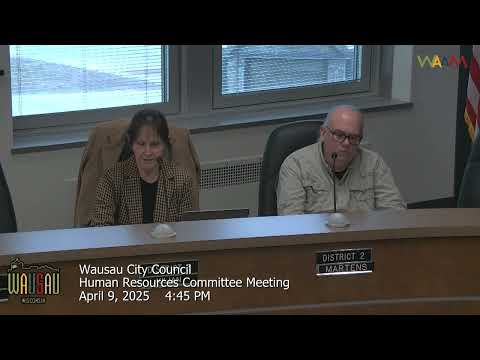
Wausau committee approves backfill for deployed officer, creates part-time officer program
Summary
The Wausau Human Resources Committee authorized backfilling a police position for a one-year military deployment and approved a part-time officer program to use trained former officers and instructors for limited summer and specialty shifts.
The Wausau Human Resources Committee on April 9 approved authorizing the police department to backfill a position while an officer is deployed on military duty and voted 3–2 to establish a part‑time officer program that would allow trained former officers or instructors to return for limited hours.
The actions came after Police Chief Barnes described a one‑year deployment beginning in May that will create a staffing gap. He told the committee the city would not pay the deployed officer during the deployment and that backfilling would use savings from that employee’s pay and benefits. “We’re not paying them during that period of time,” Barnes said, explaining the budget rationale for hiring a temporary replacement and training that person so they could be ready for expected retirements in early 2026.
The committee also approved a program to hire up to a few part‑time officers — for example, retired officers or instructors at Northcentral Technical College — to work limited hours for duties such as targeted enforcement, summer event coverage and mentoring community service officers (CSOs). Chief Barnes described part‑time staff as a lower‑cost way to access experienced officers without paying benefits. He said the department expects to manage the program within existing vacancy savings and does not plan to request new recurring budget dollars.
Committee members asked about legal and fiscal limits. Barnes explained Wisconsin Act 12’s maintenance‑of‑effort rules govern shared revenue tied to protective services and measure whether levy dollars spent for law enforcement drop from year to year; he said the rule is based on dollars spent, not on unfilled positions, and staff monitor the calculation with finance staff. “The maintenance of effort does not take into account openings that we’re trying to hire for, or positions that aren’t filled. It’s the dollars that are spent,” Barnes said.
The chief and staff emphasized that the program requires negotiated agreement with the union. The Police and Fire Commission signaled support for changes to the hiring process, but the collective bargaining agreement with WPPA (the police union) must be addressed: the union could choose to represent part‑time employees and would negotiate pay and terms. Barnes also said the part‑time positions are not intended to replace overtime opportunities for full‑time staff; labor rules and seniority lists limit how overtime and part‑time shifts interact.
Votes and motions: the authorization to exceed staffing for the deployed officer was approved without recorded opposition. The part‑time officer program passed on a 3–2 vote.
The committee recorded several operational clarifications: the temporary backfill is intended to be budget‑neutral or budget‑positive for 2025 because of salary savings while the deployed officer receives military pay; staff expect one to two retirements in January–February 2026 that would absorb a permanently retained backfill; and up to three to four part‑time officers could be available depending on departmental needs and union negotiation outcomes.
Next steps: staff will proceed under the collective bargaining and budget constraints, negotiate terms with the union as required, and return to the council or committee if further budget authority or policy changes are needed.