Get Full Government Meeting Transcripts, Videos, & Alerts Forever!
Get email alerts on the Location Data topic
No spam. Unsubscribe anytime.
Mass. hearing spotlights push to ban sale of precise location data to protect patients, protesters and vulnerable groups
Summary
A joint legislative hearing in Boston on data privacy focused early and repeatedly on bills that would ban the sale of precise cell‑phone location data and strengthen consumer protections in Massachusetts.
A joint legislative hearing in Boston on data privacy focused early and repeatedly on bills that would ban the sale of precise cell‑phone location data and strengthen consumer protections in Massachusetts.
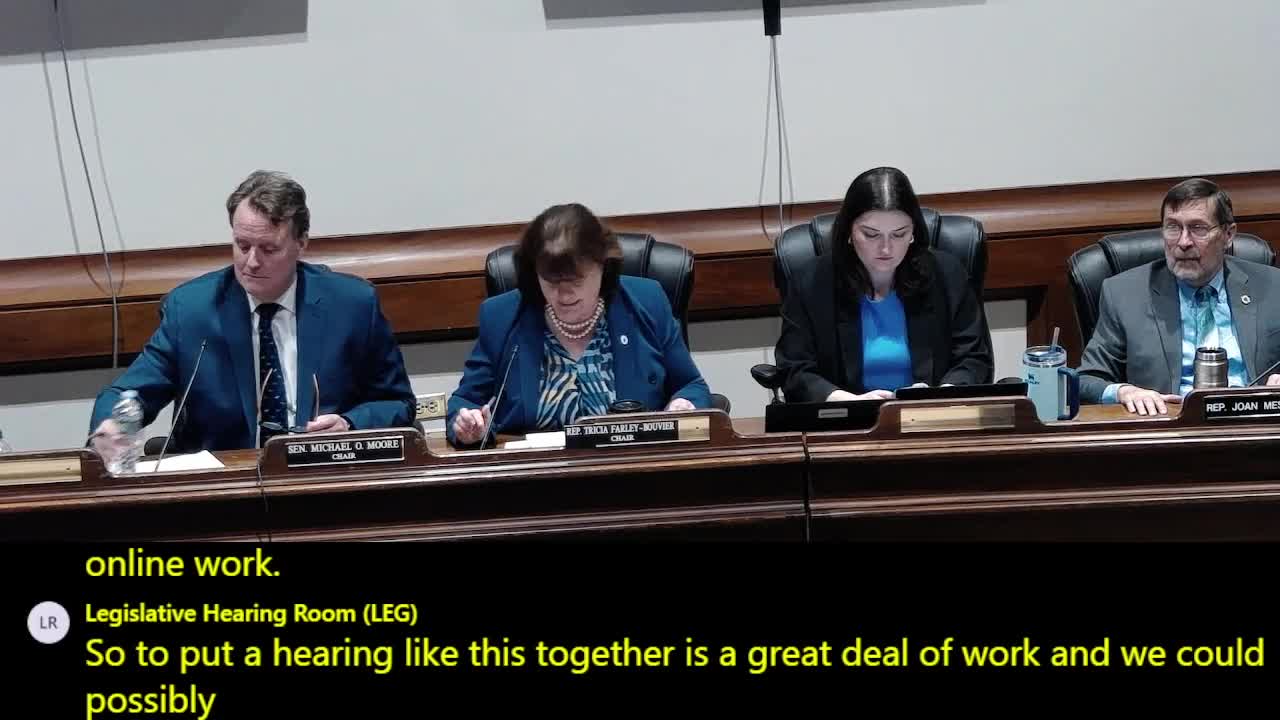
Supporters told the Joint Committee on Advanced Information Technology, the Internet and Cybersecurity that existing private data markets let brokers sell people’s movements to the highest bidder, a practice that can be used to identify visitors to reproductive‑health providers, faith centers, shelters and community events. Representative Farley Bouvier, the House chair presiding at the hearing, and Senator Michael Moore, the Senate chair, framed the panels and witnesses around the risks that location data poses to public safety and civil liberties.
Witnesses from medical, civil‑liberties and reproductive‑health organizations described specific cases and trends. Dr. Kendra Harris, an OB‑GYN who provides abortion and gender‑affirming care in Massachusetts, said patients sometimes arrive with minimal personal devices or rely on others for directions because they fear being tracked. The American College of Obstetricians and Gynecologists (represented by Megan Evans) and Planned Parenthood League of Massachusetts (represented by Carrie Riggles and Meghan Donnelly) urged the committee to pass the Location Shield Act to prevent third‑party brokers from monetizing location records that reveal clinic visits.
Advocates also said the market for location information creates risks for domestic‑violence survivors, journalists, judges, religious minorities and election workers. Representatives of the League of Women Voters and the Massachusetts Commission on LGBTQ Youth described threats and harassment against community members that can be enabled or magnified by commercially available location feeds. Consumer advocates and privacy groups pressed for legislation that pairs a ban on sales of location data with broader data‑minimization requirements and enforceable rights for residents.
Industry and trade witnesses warned about complexity and urged the committee to consider interoperability with other states. Tech industry representatives argued for models adopted in other states that they said create clearer compliance paths for businesses; privacy advocates countered that many of those models lack robust data‑minimization rules and private enforcement that make laws effective in practice.
The committee heard dozens of in‑person and virtual witnesses and encouraged written input; no final votes were recorded at the hearing. Proponents said a focused Location Shield Act, combined with a broader consumer privacy law that establishes limits on sensitive data collection and transfers, would give Massachusetts residents practical and enforceable protections without stopping legitimate uses of location when consumers provide informed consent.
Looking ahead, committee members asked for additional technical briefings and legal drafting to square enforcement language, carve‑outs for legitimate service providers, and the interplay with federal privacy and health laws. Supporters pledged follow‑up materials and said they would work with the chairs to refine statutory language before any committee report or floor action.