Get Full Government Meeting Transcripts, Videos, & Alerts Forever!
Get email alerts on the Wastewater Infrastructure topic
No spam. Unsubscribe anytime.
Nashville council selects 24-inch outfall replacement plan and moves to pursue federal and state funding
Summary
Council received a feasibility study on the 40-year-old Stoney Creek sewer outfall, selected a 24-inch new-line replacement option, authorized a design RFQ, and approved parallel state funding applications for multiple wastewater projects including the Stoney Creek outfall and Regency lift-station elimination.
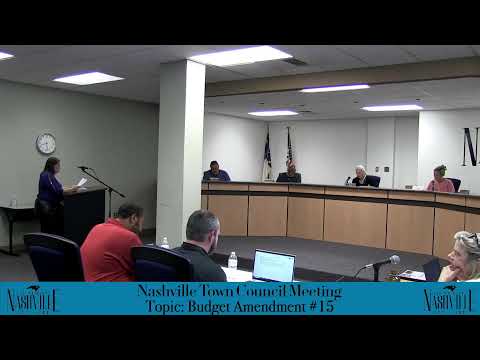
The Town of Nashville town council on April 1 received a feasibility study for the 40-year-old Stoney Creek sewer outfall and voted to move the project forward with a new 24-inch gravity outfall replacement, while pursuing FEMA BRIC and state clean water financing.
The feasibility study, presented by Mike Tolleson of MacGain Associates, reviewed three options: relining the existing 18-inch pipe, building a pump station with a force main, or replacing the outfall with a larger-diameter gravity line. Tolleson recommended replacing the existing outfall with a new 24-inch line laid parallel to the existing easement, with new manholes and improved access for routine maintenance. "When you go to a 24-inch pipe, you almost double the capacity," Tolleson said. He noted estimated project ranges of several million dollars and told the council the town is eligible to apply for FEMA BRIC (Building Resilient Infrastructure and Communities) funding with an application due October 31, 2025.
Why it matters: the outfall conveys Nashville's wastewater to the City of Rocky Mount for treatment. Council members and the town engineer said the replacement would reduce inflow and infiltration, improve long-term reliability, and create a maintainable corridor where beaver activity and standing water now impede inspection and repairs. Tolleson said a new line also helps future grant eligibility and can materially improve the town's capital-asset condition ratios noted in the recent audit.
Key details: Tolleson estimated full replacement options (18–30 inch alternatives) with high-level cost ranges in the multi‑million-dollar band and recommended designing for a 24‑inch line to provide roughly 50 years of additional capacity. He also recommended adding metering capability at an accessible point on the outfall (for example, near Red Oak Road) so the town can independently measure flow before the point where responsibility transfers to Rocky Mount. "A gravity system is always the preferred method because it doesn't use electricity," Tolleson said, while noting the pump-station/force-main option gives metering and operational benefits but adds long-term maintenance and energy costs.
Council action and next steps: the council voted to receive the feasibility study, select the replacement option (new 24-inch line) and authorize the town manager to begin the professional qualifications (RFQ) process to select a design engineer under the Mini‑Brooks Act procurement rules. The vote also included a council request to include metering in the design scope.
Parallel funding actions: staff advised that the town will pursue FEMA BRIC funding for the outfall and also apply to the state's Clean Water State Revolving Fund (CWSRF). The council voted to approve three separate town resolutions to initiate state funding applications for (1) the Stoney Creek Outfall Replacement and Rehabilitation Project, (2) the Regency Lift Station Elimination and Collection System Improvement Project, and (3) broader water/wastewater collection-system rehabilitation work so the town may pursue multiple funding sources in parallel.
Separately, the council accepted an NCDEQ (North Carolina Department of Environmental Quality) funding contract for the Essex Road Sewer Extension Improvement Project consisting of a $500,000 principal forgiveness loan and a $95,830 repayable loan; the council adopted the resolution accepting those funds.
What the council directed staff to do next: begin the RFQ process for a design engineer to produce permit-ready plans and cost estimates; include metering in the scope; continue infiltration-and‑repair work on collection-system manholes in town; and prepare BRIC and CWSRF applications aiming to be design-ready for the BRIC October 31 deadline.
Funding and timeline notes: Tolleson said BRIC grants can be up to $10 million and that moving forward with a design now improves competitiveness; project estimates will be refined during design and later during bidding. The council and staff noted that FEMA and state funding decisions are not guaranteed and that the town will proceed with parallel state applications so projects remain viable without federal awards.
Quotes and attribution come from the council meeting presenters and staff: Tolleson (MacGain Associates) and Trey (town staff), and council deliberations recorded in the council transcript.
Ending: The council’s motion to receive the study and proceed carried; staff will return with RFQ language, refined costs, and proposed funding‑application materials for council review.