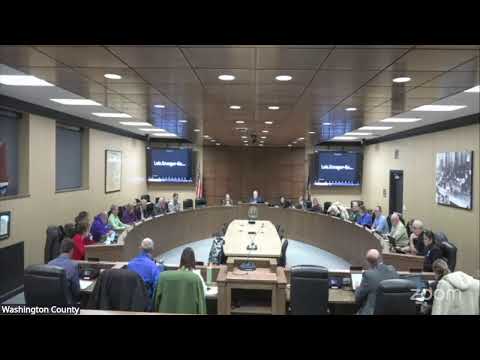
Board approves 2026–27 capital improvement plan; board also passes multiple routine resolutions and ordinances
Summary
After a detailed discussion of a $33 million capital improvement plan and the county’s approach to sales‑tax allocations, the Washington County Board approved the CIP and a slate of routine resolutions and ordinances, most by unanimous vote.
The Washington County Board of Supervisors on May 7 approved the county’s capital improvement plan (CIP) covering projects through the coming biennium and voted on several routine resolutions and ordinances that were on the consent calendar.
County staff presented a proposed $33 million CIP focused on projects across county facilities, highways, parks, public safety and IT. Staff said the plan is primarily a planning document for 2026–27 and noted that it proposes shifting a larger share of projected sales tax into the operating budget (from about 52% in the current budget to roughly 55.5% in the CIP projection), which staff estimated would generate about $660,000 of additional operating revenue. The board discussed project timing, priority setting if revenues fall, and particular facility items (roof membrane replacements, the Fair Park modernization debt service, and a future jail renovation that would convert dormitory‑style housing into individual cells).
Supervisor questions focused on how the county will prioritize projects if sales tax receipts decline, how ongoing funding for brownfield redevelopment is being handled (staff said a one‑time injection of $400,000 is planned rather than establishing a permanent annual allocation), and choices about funding facility repairs at the county campus while a task force decides the campus’s future. Staff said many projects remain flexible and that adoption of the CIP does not itself appropriate funds; funding will be set later in the 2026–27 operating budget process.
After discussion the board voted to adopt the CIP by the required two‑thirds vote. Board members also approved a set of grouped resolutions to share GIS services with municipalities, the 2024 carryover resolution, an advisory resolution urging state support for county courts, an excess right‑of‑way discontinuance, two ordinances (prohibiting parking on County Trump Highway W in Allenton and amending sections 15‑3, 70‑3 and 70‑13 relating to chair/executive/clerk duties), and several retirement commendations. Most items passed unanimously; the CIP was adopted by the required two‑thirds vote.
Votes at a glance
- Resolution (advisory) urging the governor and legislature to support county courts: passed unanimously. - Grouped resolutions to share GIS services with municipalities: passed unanimously. - Resolution 11 (2024 carryover): passed unanimously; required two‑thirds for adoption of carryover funding later in process. - Resolution 12 (2026–27 CIP adoption): passed (two‑thirds requirement met; recorded as adopted in the transcript). - Resolution 13 (discontinue excess right‑of‑way and convey to adjacent owners): passed unanimously. - Ordinance 1 (prohibit parking on County Trump Highway W in Allenton): passed unanimously. - Ordinance 2 (amend sections 15‑3, 70‑3 and 70‑13 regarding powers/duties of county chair, county executive and county clerk): passed unanimously. - Retirement commendations (multiple resolutions for long‑serving employees including James Hader, William Niehaus, Gary Pisto, Robert Schmidt): presented and entered into the record.
Staff and board members noted the CIP will be refined as the county moves through the budget calendar, and that certain projects (for example, an accelerated jail piping replacement and a proposed brownfields injection) may come forward for separate funding earlier than indicated in the plan.
AI generated
The text on this page is AI generated. Summaries, highlights, analysis, and video transcripts are all produced from the original source material.
AI can make mistakes, so if you spot one, and we will fix it for everyone.
Note: the source content is unaltered by us. Any content source we link to, be it a video, an audio recording, or a document, is presented exactly as its publisher released it. That publisher is usually a government body, sometimes an individual official or another organisation.