Get Full Government Meeting Transcripts, Videos, & Alerts Forever!
Get email alerts on the Homelessness Funding Spenddown topic
No spam. Unsubscribe anytime.
Council members press Office of Homeless Services on pace of spending from $50 million homeless package
Summary
Council members raised concerns that several allocations from a $50 million homelessness package remain largely unspent after two years and asked for updated spend-down schedules and clearer unit counts for awards tied to permanent supportive housing and supportive services.
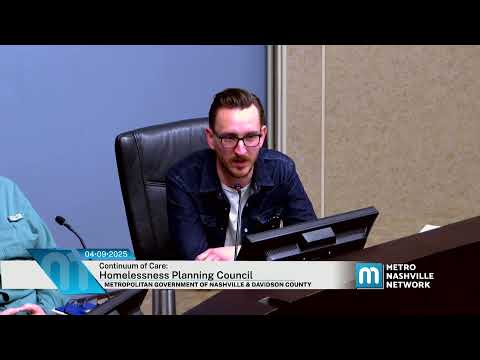
Council members at the April 9 Homelessness Planning Council meeting pressed Office of Homeless Services staff for clearer accounting and faster use of a $50 million homelessness package that was discussed in the Council packet.
Councilwoman Courtney Johnson asked for corrections to the packet’s spreadsheet and for updated counts showing how many units each allocation will support. She noted that approximately $7.5 million routed to the Barnes Fund via Omni Family Foundation had been approved by council and asked whether the corresponding contracts had been executed; staff confirmed the Barnes Fund contract had been executed.
Johnson and other council members said they were concerned that multi-year allocations — including a $9 million supportive-services pool and a $4 million low-barrier housing allocation — still show large unspent balances after roughly two years. April Calvin, director of the Office of Homeless Services, said the city has 12–18 months to spend certain funds and is projecting spend-downs using provider reporting. She said staff were meeting with service providers to scale up capacity and exploring creative options to leverage other funding streams.
Calvin described coordination with Mary Jo (staff) and monthly meetings with MDHA, plus every-other-week work groups to identify future funding. She said the city has some ARPA dollars that could be deployed and that Austin’s example—where the city, county and philanthropy braided funds and created local voucher-like subsidies—was instructive. Calvin asked providers to increase capacity and to identify ways to braid funds across sources.
Council members urged clearer outcome metrics tied to those dollars — how many people the allocations are expected to house and whether housing placements are durable — and requested updates after Calvin’s meetings with Mary Jo.
No formal vote or reallocation was taken at the meeting.