Get Full Government Meeting Transcripts, Videos, & Alerts Forever!
Get email alerts on the Student Electronic Devices Policy topic
No spam. Unsubscribe anytime.
Policy committee advances electronic devices policy to second read after detailed debate over enforcement, storage and evaluation
Summary
Wallingford-Swarthmore School District policy committee voted to advance Policy 237 (Electronic Devices) and its administrative regulation (AR) to the full board for second reading after extensive discussion about definitions, where devices must be stored, equity for students without phones and how the district will measure enforcement success.
The Wallingford-Swarthmore School District policy committee voted to send Policy 237, the district's electronic devices policy and accompanying administrative regulation (AR), to the full board for a second reading after extended debate over enforceability, storage locations and monitoring.
Committee members and administrators spent the meeting clarifying definitions and enforcement mechanics. Dr. Scanlon, speaking for district staff, said the committee had tightened definitions, including changing "instructional period" to "the time between the start and end of a class period," and had proposed a definition of "noninstructional period" to cover times such as lunch and passing periods.
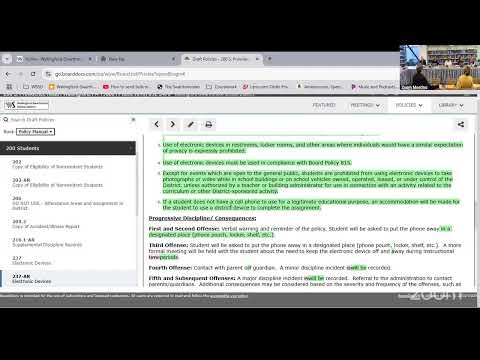
The committee and staff discussed where devices must be kept during class time. Under the proposed AR, during instructional periods electronic devices must be turned off and "away" or stored in lockers, backpacks or designated storage areas such as cell-phone caddies or classroom shelves. Committee members pressed staff to make distinct expectations for middle and high schools: middle-school students are expected to keep devices in lockers for the day, while high school storage options may include backpacks, lockers or classroom caddies because of differing schedules and building constraints.
School equity was a recurring point. The AR includes language saying a school device will be provided to a student who does not have one when a legitimate educational purpose requires device use. Alex Becker, a resident who spoke during public comment, urged a stronger, independent monitoring plan and said, "I would love for this to go into the policy so that there can be a year after year measurement." Becker also asked that "away" be specified (caddy, shelf or backpack) so enforcement does not vary by classroom.
Members discussed discipline and tracking of offenses. The committee clarified that offenses are cumulative and may be logged in a school system that administrators can review; staff said the intent is that repeated violations across classes could trigger progressive consequences. John Christodoulias, a member of the public, asked whether offenses were tallied per class or per day; staff answered that entries are schoolwide and can be cumulative.
The committee and members emphasized the need for monitoring and follow-up. Staff proposed including an assessment of the policy's implementation in a resolution accompanying the second reading rather than embedding evaluation language in the policy itself; staff said they would provide interim public updates, including a midyear review and an end-of-year assessment. Dr. Scanlon told the committee the district will report out progress to the board and community and that administrators will make implementation a focus during summer workshops and opening-day training.
Public commenters asked that any assessment include teacher, student and family input and that, where feasible, the evaluation be independent. Meg Purangeli, a resident, asked, "At what point will the teachers' voices be adhered to? Because if we're at 69% of teachers that prefer and support a bell to bell ban, what percentage is going to be enough to have any sort of movement?"
After making several clarifying edits (including changing first- and second-offense language to match third-offense wording that devices be placed "in a designated place"), the committee chair called for a motion to move the policy to the full board for second reading. The committee voice-voted to advance the policy; there were no recorded nays.
The committee asked staff to return with operational details for the AR, to specify how offenses will be logged, to clarify what counts as an "away" placement, and to include a plan for interim monitoring and public reporting during implementation next school year.
Ending: The committee will present Policy 237 and its AR (as edited) to the full board for a second reading; staff said they will prepare implementation materials, teacher training, and interim evaluation reporting for the board and community.