Get Full Government Meeting Transcripts, Videos, & Alerts Forever!
Get email alerts on the Lake Ballinger Water Quality topic
No spam. Unsubscribe anytime.
Edmonds reports March sewage spill at Lake Ballinger, city buys abandoned house slated for demolition
Summary
City of Edmonds staff reported a March sewage release that raised E. coli readings in Lake Ballinger, said the city purchased an abandoned, dilapidated house at 7317 Lake Ballinger Way for demolition, and noted resident reports of elevated algae; volunteer samplers also reported blue‑green algae and diatoms downstream in some slow‑flow reaches.
Patrick Johnson, stormwater technician for the City of Edmonds, told the forum that public‑works crews discovered a sewage release during routine inspections on March 12 and traced elevated bacteria to an outfall affecting Lake Ballinger.
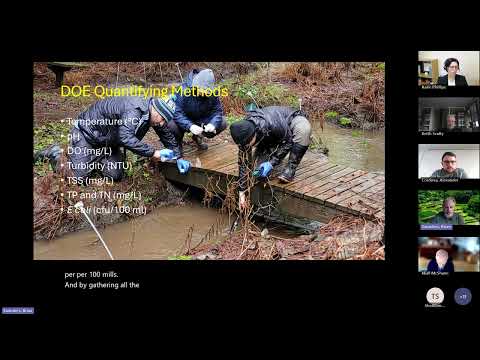
“We did 7 rounds of testing on the lake, with the highest reading being 874 coliform units per hundred milliliters,” Johnson said. He said crews cleared the system and subsequent testing fell to 11 CFU/100 mL by the seventh round; the city posted then removed warning signs as testing returned to safe levels.
Johnson said investigators detected sewer indicators upstream near a condominium complex, but camera inspections did not locate a definitive origin; the cause remains under investigation and the city plans periodic monitoring through spring and summer.
Johnson also reported that the city completed a purchase of a long‑vacant property at 7317 Lake Ballinger Way and expects to demolish the unsafe structure next month, removing debris and restoring the lot (the city said the foundation may remain initially). He said future plans could include treating stormwater that discharges nearby but that redevelopment plans are preliminary.
Volunteer student Alex Cordova said his group found algal taxa in some stream samples downstream of Lake Ballinger. “I was finding a whole lot of Oscillatoria and a whole lot of navicular diatoms,” Cordova said; he explained that Oscillatoria is a cyanobacterium capable of producing cyanotoxins when disturbed and that navicular diatoms have silicate cell walls and do not decompose rapidly.
City staff urged residents to report algae sightings; Edmonds said laboratories can test suspect blooms if residents notify public works. Municipal staff also noted the lake monitor and water‑level data are available on the City of Edmonds website and that the lake currently has storage capacity heading into spring.
Forum participants discussed possible long‑term stormwater treatment options near the newly acquired lot because two outfalls run adjacent to the property; Johnson said treating stormwater before it enters the lake is a goal but would require future study and design.