Get Full Government Meeting Transcripts, Videos, & Alerts Forever!
Get email alerts on the Nuisance Ordinance topic
No spam. Unsubscribe anytime.
Committee amends criminal-nuisance ordinance language, adds $250 fine; final vote paused
Summary
The Safety Committee heard amendments to Ordinance 228-2025 to clarify how criminal 'nuisance' activity is proved and enforced, adding a $250 fine and changing how abatement costs are imposed; committee approved amendments but postponed final action to resume after presentations.
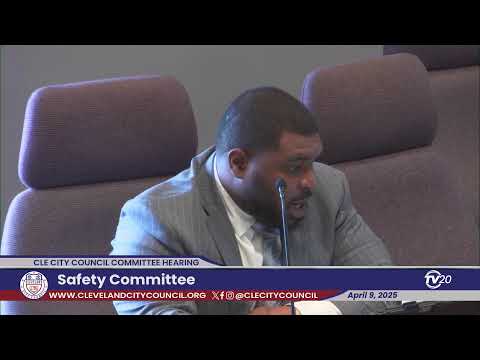
The Cleveland City Council Safety Committee on a second hearing reviewed Ordinance 228-2025, an emergency ordinance (sponsor: Councilmembers Polentic and Griffin) to amend sections 6.30.01 and 6.30.02 of the Codified Ordinances of Cleveland governing criminal nuisance activity, enforcement and cost certification. Committee members voted by voice to adopt two administration-drafted amendments to the ordinance but paused final disposition of the ordinance to hear a scheduled presentation.
The ordinance revisions presented Feb. 20 would tighten how the city determines when a property is declared a criminal nuisance, clarify the abatement and invoicing procedure handled through the Division of Assessments and Licenses, and add a $250 fine when the director of public safety or designee declares property a nuisance. The administration’s amendment replaces mandatory language in several sections (striking “shall” and inserting “may”) to give the public safety director discretion to charge calculated abatement costs; it also adds an explicit $250 fine, an appeals path for property owners and a clerical change replacing the word “occasions” with “calendar days.”
Why it matters: the changes affect how property owners — including absentee landlords — can be held financially responsible when repeated criminal activity occurs on their parcels. The proposal also changes how low-level offenses are counted toward nuisance determinations and allows officers and investigators to rely on witness statements as part of a probable-cause determination.
Public-safety staff and committee members emphasized the practical problem the revision is intended to fix. Wayne Drummond, Director of Public Safety, and Assistant Director Jason Shatner told the committee that the ordinance as previously written meant divisions counted citations or arrests in ways that made enforcement inconsistent, because many nuisance activities (for example, noise, parties or littering) are transient and officers often do not witness a misdemeanor in progress. Assistant Director Shatner said the revised language allows finding probable cause based on witness statements and officer investigation without requiring a conviction or arrest to count an event toward a nuisance declaration.
Data presented by the department: the administration provided a five-year summary that showed 26 declared criminal nuisances in 2019–2024 (2019: 9; 2020: 8; 2021: 6; 2022: 2; 2023: 1; 2024: 0). Abatement invoices certified to the county totaled modest sums in the years reported (2019: $800; 2020: $900; 2021: $600; 2022: $0; 2023: $600; 2024: $0). Staff said the city has historically assessed a flat abatement charge of $100 but that the calculation in the ordinance (time on scene × an hourly rate that includes wages/benefits, vehicle/mileage, dispatch and administrative costs) is very labor intensive to assemble for each event.
Process described: under the ordinance as amended, after a third documented nuisance activity a property owner receives notice that a fourth activity may trigger a nuisance declaration. The owner must submit a written nuisance-abatement plan to the director of public safety within 10 days; failure to submit a plan incurs a $100-per-day charge until a plan is filed. If a fourth qualifying activity occurs within six months of the third and the director declares the property a nuisance, the owner would receive an invoice that includes the $250 nuisance fine and, at the director’s discretion, calculated abatement costs that — if unpaid — would be certified to property taxes in September.
Committee debate and outcome: several members pressed the administration on the change from mandatory (“shall”) to discretionary (“may”) when charging calculated abatement costs. Some members said “shall” provides predictability and prevents future directors from declining to impose costs; administration witnesses said the “may” language reflects the heavy staff burden required to compute abatement costs and preserves the director’s ability to target that calculation to extreme cases. After discussion the committee approved the administration’s proposed amendments by voice vote (amendment adopting “may” language and adding the $250 fine; a separate amendment changing “occasions” to “calendar days”) and then paused final action on the ordinance to hear the Cleveland Foundation presentation on the Neighborhood Safety Fund.
Actions taken in committee included two voice votes adopting the administration’s proposed amendments; the ordinance was not finally adopted at this meeting and action was postponed pending the committee’s resumption of its agenda.
Next steps: the committee chair paused the ordinance discussion and scheduled resumption; the administration remained at the table. The councilman who sponsored the original 2018 changes said the intent is to restore enforceability and to use the amended provisions to require property owners to secure vacant lots, submit abatement plans and be held financially responsible when repeated criminal activity occurs.