Plumbing-code tag recommends keeping Washington amendments, advises not adopting most new 2024 UPC appendices
Loading...
Summary
At a technical advisory (MVP) tag meeting, members recommended the standing staff position: retain existing Washington state plumbing-code amendments and not adopt the bulk of the new 2024 Uniform Plumbing Code appendices; the group also identified several sections for code-change proposals and opened the public code-change window.
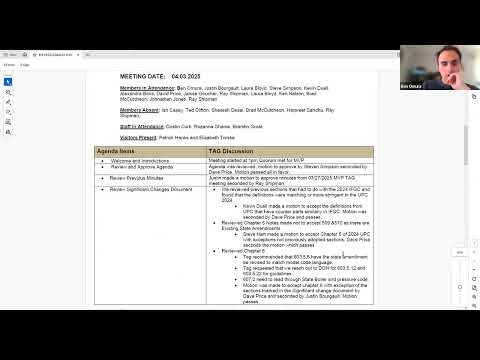
Members of the Mechanical Ventilation and Plumbing Codes (MVP) technical advisory group, meeting under the State Building Code Council process, reviewed the 2024 Uniform Plumbing Code (UPC) significant changes and existing Washington state amendments and moved to carry forward staff recommendations to not adopt most new appendices and to retain the state's existing amendments across the UPC chapters.
The tag examined the list of new and revised appendices in the 2024 UPC, discussed potential conflicts with Washington Administrative Code and Department of Health backflow and drinking-water rules, and voted to recommend that the council follow staff recommendations on adoption. Tag members also voted repeatedly to retain existing Washington state amendments in chapters 1 through 17 of the UPC, while flagging a small number of sections for follow-up code-change proposals.
Why it matters: Washington adopts the UPC with a set of state amendments and only the appendices specifically adopted by state law (RCW). The tag’s recommendations guide the Standing Committee and, ultimately, the Building Code Council as the state opens the public code-change proposal window. Changes adopted into the state code could affect plumbing design, water-safety practices (including backflow and Legionella guidance), and local permitting.
What the tag decided
- Appendices: After reviewing the “significant code changes” document and the new appendices added to the 2024 UPC (for example, Appendix N on Legionella guidance; Appendix O for non‑sewered sanitation; Appendix Q for indoor horticultural facilities; Appendix R for tiny houses; Appendix S for on‑site stormwater treatment systems), the tag voted to carry forward staff recommendations not to adopt those appendices statewide. The motion to accept the appendices “as presented by staff” passed.
- State amendments: The tag moved, repeatedly and chapter-by-chapter, to recommend retaining Washington’s existing amendments to the UPC (chapters 1–17). The group approved retaining current state amendment language where present and, in several places, noted editorial or formatting fixes and a handful of sections to address by code-change proposal (for example: cross-references in shower and fixture sections and integration work for 9.11.1 related language).
- Follow-up code-change proposals and schedule: Staff confirmed the public code-change proposal window will open the week following the tag meeting (staff cited an April 18 opening in the meeting) and is expected to close on June 16, with a council meeting on or about June 20. Tag members were told they can submit code-change proposals (the tag itself may be listed as proponent) and staff will circulate guidance and the SBCC code-change form. Brandon (SBCC staff) said the code‑change form and guidance will be posted and circulated to the tag.
Selected discussion points
- Applicability of appendices: Members noted many of the new appendices are guidance or alternate means-and-methods documents that would only apply if a proponent invoked them under alternate means and methods; they are not automatically binding statewide. As one staff member summarized, RCW language identifies which appendices the state adopts.
- Legionella guidance (Appendix N): Tag members and a Legionella subject-matter contact discussed that Appendix N reads primarily as guidance; the tag noted it is not currently adopted by Washington but could be used as an alternate approach if a proponent sought to use it. One member recommended caution before making sampling or prescriptive requirements mandatory absent clear state adoption.
- Backflow and beverage dispensers: The tag discussed conflicts between model-code allowance for some ASSE-type devices and the Department of Health’s backflow and premise-isolation standards. Several members recommended retaining existing Washington amendment language on backflow/device requirements pending coordination with the Office of Drinking Water.
- Water heater and fixture definitions: The group reviewed new and revised definitions (for example, hot/warm water temperature bands, “body spray” or related terms) and agreed to keep the current Washington definitions where they exist; members noted a few definitions and formatting items that should be corrected or clarified in a code-change proposal.
Votes at a glance
- Approve agenda — Moved by Steve Simpson; seconded (by Brad McPichan). Outcome: passed.
- Approve minutes from April 3 meeting — Moved by Steve Simpson; seconded (by Brad McPichan). Outcome: passed.
- Recommend carrying staff recommendations on appendices (include not adopting most new 2024 UPC appendices; carry forward staff notes on existing appendices) — Moved by Evan (last name not stated); seconded (not specified). Outcome: passed.
- Recommend retaining existing Washington state amendments for UPC chapters 1–17 (individual chapter votes were taken in sequence and all passed) — Movers included tag members (several motions were made by Steve Simpson, Bill Masaki, Kevin Duol, among others); seconds varied or were not always spoken on the record. Outcome: all chapter retain motions passed; several sections were flagged for code-change proposals and editorial fixes.
- Retain state amendment for beverage-dispensing/backflow language (section 603.5.12) — Moved by Steve Simpson; seconded (not specified). Outcome: passed (the tag voted to retain the state amendment rather than accept the model-code change for that item).
Next steps and staff guidance
Staff (Brandon and Dustin) said they will publish the code-change proposal form and instructions on the SBCC website and circulate the link to tag members. The tag will forward a package of initial recommendations to the standing committee and the Building Code Council, and staff will confirm the public outreach and submission timeline. Tag members were encouraged to submit formal code-change proposals for sections they flagged during the meeting.
Ending
The tag adjourned after finishing the initial review and agreed to reconvene as needed once the code-change proposal window opens and proposals are submitted. Staff will circulate the finalized significant-changes document with notes and the code-change submission instructions.