Get Full Government Meeting Transcripts, Videos, & Alerts Forever!
Get email alerts on the Funding Formula topic
No spam. Unsubscribe anytime.
EEC begins review of C3 funding formula; board to consider targeted adjustments this year
Summary
EEC staff said they will review the Commonwealth Cares for Children (C3) formula over May–June and return with proposals; issues under consideration include enrollment thresholds for payments, equity tier design, CEO compensation limits and treatment of certain program types.
Department of Early Education and Care staff told the board they will review the Commonwealth Cares for Children (C3) funding formula and return with proposed adjustments in June for public comment and final action in the fall.
The C3 formula currently multiplies a program’s licensed capacity (subject to an enrollment adjustment) by a base rate (set by program type and youngest age served) and an equity adjustment tiered by three categories: (1) highest tier for Head Start programs or those serving high shares of CCFA children or very‑low opportunity census tracts, (2) an intermediate tier for programs with smaller shares of CCFA children or that make significant scholarship investments, and (3) a baseline tier for others. EEC staff noted the formula pays a program its full licensed capacity if enrollment is at 75% or higher; below 75% payment is prorated by percent enrolled.
Issues under review: Staff listed several topics they will examine and solicit feedback on:
- Enrollment buffer: whether the 75% threshold is the right cutoff for paying full license capacity or whether another level (e.g., 85%) is more appropriate. - Equity‑tier gradations: the second tier covers programs that serve between 1% and 24% CCFA slots — staff said that range is broad and may merit a more graduated scale to incentivize incremental growth in serving low‑income children. - CEO compensation index: the current formula removes equity adjustments for programs with very large CEO‑to‑lowest‑paid‑worker pay ratios. Staff said that rule may unintentionally disincentivize participation and will be re‑examined. - Program models: some out‑of‑school‑time and specialized programs have staffing models and costs not fully captured in the current cost modeling; staff said they will consider adjustments for these models.
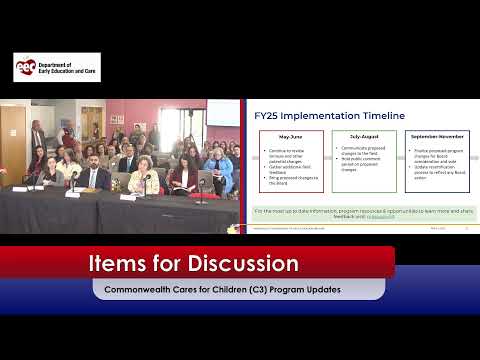
Next steps and timing: EEC plans to continue stakeholder engagement through May and June, then present a detailed proposal to the board; the proposal would go out for public comment over the summer and return in the fall for final action with any changes to take effect in November. Staff emphasized statutory guidance in the current budget language that encourages salary‑scale alignment with public‑school teachers, a separate development EEC is working on and may integrate into C3 later.
Board members urged caution in making large formula shifts quickly and recommended additional analysis and synthesis of related research and field feedback; staff opened a feedback form on the C3 page for written input from providers and partners.
Ending: EEC staff said the aim is to preserve predictability and positive gains from existing C3 funding while refining design to be more equitable and better aligned to diverse program types.