Get Full Government Meeting Transcripts, Videos, & Alerts Forever!
Get email alerts on the Comprehensive Plan topic
No spam. Unsubscribe anytime.
Shelton staff outline accelerated timeline, growth alternatives for comprehensive plan update
Summary
Economic development director Jay Hill told the City Council on April 8 that Shelton’s comprehensive plan update is on an expedited path after the state granted a six-month extension and that the work must include an environmental impact statement analyzing traffic, water, wastewater, school capacity and economic effects.
Economic development director Jay Hill told the City Council on April 8 that Shelton’s comprehensive plan update is on an expedited path after the state granted a six-month extension and that the work must include an environmental impact statement analyzing traffic, water, wastewater, school capacity and economic effects.
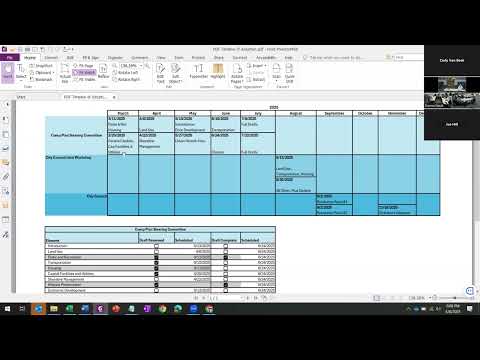
Hill said consultants working on the plan are stretched thin statewide and that Commerce is willing to accept a “principal draft’’ (a near-complete draft) so the city can receive grant reimbursement. The schedule Hill laid out calls for a principal draft in early June, committee-delivered drafts by July, two joint council-steering-committee work sessions in August and an intended adoption by Nov. 18, with Commerce review to follow if the council issues the notice of intent to adopt in mid-September.
The update will cover mandatory changes from recent state laws, including “middle housing’’ requirements and other streamlining measures, Hill said. He said the city must also perform an environmental impact statement (EIS) to test development scenarios across public services and infrastructure. “They’re going to look at traffic and water, wastewater, school services, economic impacts — things like that of our development scenarios,” he said.
Why it matters: The comprehensive plan guides where infrastructure and capital funding are directed and determines how Shelton and partner agencies prioritize transportation and utility investments that support growth. Hill emphasized the plan’s role in qualifying projects for grants and in creating an actionable implementation matrix the council can use to track progress.
Growth projections and alternatives
Hill described a “no-action’’ baseline and a build alternative the steering committee is now analyzing. He said the baseline projection calls for growth of 5,850 people over 20 years with an increase of 2,270 housing units. An alternative forecast under consideration, which reflects different assumptions and new state requirements, projects higher growth; Hill presented the alternative’s figures as an increase of 7,401 people (as discussed in the meeting) and urged the council to review the consultant analyses before settling on a preferred alternative.
A central policy choice for the council will be whether to distribute growth broadly across the city or concentrate it within defined “residential targeted areas’’ (RTAs). Hill said the RTAs under discussion would focus about 15% of new units in concentrated nodes — for example around the Wallace/Neyland interchange and a downtown target — to improve transit, connect residents to jobs and limit neighborhood-level impacts.
Hill noted the planning process will be iterative and coordinated with Mason County, the city’s transportation plan and the city’s climate and hazard-resilience work; all of those components will feed back into the land-use element. He told council members there will be “lots of opportunities’’ for public input during the review period and work sessions, and that the city intends to include an implementation chapter with action items, responsible parties and measurable metrics so the plan does not “sit on the shelf.’’
Council questions and next steps
Council members asked about the plan’s horizon and how component plans (water, sewer, parks, transportation) interlock. Hill clarified the comprehensive plan frames 20-year growth but that component capital plans have differing horizons for grant eligibility. He said the city will aim to submit the principal draft to Commerce in June to secure reimbursable grant funding, and to schedule the council’s adoption hearing in November while preserving a small window in December in case Commerce requires substantive revisions.
Hill closed by reiterating that the update is intended to be collaborative: “It’s not like we’re just gonna bring it to you and say, alright. Adopt it,” he said, adding that the council will be asked to pick a preferred alternative when the notice of intent to adopt is presented.
Ending: City staff will return with draft materials over the summer and two joint council-steering-committee work sessions in August; council action and Commerce review are expected in the fall.