Get Full Government Meeting Transcripts, Videos, & Alerts Forever!
Get email alerts on the Library History topic
No spam. Unsubscribe anytime.
Friday Memorial Library marks final National Library Week in historic Glover Park building
Summary
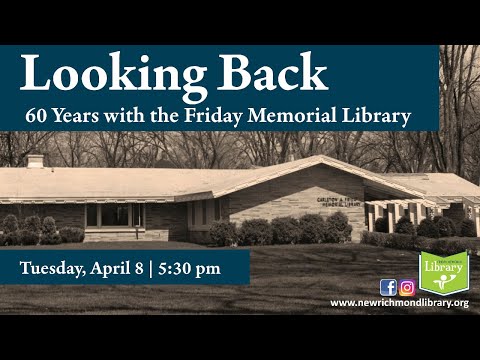
At a public program at Friday Memorial Library in New Richmond, part-time library staffer Todd Kittle recounted the building's local history, the Friday Foundation gift that funded the facility, the roles of longtime librarians and volunteers, and how services and programming expanded before the library relocates from the Glover Park site.
Todd Kittle, a part-time information and reference assistant at Friday Memorial Library, used a public presentation to trace more than a century of the library's history and to catalogue services and programs offered at the Glover Park building as the library prepares to leave the facility.
Kittle opened by noting that the program coincided with National Library Week and that it was "the last National Library Week we will observe in this facility," framing the talk as a retrospective for patrons before the building closes as a library site. He laid out early local efforts to sustain a public library (an 1883 New Richmond Library Association, subsequent subscription models), John Glover's 1913 gift of land for a public park, and the role of the Friday family and the Friday Foundation in funding the current building that opened for patrons in March 1963 and was formally handed to the city later that spring.
Kittle described the Friday Foundation's involvement in mid-20th-century civic projects and cited a 1955 gift of $80,000 from the foundation to build the community pool, a figure Kittle said would equal "about $950,000" in today's dollars by his calculation. He said the foundation later offered the library building, including arranging the architect and location in Glover Park; patrons and local press covered the successive moves and the facility's official opening in 1963.
The presentation highlighted the influence of three librarians in the facility's development. Kittle credited Catherine B. "Tony" Casey with extending the library's reach into arts and community services, with programs, local volunteer "library cadets" and strong personal outreach to patrons. He described Florence Railsback's tenure as modernizing and expanding community outreach and information services, and noted trustee-led fundraising and volunteers that funded an addition completed and opened to the public in 1989'90 (official celebration in 1990), enlarging children's spaces and service areas.
Kittle reviewed programming and available materials that have grown beyond books: patrons could historically check out movies, projectors, park passes, video game consoles and cartridges, 3-D printers, a robot, energy-efficiency meters, and other equipment. He described a timeline of services from early story hours (noted as far back as 1917) to the later adoption of computer catalogs and what he called the "Moore system," which he said expanded interlibrary access across many public libraries.
Volunteers and the Friends of the Library were singled out as sustained contributors. Kittle said Friends of the Library incorporated in 1984 and have helped fund programming and parts of the collection through book sales and fundraising. He also recounted local fundraising in the late 1980s, when the city committed funds and community leaders and volunteers raised the remaining money for the 1989 addition.
Kittle read historic accounts and local press items to illustrate the library's civic role, including an anecdote about World War II-era German POWs who worked in local industry and archival press descriptions of Carlton A. Friday's philanthropic activities. He also noted the facility's use for community events, a bandstand that once stood on the Glover Park hill, and the library's role as a local programming hub (summer reading, genealogy, adult education, crafts, outings and speaker series).
Kittle emphasized continuity and change: the site that began as rotating subscription collections evolved into the Friday Memorial Library building and later a multi-use community information center. He closed by inviting attendees to share memories and by reminding patrons about artifacts and displays at the facility.
The presentation contained local newspaper citations and quoted contemporary texts read aloud by Kittle, including a 1963 library handover note that he read as a historical excerpt. Kittle's remarks were drawn from archived local newspapers, library records and photographs referenced during the program.