Get Full Government Meeting Transcripts, Videos, & Alerts Forever!
Get email alerts on the Smob Debate topic
No spam. Unsubscribe anytime.
Three finalists debate priorities in Anne Arundel County student member election
Summary
Three finalists for the Anne Arundel County Public Schools student member of the Board of Education presented competing priorities at a public debate on April 21, highlighting mental health, equity, student outreach and school safety ahead of the April election.
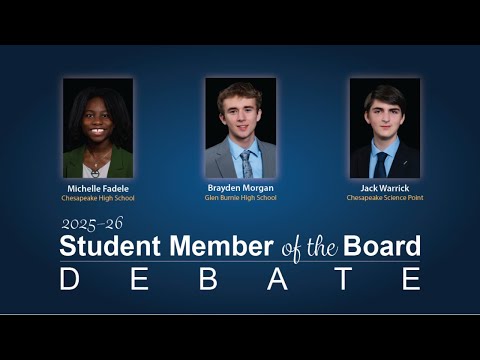
Annapolis, Md. — Three finalists for the 2025–26 student member of the Board of Education (SMOB) for Anne Arundel County Public Schools debated priorities for the one-year student representative on April 21, outlining proposals on mental health, equity, student outreach and school safety.
At a public forum moderated by Jason Simonoff Jr., who identified himself as a CRASC Secretary of Education, the finalists — Michelle Fadel, a junior at Chesapeake High School; Jack Warwick of Chesapeake Science Point; and Braden Morgan of Glen Burnie High School — each summarized platforms and answered questions submitted by the Chesapeake Regional Association of Student Councils and via AACPS’s CRASC webpage. The debate format gave each candidate three minutes to open, one minute to answer questions with optional 30-second rebuttals, and included a sequence of questions on budget priorities, equity, student supports and redistricting.
The three candidates emphasized student outreach and increased mental-health services but proposed different tactics. Michelle Fadel ran on three pillars — “advocacy, connection and elevation” — and called for expanding advisory council access, using social media and a Canvas classroom to increase student awareness of the SMOB and building school visits and read-alouds for younger students. Jack Warwick focused on eliminating inequities through his “GEMS” platform, proposed adding a school-day ACT option and emphasized data-driven allocation of services. Braden Morgan stressed peer-to-peer systems and special-education outreach, including work to establish a special-education-led student council.
Candidates repeatedly tied their proposals to mental-health supports and to improving access to existing programs. They also discussed school safety and the county’s proposed noninvasive weapons-detection pilot; Michelle Fadel voiced support for the pilot, while Jack Warwick framed it as an immediate measure but argued for long-term prevention through mental-health services and conflict-resolution curricula.
All three said they would prioritize hearing directly from students countywide. Proposed outreach methods included social-media engagement, open advisory meetings, town halls, direct school visits, classroom visits and anonymous feedback channels. Several candidates specifically named CRASC and statewide organizations such as MASC and AVID as bodies they have worked with or would coordinate with while serving.
The debate included references to recent state legislation: Fadel said Senate Bill 307 had been signed recently and described it as raising Board member compensation to parity; she said students had testified and lobbied in support. (The comment reflects Fadel’s account during the debate.)
The debate concluded with closing remarks and an invitation to an SMOB Instagram Live event scheduled for Tuesday, April 22, at 7 p.m., with details on the CRASC website. The county has more than 84,000 students, a detail candidates cited when describing the scale of outreach they plan to pursue.
The finalists face the SMOB election in April; the board’s rules give the winning student a one-year voting seat on the Board of Education.