Get Full Government Meeting Transcripts, Videos, & Alerts Forever!
Get email alerts on the Hb1125 Earned Wage Access topic
No spam. Unsubscribe anytime.
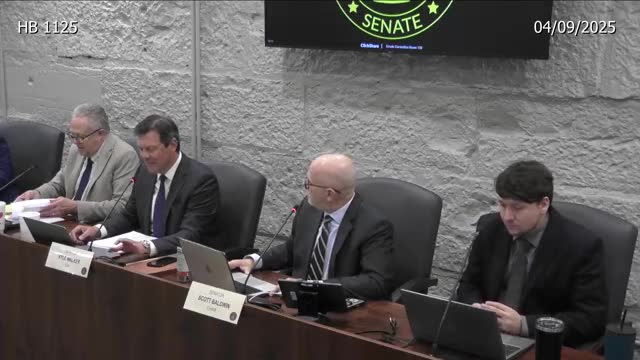
Senate committee adopts consumer-protection amendment, advances earned wage access bill 7-1
Summary
The Senate Insurance and Financial Institutions Committee approved House Bill 1125, an earned wage access measure, 7-1 after adopting a substantial amendment from Senator Walker that adds consumer protections, caps fees and limits data sharing.
The Indiana Senate Insurance and Financial Institutions Committee voted 7-1 to advance House Bill 1125 after adopting a substantial amendment from Senator Walker that committee members and stakeholders said adds multiple consumer protections for earned wage access (EWA) services.
Senator Walker, presenting the amendment, said it was negotiated with committee members, industry representatives and consumer advocates and described the main changes as new consumer safeguards, fee limits and data restrictions. "It clarifies that an EWA cannot report consumer activity to a consumer reporting agency," Walker said. He told the panel the amendment also "establishes limits on any fees for expedited service to the greater of $5 or 5%," aligns provider penalties with existing code, requires that a no-cost option be displayed in the same color, font size and general location as any expedited option, and that a delivery option with a fee may not be the default within the app.
Other consumer protections in the amendment, as summarized by Walker and recorded in the transcript, include: the requirement that optional tips default to zero; a provider may not increase optional fees if a consumer elects not to tip; providers must initiate delivery of proceeds no later than one business day after a consumer selects the no-cost option; software may not subject users to unsolicited advertising, surveys or notifications unless the user has opted in; providers may not access or sell a user’s location data except to verify Indiana residence when creating an account (or if the user later authorizes access); and providers may not sell or share consumer data with payday lenders.
The committee discussed ownership and control definitions included in the bill. Senator Andoff asked about a perceived discrepancy between ownership thresholds listed in different subsections — a 25% threshold tied to voting power and a 10% threshold tied to managerial or policy influence. Committee members clarified that the 25% figure refers to voting ownership while the 10% figure addresses control over management or policy, and that the bill includes a definition of "passive investor" and a rebuttable presumption that a person meeting that definition is passive. A committee explanation on the record said those provisions mirror language already in state licensing code and are commonly used when purchasers acquire already-licensed entities.
Senator Walker also said the amendment changes the effective date to a date in 2026 to give the Department of Financial Institutions time to implement the new licensing and oversight requirements; the transcript records the phrase "oneonetwenty 26," which was unclear on the record, and no specific calendar date was stated.
On the roll call the committee recorded these votes on the amended bill: Senator Randolph — no; Senator Cadora — yes; Senator Walker — yes; Senator Gaskell — yes; Senator Schmidt — aye; Senator Freeman — yes (explained earlier in debate that he had questions but supported the amendment); Senator Carrasco — aye. Chairman Baldwin cast the chair's vote in the affirmative. The clerk recorded the tally as seven in favor and one opposed.
Outcome: House Bill 1125, as amended, was reported to the Senate floor 7-1. The amendment text and sponsor said key changes were intended to protect consumers by limiting fees, restricting data sharing and setting in-app presentation rules for no-cost options.
The transcript shows committee members raised additional definitional questions about control and passive-investor standards; committee members said those are consistent with existing code and that further technical drafting may continue.