Get Full Government Meeting Transcripts, Videos, & Alerts Forever!
Get email alerts on the Hb1276 Farmers Market Sampling topic
No spam. Unsubscribe anytime.
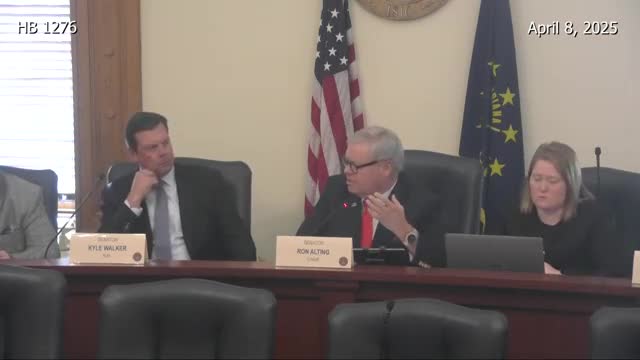
Senate committee approves amended HB 1276 to allow off‑premise sales, sampling at farmers markets; bill passes 9-0
Summary
The Indiana Senate Public Policy Committee moved and approved an amended House Bill 1276 that expands sampling and off‑premise sales privileges for craft alcohol producers at farmers markets, changes expo/trade-show days, modifies permitting for food halls, and adds a local opt‑out. The committee passed the bill 9–0 on a roll call vote.
Senator Alting, chair of the Senate Public Policy Committee, opened the hearing and offered Amendment No. 16 to House Bill 1276, saying the amendment consolidates multiple changes to alcohol and event permitting and then moved the amendment with consent.
The amendment expands several privileges for craft alcohol producers at farmers markets, increases permitted expo or trade-show days, revises food‑hall permit definitions for a specific downtown Indianapolis market, allows limited sampling of mixed beverages at packaged liquor retailers, and creates a local opt‑out for communities that do not want sales or sampling at farmers markets.
The amendment allows craft breweries to provide up to three 6‑ounce samples to a customer and farm wineries to provide up to three 1‑ounce samples at a farmers market; the chair noted those sample sizes match existing sampling allowances for packaged liquor stores. The amendment also permits artisan distilleries, craft breweries and farm wineries to sell alcoholic beverages for off‑premise consumption at farmers markets but bars artisan distilleries from distributing hard‑liquor samples at markets.
Andrea Hamoya, founder and CEO of Ashen Elm Cider Company, described her cider business’s farmers‑market program and urged passage. “Without sampling, we expect a drop in sales by at least half,” Hamoya said, saying the market program generates about $200,000 in summer revenue for her business and supports distribution growth in new areas.
Christina Sesnick, Indiana government relations director for the American Heart Association, testifying with Tobacco Free Indiana, asked the committee to remove a provision (Section 8.7) that would permit segregated smoking rooms; the chair confirmed that provision had already been removed from the bill.
Lisa Hutchison, vice president of prevention and policy at Mental Health America of Indiana, expressed concern about alcohol‑by‑volume limits and monitoring: “I didn't see any restrictions on how high the alcohol by volume content can be for beverages,” she said, and asked how the number of samples would be tracked across multiple vendors at an event.
John Willey of 19 Star State Solutions, representing the Indiana Distillers Guild, and Tyler Starkey, executive director of the Indiana Beverage Alliance, spoke in support of the provisions that allow distillers to attend farmers markets and permit mixed‑beverage sampling consistent with other beverage categories.
The amendment also increases expo or trade‑show days in the bill and amends the definition of a master food hall permit to cover a food hall with at least five vendors located in “Consolidated City” that is within 500 feet of a building on the National Register of Historic Places or that otherwise qualifies under IC 30‑6‑7‑11‑1, citing the example of Indianapolis’s City Market.
On a roll call, the committee approved the amended bill 9–0. Votes recorded as “aye” included Senator Alting, Senator Kyle Walker, Senator Becker, Senator Bush, Senator Durnell, Senator Maxwell, Senator Greg Walker, Senator Spencer, Senator Jackson and Senator Haskovsky; the clerk announced the bill “passes as amended 9 to 0.”
The chair closed the hearing with thanks to committee members and industry stakeholders; the committee adjourned after approving the measure.
Votes at a glance: HB 1276 (as amended) — Passed 9–0 on roll call; key provisions include expanded sampling and off‑premise sales privileges for craft producers at farmers markets, an opt‑out for local governments, an increase in expo/trade‑show days, and adjustments to master food hall permit criteria.