Get Full Government Meeting Transcripts, Videos, & Alerts Forever!
Get email alerts on the Wildfire Mapping topic
No spam. Unsubscribe anytime.
Calimesa council opens public comment on statemandated fire-hazard remapping; chiefs warn of consequences
Summary
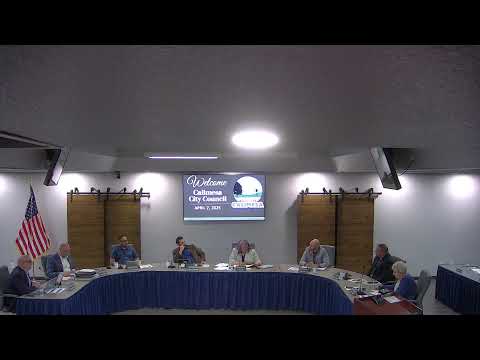
Calimesa City Council on April 7 directed staff to open a public comment period on the statemandated 2025 Local Responsibility Area fire-hazard severity zone mapping under Executive Order N-18-25.
Calimesa City Council on April 7 directed staff to open a public comment period on the statemandated Local Responsibility Area (LRA) fire hazard severity zone mapping and Executive Order N-18-25, beginning the local step in a statewide process that will require cities to adopt zoning designations and, eventually, new municipal code language.
The action came after Fire Chief O'Connell outlined the state process and what he described as a new and controversial set of requirements developed by the state fire marshal and CAL FIRE. "Zone 0 will require removal of all combustible material. That's all combustible material located within 5 feet of any structure," Chief O'Connell said, explaining the difference between the historical two-zone defensible-space approach and the newly proposed zone 0, zone 1 and zone 2 structure.
Why it matters: The mapping and subsequent ordinance changes will determine which properties are labeled moderate, high or very high fire severity and trigger different defensible-space and property-clearance rules. Council members said the mapping could affect homeowners' insurance costs and place new costs on residents and the city without dedicated state funding.
Chief O'Connell told the council the changes stem from updated modeling that factors fire history, terrain, fuels and ember-cast behavior; he recommended the city open and catalogue public comments required by the state process. He described the mandate as "unfunded" and said there is no straightforward local mechanism to rebut or negotiate the state determinations.
Council members pressed staff on likely penalties for noncompliance, enforcement mechanisms and the timeline. City Attorney Flowers (on the record during the discussion) cited California Government Code requirements and said local agencies typically have up to 120 days to adopt ordinances to designate hazard zones after receiving the state recommendations. She and Chief O'Connell said the consequences for failing to adopt a compliant map are not spelled out in a single, clear statutory penalty but could affect eligibility for some state grants and create local nuisance-enforcement obligations.
Council members discussed practical steps to respond while the city compiles public feedback. Mayor Molina and Council members recommended: (1) posting the state map and guidance on the city's website and social channels, (2) asking residents to submit comments during the public comment period, (3) collecting local examples and concerns to forward to statewide associations such as the League of California Cities, and (4) coordinating with Riverside County and neighboring cities on shared comments and advocacy.
City staff said the state materials and the interactive mapping are linked in the staff report and that the city clerk will open an online comment portal. Chief O'Connell said after the comment period staff and legal counsel will return with an ordinance for council consideration outlining local adoption and enforcement steps.
Council members repeatedly expressed frustration about the process and the lack of funding. "We're being handed something we completely disagree with and not given the tools to respond," one council member said. Council discussion also raised the risk that insurance premiums could rise where maps place properties in higher severity zones and that enforcement could lead to administrative citations or nuisance abatement at the local level.
Next steps: Staff will publish links to the state map and executive order on the city's website, open the public comment period, collect and catalog submissions, and return to the council with a proposed ordinance and additional legal analysis after the comment period closes.
Votes at the meeting did not record a formal roll-call adoption on the maps; the council gave direction to open the comment period and to prepare follow-up ordinance language and legal review.