Get Full Government Meeting Transcripts, Videos, & Alerts Forever!
Get email alerts on the Energy Production Zones topic
No spam. Unsubscribe anytime.
Panel approves energy‑production‑zones bill after heated public testimony on local control
Summary
Senate Bill 425, which would create "energy production zones" to encourage building generation on existing generation sites and limit some local moratoria, passed the committee after testimony from utilities, environmental groups and local residents raised concerns about local control and excluded technologies.
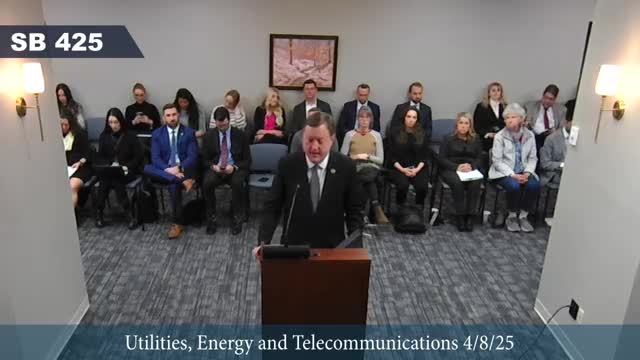
The Utilities, Energy and Telecommunications Committee passed Senate Bill 425 after extensive testimony and debate over whether the measure properly balances land reuse and local control.
Senator Cook, the bill’s sponsor, said the bill aims to encourage new generation to be sited on land that already hosts energy production — including former mine sites or retired plant footprints — by designating them as energy production zones. "A zone is a premise of land where there is an existing generation facility with a generating capacity of at least 80 megawatts," Cook told the committee. The bill as amended excludes wind and solar from the primary zone exemption, a change that drew critical public comment.
The committee adopted Amendment 15, which the sponsor described as clarifying deadlines, force majeure‑type pauses if events outside participants’ control occur (the amendment lists examples such as pandemics and natural disasters), and limits on repeating moratoria that can be used to indefinitely delay projects.
Witnesses were divided. Danielle McGrath of the Indiana Energy Association supported the bill’s approach to streamline approvals for reuse of existing generation sites, citing speed of interconnection and existing transmission infrastructure as advantages for investment. The Indiana Manufacturers Association also testified in favor, stressing reliability and the economic benefits of stable energy supply. The Indiana County Commissioners urged clarifying language to ensure the bill does not undercut local zoning ordinances and said they supported anti‑permanent‑moratorium language but sought stronger assurances the bill would not broadly preempt local planning.
Local residents and environmental groups urged caution. Testimony from Sam Carpenter of Hoosier Environmental Council and multiple nearby residents warned that removing wind and solar from the bill and constraining local permitting risks eroding community input and could put schools and neighborhoods near heavy industrial land uses. A Porter County resident said two proposed data centers next to schools in her township underscored community worries about proximity and local review; another witness described petitions and local opposition.
Committee debate centered on two issues: technology scope and whether the bill’s amendment would unintentionally alter broader local planning and zoning processes. Representative Pierce urged that excluding wind and solar from the measure was a mistake that disadvantaged technologies able to be deployed quickly, while other members said the exclusion reflected prior Senate committee decisions and local political realities.
County and local government representatives asked for a clarifying statement that the bill would not undermine existing zoning ordinances or local permitting except as explicitly stated in the energy‑zone and moratorium sections; some witnesses said the amended language was broad and could affect planning and zoning beyond energy projects.
The committee passed the bill as amended by a roll call recorded in the transcript as 9‑4. Sponsors said the intent is to provide certainty for investors who want to redevelop previously used generation sites while preventing indefinite local bans that could block investment.
Votes at a glance: SB425 as amended passed the committee by recorded vote 9‑4. Proponents included investor‑owned utilities and manufacturing interests; opponents included environmental groups and local residents citing concerns about local control and excluded technologies.