Get Full Government Meeting Transcripts, Videos, & Alerts Forever!
Get email alerts on the Utility Partnerships Cost Recovery topic
No spam. Unsubscribe anytime.
Committee advances bill to allow utility partnerships but bars recovery from ratepayers for partner contributions
Summary
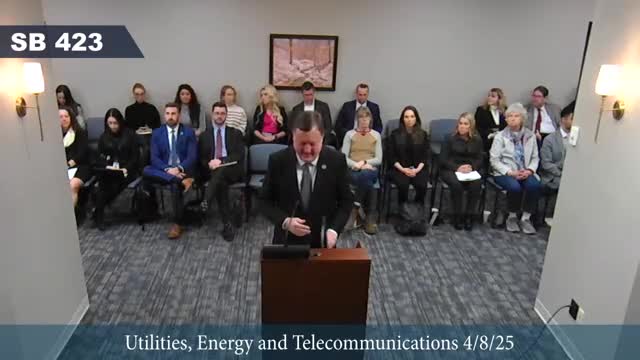
Senate Bill 423 was amended to broaden who can partner with utilities on energy projects and to clarify that costs contributed by partners cannot subsequently be recovered from utility ratepayers; the committee approved the measure after discussion about ratepayer protections.
The Utilities, Energy and Telecommunications Committee advanced an amended version of Senate Bill 423 that allows eligible utilities to form partnerships with a broader set of partners and clarifies that costs contributed by partners cannot be later passed on to ratepayers.
Senator Cook, the bill’s sponsor, said the amendment expands the original pilot concept to permit any utility that wishes to form a partnership with another utility, a customer, a capital partner, a military installation, a reuse authority, an SMR manufacturer or a state educational institution to seek IURC review and approval for that partnership. "If you are a partner you cannot as a utility then try to recover those same costs from the ratepayers," Cook said during remarks on the amendment.
Committee members questioned whether removing the pilot cap (previously limited to two projects or pilots) increases the possibility that ratepayers could be asked to cover planning costs for projects that do not come to fruition. Representative Pearson and others pressed that expanding the cap could increase opportunities for utilities to pursue projects that ultimately fail and leave ratepayers to carry planning costs in later proceedings.
Senate staff and supporters said the amendment was written to reflect market activity: potential partnerships were already forming under current statute and stakeholders asked the legislature to remove an artificial cap that had been intended for pilots. The amendment further clarifies that partner contributions — such as donated land or equipment — cannot later be recovered through rate‑base charges.
Opponents on the record expressed concern about ratepayer exposure. Representative Frey said she could not support the bill because of concerns that ratepayers might have to pay for an unproven technology if a project fails. Representative Pierce expressed similar reservations about protecting ratepayers from bearing planning costs for projects that do not proceed.
During the committee vote the bill as amended was approved and recorded in the transcript with a committee outcome noted as passing; the transcript recorded a committee tally announced verbally as "Passes 8‑4" in the committee record.
The amendment also clarifies that qualifying infrastructure projects that receive partner contributions must not seek to recover those contributed items from ratepayers when utilities later seek cost recovery before the IURC. The committee record shows the broader policy debate centered on balancing state‑level incentives for new generation projects while maintaining protections for utility customers.
Committee testimony and discussion referenced the Quip/QIP process (as discussed by members), the IURC’s review authority, and long‑running concerns about how planning and construction costs are treated in rate cases. Lawmakers and witnesses said additional consumer‑communication and transparency measures could be examined in future sessions.
Votes at a glance: Committee advanced SB423 as amended; transcript records the committee result as "passes 8‑4."