Get Full Government Meeting Transcripts, Videos, & Alerts Forever!
Get email alerts on the Ethics Training topic
No spam. Unsubscribe anytime.
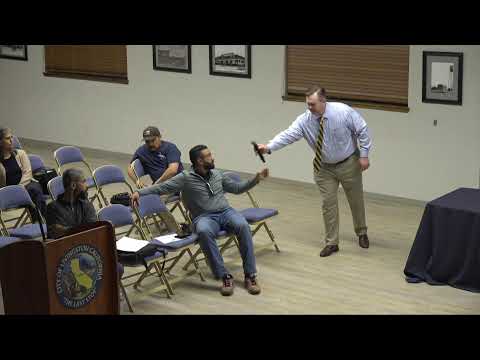
Livingston City Council holds AB 1234 ethics workshop, covers conflicts, gifts and open-meeting rules
Summary
Assistant City Attorney Shannon Chaffin led a required AB 1234 ethics training for the Livingston City Council on April 8, emphasizing conflicts of interest, gift limits and open‑meeting and public‑records rules.
Assistant City Attorney Shannon Chaffin led a required AB 1234 ethics training for the Livingston City Council on April 8, emphasizing conflicts of interest, gift limits and open‑meeting and public‑records rules.
Chaffin told the council the session was designed to be a broad overview, not a deep technical course, and said, “I will get you out in exactly 2 hours.” She reviewed the Political Reform Act, the Brown Act, the Public Records Act, Federal/State enforcement by the California Fair Political Practices Commission (FPPC) and what she referred to as the Levine (pay‑to‑play) rules. She urged officials to seek written FPPC advice for high‑risk questions and summarized practical steps to avoid legal exposure.
The training opened with Chaffin contrasting “the law” and “ethics,” noting that the law provides a minimum standard: “The law is the minimum standard as to what we must do. It is the floor.” She repeatedly stressed disclosure and recusal when an official’s financial interest is “reasonably foreseeable” and “material,” and offered concrete thresholds the FPPC uses in practice: the $500 campaign/contribution trigger, the $2,000 business/property rule, and a 500‑foot presumption for nearby property interests (with a 500–1,000‑foot “yellow zone” requiring counsel contact).
Chaffin reviewed several key topics covered during the workshop: disqualification procedures (announce the nature of the conflict on the record and, in most cases, leave the room), the difference between voluntary abstention and legally required disqualification, limits on officials’ participation in contracts that would result in self‑dealing, and the “revolving door” limits on representing private parties after leaving office. She warned that contracts entered while a conflicted official participates may be void and that civil and criminal penalties and attorney fee exposure can follow.
On gifts and reporting, Chaffin explained recent adjustments to reporting thresholds and gift limits discussed in the session: the $50 reportable interest threshold on Form 700 and a $630 annual de minimis receipt threshold (as cited in the presentation). She cautioned that common items such as event tickets, meals, raffle prizes and travel can create reportable gifts and that accumulated small items can exceed the reporting limit.
Chaffin also covered transparency and records: public records held on personal devices can become agency records when they concern city business; officials were advised to forward city‑business messages to their city accounts and to avoid conducting substantive city business via personal devices. She described Brown Act constraints on serial communications and social‑media interactions (including the cautionary example that a “thumbs up” emoji can create an unlawful serial meeting if it conveys a collective decision among a quorum).
The training included examples drawn from other California jurisdictions — including Operation Rezone (Fresno), a Moreno Valley corruption case and other enforcement examples — to illustrate penalties that can follow ethics and contract violations. Chaffin repeatedly recommended contacting the city attorney’s office or the FPPC early: “If in doubt, send it out,” she said, urging officials to seek written FPPC advice when possible because only a formal FPPC advice letter provides the strongest legal cover.
No substantive council votes or policy decisions occurred during the special meeting; the only formal action recorded in the meeting minutes was adjournment at 8:02 p.m. The session concluded with a reminder to sign attendance sheets to receive proof of participation for the required ethics training.
The training was presented to all council members in attendance except for Councilmember Wallace; Councilmember Ross and Councilmember Appel were recorded present, and the meeting was chaired by Mayor Pro Tem Temps.
Ending: Chaffin provided contact references (FPPC and the city attorney’s office) and advised officials to document requests for advice. Attendees were reminded to sign the participation sheet to receive AB 1234 credit.