Get Full Government Meeting Transcripts, Videos, & Alerts Forever!
Get email alerts on the Cannabis Siting topic
No spam. Unsubscribe anytime.
Committee weighs SB75 to ease county siting rules after counties restrict retail marijuana
Summary
The Senate Elections and Government Affairs Committee heard Senate Bill 75, a proposal to ease county-level siting rules for retail adult-use marijuana, allow conversion of existing medical dispensaries to retail, and set minimum operating standards, the bill's sponsor said.
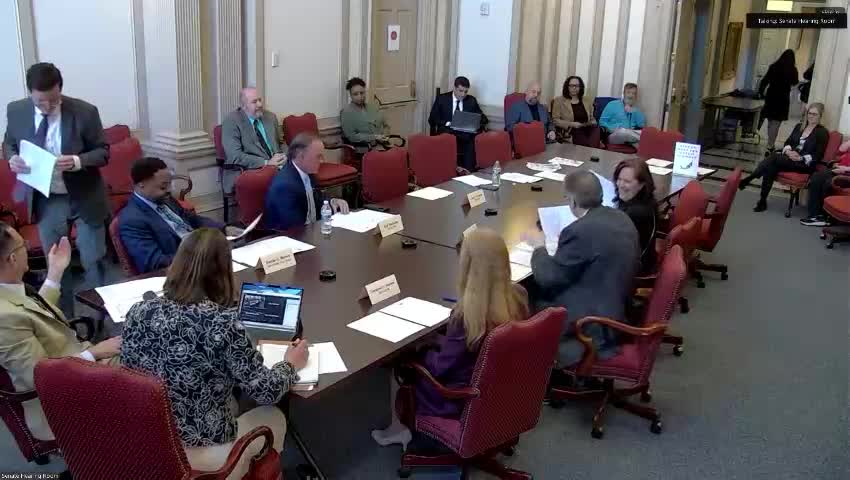
The Senate Elections and Government Affairs Committee heard Senate Bill 75 on Tuesday, a measure sponsors said is intended to increase locations available for retail adult-use marijuana by amending county siting restrictions and clarifying conversion rights for existing medical dispensaries.
Senator Party, the bill's presenter, told the committee the law that legalized retail adult-use marijuana left siting control to counties and that some county ordinances have effectively eliminated commercial options. "The reality is they have effectively made the sale of marijuana illegal in Sussex County," Senator Party said, citing Sussex County's use of a three-mile buffer around municipalities, churches, schools, parks, day cares and government buildings and its designation of only a small set of C3 commercial parcels as potential retail sites.
SB75, as introduced, would: allow medical marijuana compassion centers that received conversion licenses to operate retail stores and apply for necessary building permits; require minimum hours of operation (9 a.m.–9 p.m. Monday–Saturday; noon–8 p.m. Sunday); prohibit counties from banning indoor, fully enclosed cultivation facilities in agricultural or industrial zones; and allow counties to prohibit retail stores only within a half mile of another retail store or within 500 feet of a school, licensed childcare facility, residential treatment facility, park or library. The sponsor said an amendment will remove "place of worship" from the setback list because private homes can be listed as churches on mapping services.
Presenters and industry speakers said existing county ordinances in Sussex and New Castle counties leave very few legally available parcels. The sponsor noted Sussex County lists 17 C3 parcels (average size about seven acres, smallest about two acres), many already developed, and pointed to county maps showing broad exclusion zones that cover large parts of available land. The sponsor and industry witnesses said the combined effect of buffers and zoning has left licensed operators unable to find available locations.
Several license holders and industry representatives testified in favor of the bill. Charles Wark, owner of Lucky's and a social-equity licensee, said license holders are struggling to find sites and that "the state's just losing money by slowing this up." Tracy Sutherland, a social-equity licensee for testing facilities, said reducing buffers to 500 feet would make at least two additional locations available. Lizzie Golub, identified in the record as the director of Delaware Normal, urged the committee to allow licensees to operate in any Delaware county: "The people who've received a license have waited patiently and deserve the right to proceed. They deserve to go in any county in Delaware."
Industry representatives including James Bridal, president of the Delaware Cannabis Industry Association, argued that a regulated retail market will reduce the illicit supply of untested products. Committee members raised questions about parity with liquor licensing and noted that some existing liquor rules have different distance and licensing approaches.
The sponsor emphasized SB75 applies only to counties, not municipalities, and said Kent County has not yet finalized its ordinances. The committee heard public testimony both in-person and virtually and did not take a formal vote at the hearing. Sponsors said two amendments were expected: a technical correction and one addressing churches/places of worship.
Committee members and staff indicated further questions remain about local control, interaction with existing county ordinances and how the changes would be enforced. No committee vote was recorded at today's hearing; the chair adjourned the committee after public testimony.