Get Full Government Meeting Transcripts, Videos, & Alerts Forever!
Get email alerts on the Public Safety Police topic
No spam. Unsubscribe anytime.
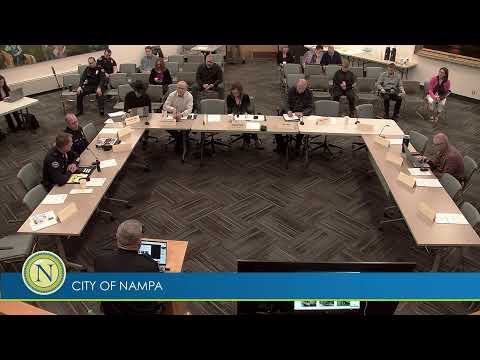
Nampa police outline staffing shortfalls, dispatch strain and technology needs at council workshop
Summary
At a Wednesday morning Nampa City Council workshop, Police Department leaders briefed the council and public on FY26 staffing needs, crime trends and technology purchases, saying the department faces persistent gaps in patrol and dispatch staffing and growing operational costs.
At a Wednesday morning Nampa City Council workshop, Police Department leaders briefed the council and public on FY26 staffing needs, crime trends and technology purchases, saying the department faces persistent gaps in patrol and dispatch staffing and growing operational costs.
Police Chief Eric (presenting) said the department currently has about 223 employees across sworn and civilian roles, with patrol typically staffed around 70 officers at a time because of training and academy cycles. He told the council the department has increased use of technology — CompStat, a real‑time crime center and digital forensics — to target crime, but that staffing and budget constraints limit how quickly the department can expand or sustain those tools.
Chief Eric said the policing allocation model (PAM) used for planning recommends adding 12 officers now and roughly 15 more by 2029 to meet projected demand. He urged the council to prioritize both patrol positions and additional dispatch supervision and staff; the department’s initial estimate, given current city funding projections, would allow about five new positions in FY26 and two of those should be dispatch supervisors.
Why it matters: Council members said public safety is the highest spending priority reported in the city survey, and the police presentation linked staffing decisions to response times, overtime costs and the ability to sustain specialized units such as gang investigators and school resource officers.
Key facts and figures - Department workforce: about 223 total employees (Chief Eric’s presentation). - Patrol: roughly 70 officers typically available on patrol at any one time, with additional officers in training or academy classes. - Dispatch staffing: four dispatchers per fully staffed shift is standard; the department often operates with three when staffing gaps occur. The department reported about 13,000 Nampa Fire calls last year and described about 126,000 incoming business calls to the dispatch center in the prior year (presentation figures). The chief said shortages cause frequent overtime and limit supervisors’ ability to manage incidents in real time. - Dispatch overtime: the department said its staffing patterns effectively create built‑in overtime (the presentation cited roughly 3,300 hours of built‑in overtime for dispatch) and that adding roughly eight positions could create swing shifts and reduce that overtime burden. - PAM recommendations: presentation materials the chief summarized recommend adding officer capacity over the next several years; the chief attributed the PAM numbers to the policing allocation model used in recent departmental planning. - Crime trends: the department reported Group A crimes were down year‑to‑date (a 17.3% drop was cited on the presentation), and said violent crime rates are below Idaho and national averages in recent comparison slides the department shared. The presentation also noted increases in some categories such as fraud and human‑trafficking case counts compared with 2020 figures.
Technology, investigations and operations Chief Eric and staff described new or ongoing operational needs: - Peregrine software: the department proposes an efficiency/analytics platform (Peregrine) budgeted in FY26 at about $97,000 annually; the software would link existing databases (body cam, CAD, reports) into investigator dashboards and could reduce some analyst workload over time. - Drone program (drone‑as‑first‑responder): the department described a DFR model to launch drones to incoming 911 calls so a real‑time crime center operator can assess hazards before officers arrive. The chief said the department would not seek new sworn positions specifically for the drone program immediately, and that the program would be evaluated for staffing impacts over time. The presentation listed a one‑time capital cost and ongoing software subscription in the operational budget. - Forensics and labs: the department reported it uses the state lab (with typical turnaround of several months) and sometimes pays for private lab services to shorten wait times; it also has sought training to expand local DNA handling capabilities.
Prosecution and human trafficking The police presentation said Idaho’s 2023 legislative changes tightened human‑trafficking statutes and that Nampa has been active in investigations and prosecutions: the department said it is coordinating cases with the U.S. Attorney’s Office and Canyon County prosecutors and that those agencies currently meet regularly on trafficking investigations.
Council discussion and funding options Council members asked detailed questions about dispatch coverage, peak call times, response to enclave areas outside city limits, and whether growth still “pays for growth.” Staff and the chief explained the distinction between enterprise funds (water, wastewater) — which collect fees at hookup and are generally self‑funding — and the general fund (police, parks) that relies heavily on property tax and state shared revenues.
On funding: presenters said the city currently has limited capacity to add positions in FY26. The council discussed the option of using foregone property‑tax authority to raise recurring revenue for police. A staff member reported that Steve Onfray provided a figure that a 1% foregone would cost about $2.84 per $100,000 of taxable value (presented as a per‑$100,000 illustrative cost), and council members debated whether to pursue foregone on a recurring basis targeted to police staffing.
Next steps and council direction Council members directed staff to provide additional materials for budget deliberations, including the financial model that City staff said showed a multi‑year gap between revenue and projected service costs, and to add the chief’s staffing and financial slides to council budget packets. The chief and staff offered to schedule more one‑on‑one briefings and follow‑up meetings with council members.
No formal council action (vote) on police staffing or new recurring funding occurred at the workshop; the police briefing was presented for information and to shape the FY26 budget discussions.
Ending Council members and staff said the presentation was the start of budget deliberations; staff will provide the requested supporting documents and additional comparisons of peer cities and staffing ratios before final budget decisions.