Get Full Government Meeting Transcripts, Videos, & Alerts Forever!
Get email alerts on the Automated Speed Enforcement topic
No spam. Unsubscribe anytime.
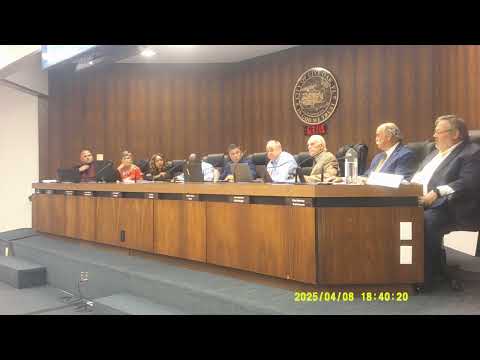
Live Oak council advances plan to seek RFP for automated school‑zone speed enforcement after vendor briefing
Summary
After a presentation from Blue Line Solutions on automated speed‑enforcement cameras under House Bill 657, council members moved to prepare a request for proposals and schedule a stakeholder workshop; no formal vote on procurement was recorded in the transcript.
A motion to prepare a request for proposals (RFP) for automated speed‑enforcement cameras in City of Live Oak school zones was introduced and seconded after a presentation by Blue Line Solutions; the transcript does not record a formal roll‑call vote. Council members discussed scheduling a workshop with stakeholders, RFP timing and technical and legal details before any procurement decision.
Blue Line Solutions representatives David Bocchino, a sales representative, and Paul Persick, a colleague and former law enforcement officer, told the City Council the company performed five‑day speed studies at four Live Oak schools and found more than 4,500 instances of drivers exceeding posted school‑zone limits by 11 mph during a single school week. Bocchino referenced House Bill 657, signed in July 2023, as the enabling law that allows cities and counties to activate automated speed enforcement under a state framework.
The company described the program mechanics: after a 30‑day public awareness and warning period, a driver caught traveling 11 mph or more over the posted school‑zone limit would receive a $100 citation that carries no license points. According to the vendor, the statutory distribution is $60 to the city (shared as negotiated with the vendor), $20 to the state, $12 to the school where the infraction occurred, $5 for school crossing‑guard recruitment, and $3 to Florida Department of Law Enforcement (FDLE) training funds. Bocchino said the vendor funds the infrastructure and that similar programs reported a 94–95% reduction in speeding infractions in jurisdictions where the system operates.
Council members and residents asked operational questions about calendar changes, hurricane closures, fairness between schools, and data handling. The vendor said its production team would coordinate with schools and the city to avoid issuing citations on days when schools are closed and that the company provides a public portal and contest process. The company said it uses single‑beam LIDAR for lane‑specific detection, captures a short video plus a rear license‑plate image, and can provide an automatic license plate reader (ALPR) camera at no cost to the city for investigative use.
City staff member Joanne (surname not specified) advised the council that drafting an RFP package would take time and that a 45‑day advertisement period is standard. The vendor said typical contract setup times vary with permitting and coordination; they quoted a range of roughly three to eight months to implement and an average of five to six months to get a program fully running. The vendor said contract lengths in other municipalities have ranged from about two to five years, with three years common.
Council discussion emphasized stakeholder engagement. Several council members urged inviting the school district, sheriff’s office/school resource officers, fire and EMS, and other stakeholders to a workshop; the transcript records the council discussing a workshop and tentatively scheduling an April 22 workshop at 4:15 p.m. and a June meeting target for RFP action, but it does not record a final, formal council vote to approve specific procurement terms in the transcript excerpt.
Next steps recorded in the meeting transcript: a motion to prepare an RFP was made and seconded; council members and staff discussed stakeholder workshops, RFP timing and advertisement windows, and technical and permitting requirements. No formal vote tally or final contract approval appears in the transcript excerpt provided.