Get Full Government Meeting Transcripts, Videos, & Alerts Forever!
Highlands hears engineering plan for Mirror Lake dredging; consultants recommend phased work and bid alternates
Summary
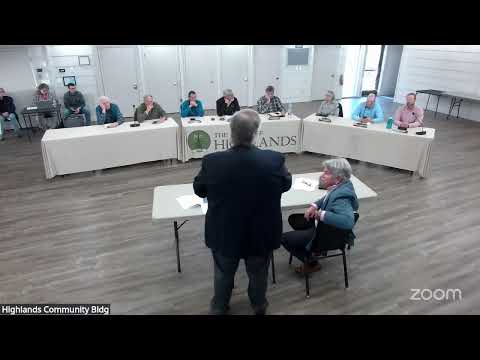
The Highlands Board of Commissioners on April 2025 heard a preliminary engineering report from McGill Associates on plans to dredge Mirror Lake, where the town holds a $5,000,000 grant for dredging.
The Highlands Board of Commissioners on April 2025 heard a preliminary engineering report from McGill Associates on plans to dredge Mirror Lake, where the town holds a $5,000,000 grant for dredging. McGill presented survey results, disposal options and a recommended phased approach that would move the open-water lake work forward first while permitting work in riverine and wetland areas continues.
The study, presented by Joel Storro, principal at McGill Associates, and Mike Hanson, vice president and water-resources lead, found highly variable depths and sediment accumulation across the system. "We found that the water depth range from, as little as inches in certain areas ... up to about 18 to 20 feet in the open water area of the lake," Hanson said, describing pockets of significant sediment deposition in the riverine reach, the main lake and adjacent wetlands. Hanson said phase 1—work already under way by a local contractor—was removing roughly 5,000 cubic yards of material, while full-lake removals would involve much larger volumes (tens of thousands of cubic yards) and correspondingly higher disposal costs.
The technical team told commissioners the type and location of sediments will influence methods and costs. McGill said lighter, silty sediments in the open-water lake are best addressed with hydraulic dredging and dewatering in geotextile bags, while coarser granular material in the river reaches may require mechanical methods. Hanson noted the phase-1 contractor has used hydraulic…
Already have an account? Log in
Subscribe to keep reading
Unlock the rest of this article — and every article on Citizen Portal.
- Unlimited articles
- AI-powered breakdowns of topics, speakers, decisions, and budgets
- Instant alerts when your location has a new meeting
- Follow topics and more locations
- 1,000 AI Insights / month, plus AI Chat