Get Full Government Meeting Transcripts, Videos, & Alerts Forever!
Get email alerts on the Mirror Lake Dredging topic
No spam. Unsubscribe anytime.
Highlands hears engineering plan for Mirror Lake dredging; consultants recommend phased work and bid alternates
Summary
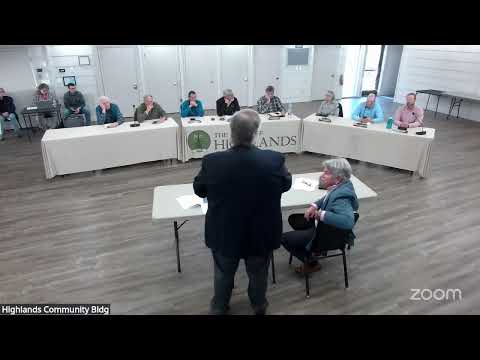
The Highlands Board of Commissioners on April 2025 heard a preliminary engineering report from McGill Associates on plans to dredge Mirror Lake, where the town holds a $5,000,000 grant for dredging.
The Highlands Board of Commissioners on April 2025 heard a preliminary engineering report from McGill Associates on plans to dredge Mirror Lake, where the town holds a $5,000,000 grant for dredging. McGill presented survey results, disposal options and a recommended phased approach that would move the open-water lake work forward first while permitting work in riverine and wetland areas continues.
The study, presented by Joel Storro, principal at McGill Associates, and Mike Hanson, vice president and water-resources lead, found highly variable depths and sediment accumulation across the system. "We found that the water depth range from, as little as inches in certain areas ... up to about 18 to 20 feet in the open water area of the lake," Hanson said, describing pockets of significant sediment deposition in the riverine reach, the main lake and adjacent wetlands. Hanson said phase 1—work already under way by a local contractor—was removing roughly 5,000 cubic yards of material, while full-lake removals would involve much larger volumes (tens of thousands of cubic yards) and correspondingly higher disposal costs.
The technical team told commissioners the type and location of sediments will influence methods and costs. McGill said lighter, silty sediments in the open-water lake are best addressed with hydraulic dredging and dewatering in geotextile bags, while coarser granular material in the river reaches may require mechanical methods. Hanson noted the phase-1 contractor has used hydraulic dredging and geotextile bags on a small scale and that the larger project will require a more deliberate, higher-throughput plan.
Why it matters: the town is the municipal pass-through and administrator of the $5 million grant; the size of the sediment volume, disposal distances and wetland mitigation requirements will determine whether the available funds cover construction, permitting and construction management. McGill said a full, aggressive dredge that restores historic depths could exceed the grant. "We came up with an estimate that was in excess of $6,000,000" for one full-dredge alternative, the consultant said; a more limited approach that preserves wetlands and restricts dredging to non-wetland areas produced lower cost estimates that McGill said could fall within the funding envelope, depending on final scope and bids.
Key recommendations and schedule: McGill recommended a phased program. The firm suggested (1) advance design and permitting for the open-water lake portion ("phase 2"), which is expected to require a relatively standard 3–4 month environmental permit review with state agencies and the U.S. Army Corps of Engineers; and (2) parallel design work but a longer permitting track (up to about nine months) for riverine and Mill Creek work ("phase 3") because of greater wetland impacts and turbidity risk. Mike Hanson described using bid alternates so the town can award a base contract and selectively add work if bid prices allow. McGill provided a notional schedule that would allow bidding on the open-water work by late summer with potential construction starting in late 2025 and later work in 2026, subject to permitting and available funds.
Disposal and testing: McGill identified two likely disposal options for dewatered dredge material: the closed Old Highlands Landfill (nearer, roughly an 8–9 mile round trip) and the Franklin Landfill in Macon County (about a 40-mile trip). The consultants said haul distance is a major cost driver. They reported initial laboratory testing did not show concentrations that would require special hazardous disposal, though some elements such as arsenic appeared in early samples and prompted a second round of testing; the later testing cleared the material for the candidate disposal sites in McGill's judgment.
Wetlands and mitigation: McGill said a full-dredge alternative would likely impact wetlands and trigger mitigation obligations. The consultant noted mitigation ratios vary by wetland quality and agency requirements (1:1 to higher ratios) and estimated a per‑acre buyout value in the analysis of about $77,000 per acre. McGill estimated Mill Creek's wetland area at "in excess of 5 acres" and said mitigation-only costs for that scope could run from roughly $350,000 (1:1) up to about $700,000 if agencies require a higher ratio.
Costs and unit rates: McGill and speakers compared cost assumptions. The firm estimated that large-scale dredging economies could reduce unit costs relative to small-phase work, and suggested rough engineering‑level unit costs in a lower range (the firm cited perhaps $75–$80 per cubic yard in a large-scale operation) versus higher per‑yard costs reported by the phase‑1 contractor. The town's public works director, Lamar Nicks, reviewed McGill's report for the town and found it complete.
Community questions and next steps: Commissioners and several residents asked about Mill Creek testing, long-term maintenance, sediment traps upstream, and fundraising. McGill recommended considering sedimentation basins at tributary mouths (Mill Creek and other small tributaries shown on project maps) and suggested a long-term maintenance plan so the town does not repeat a multi‑decade accumulation cycle. The firm also discussed options to fund ongoing maintenance, including assessment districts or association fees, and said additional, targeted testing in Mill Creek would be prudent before any large-scale work there.
Formal action recorded at the meeting was limited to routine business; the commission did not take a construction contract action during the session. McGill asked the town for direction to proceed with design and permitting work on the open-water lake option and to prepare bid documents with alternates; the commissioners indicated they would deliberate and follow up. The consultants offered to return for further sessions as the town narrows scope and funding decisions.
Votes at a glance: The only formal recorded vote at the meeting was a motion to adjourn, which was seconded and approved by voice vote.