Get Full Government Meeting Transcripts, Videos, & Alerts Forever!
Get email alerts on the Ems Response Times topic
No spam. Unsubscribe anytime.
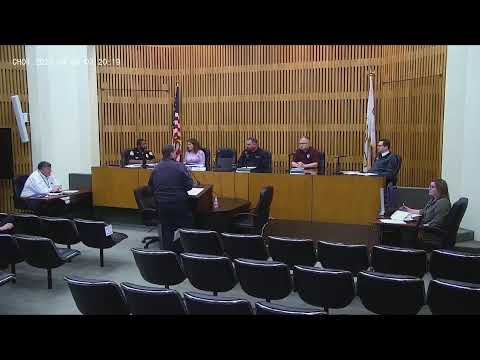
Decatur Fire Rescue reports high EMS fractile response rates, details staffing, transports and time-exception process
Summary
At a Decatur City meeting, Decatur Fire Rescue leaders reported monthly and quarterly EMS response-rate statistics, staffing and transport volumes, and explained time-exception procedures after several missed-response incidents including a train delay. Presenters offered differing aggregate quarter figures; no formal actions were taken.
Decatur Fire Rescue reported broadly strong emergency medical services (EMS) response times for January through March and described staffing, transport volumes and the department’s process for reviewing missed-response time exceptions.
The department’s returning chief, Chief England, summarized monthly figures and said "for the first quarter combined for fractile responses, for the city limits, [it] is 97%. And for the police jurisdiction, is 98%." He told the meeting the city’s ordinance designates Decatur Fire as the primary EMS responder in city limits and described how fractile-response benchmarks are counted.
Later in the same discussion, Tyler Spiekel, Decatur Fire Rescue staff, presented more detailed monthly counts and slightly different quarter aggregates. Spiekel said, "We had a total of 1,432 requests for service, and we transported 1,111 patients" for January, and for the quarter reported "a total of 4,399 requests for service, and we transported a total of 3,343 patients." He also said the department is "averaging about a hundred calls a day that we're responding to," counting the broader county service area.
Both presenters explained how response time is measured. Chief England said the clock starts at dispatch and stops when the first unit from each agency arrives; he noted the department is held to the same city-limit standards as ambulance providers. Chief England also said ambulance providers may submit a time-exception form for late arrivals; "they can submit a time exception form to me," he said, and the department reviews submitted forms and the underlying dispatch data before approving exceptions.
Speakers described circumstances that generate approved exceptions. Chief England and Spiekel gave an example from March in which an ambulance missed the time standard because a stopped train blocked the Beltline near Parkway Hospital, requiring responders to backtrack. Spiekel said two submitted time exceptions during March were approved and that three time exceptions for the quarter were approved in total.
On staffing and deployment, Spiekel said the department typically staffs 10 to 12 trucks during the day shift and three to four at night, with units posted around the city (east, west and south postings near the Target shopping center). He said trucks rotate during peak deployment and county apparatus are used to backfill when city resources are low.
Presenters noted the difference between posting (routine placement around the city) and staging (waiting on law enforcement when a scene requires it). Chief England said staging stops the department’s arrival-time clock in instances where officers must clear a scene before medical responders enter.
Chief England said he is completing the department’s annual report and expects to submit it once he receives a few remaining statistics from staff member Samantha Sanders. No motions or formal votes were recorded on the topic during the meeting.
The meeting included questions from council members and other participants about how calls are counted, how fractile response is calculated and whether posted units affect arrival times; those operational clarifications were addressed by Chief England and Spiekel during the report.