Get Full Government Meeting Transcripts, Videos, & Alerts Forever!
Get email alerts on the Suicide Coercion topic
No spam. Unsubscribe anytime.
Senator Feingold presses for 'Conrad's Law' to criminalize coercion to die by suicide
Summary
Senator Jacobin Feingold urged the Judiciary Committee to enact 'Conrad's Law' (H.17‑48/S.11‑09), a narrowly tailored statute criminalizing coercion of another person to die by suicide, arguing it would provide prosecutors a clear tool distinct from involuntary manslaughter and that numerous other states have adopted similar statutes.
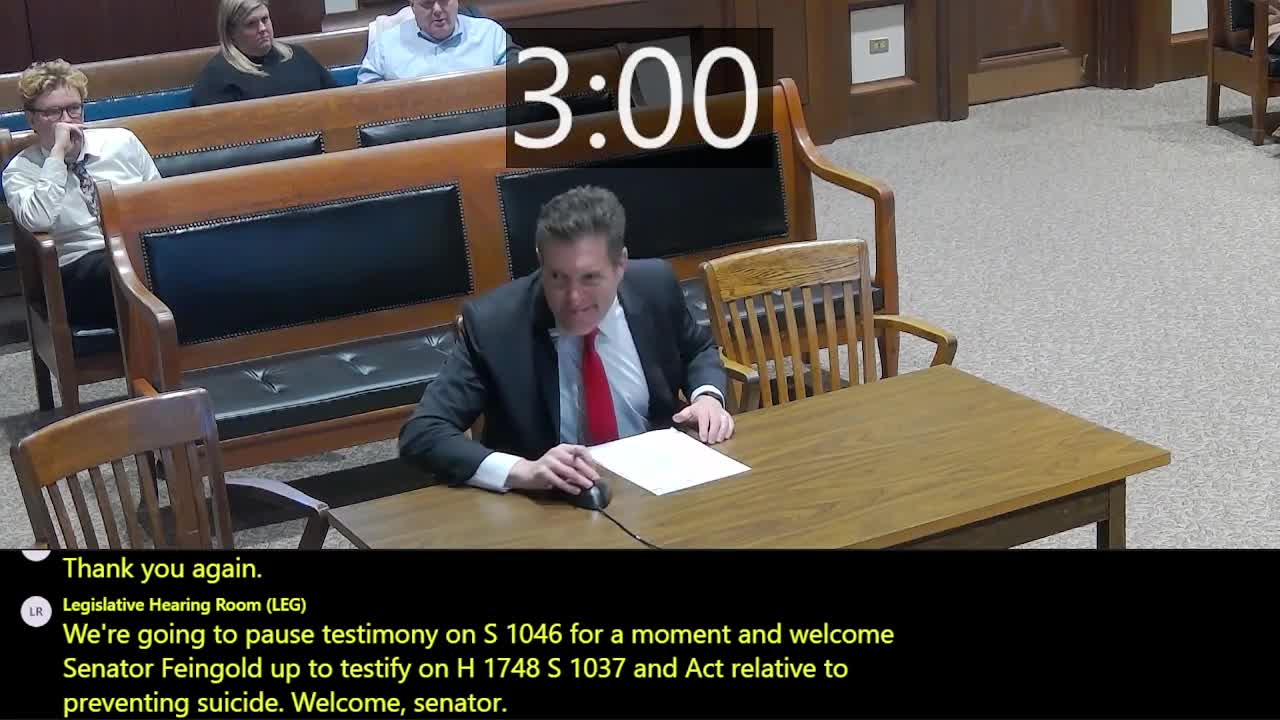
Senator [last name used in transcript as] Feingold told the Joint Committee on the Judiciary he filed H.17‑48/S.11‑09, called “Conrad’s Law,” to make it unlawful to intentionally coerce another person into dying by suicide.
Feingold said the bill was developed with the Roy family and academic counsel after the Michelle Carter case and related prosecutions exposed a gap in Massachusetts law that prosecutors often address through involuntary manslaughter statutes. He said the absence of a dedicated offense left prosecutors and families with prolonged, difficult litigation.
Under the proposed statute, a person who “knew that someone else was experiencing suicidal ideation and intentionally coerced them into taking their own life or provided them with the means to do so” would face up to five years in prison. Feingold said the law would be narrowly tailored to criminalize coercion rather than lawful end‑of‑life choices, and he cited more than 40 other states that have adopted similar statutes.
Committee members asked about discretion for prosecutors and concerns about applying criminal law when the coercer is a young person or mentally ill. Feingold said the bill’s five‑year maximum gives prosecutorial discretion and that sponsors were willing to work with the Judiciary Committee to refine protections and mental-health considerations.
Feingold requested the committee’s help in finding common ground; no formal committee action was taken during the hearing.