Get Full Government Meeting Transcripts, Videos, & Alerts Forever!
Get email alerts on the Community Security And Support topic
No spam. Unsubscribe anytime.
Massachusetts Jewish leaders urge expanded nonprofit security funding, kosher food access and cemetery protections
Summary
Orthodox and community leaders urged the state to expand nonprofit security grants and personnel, improve victim services and protect Jewish cemeteries, saying recent vandalism, assaults and threats across Massachusetts leave congregants vulnerable.
Community leaders representing Orthodox and other Jewish organizations told the Massachusetts Special Commission on Antisemitism that day‑to‑day safety needs in the state require stepped up funding, policing coordination and accessible services.
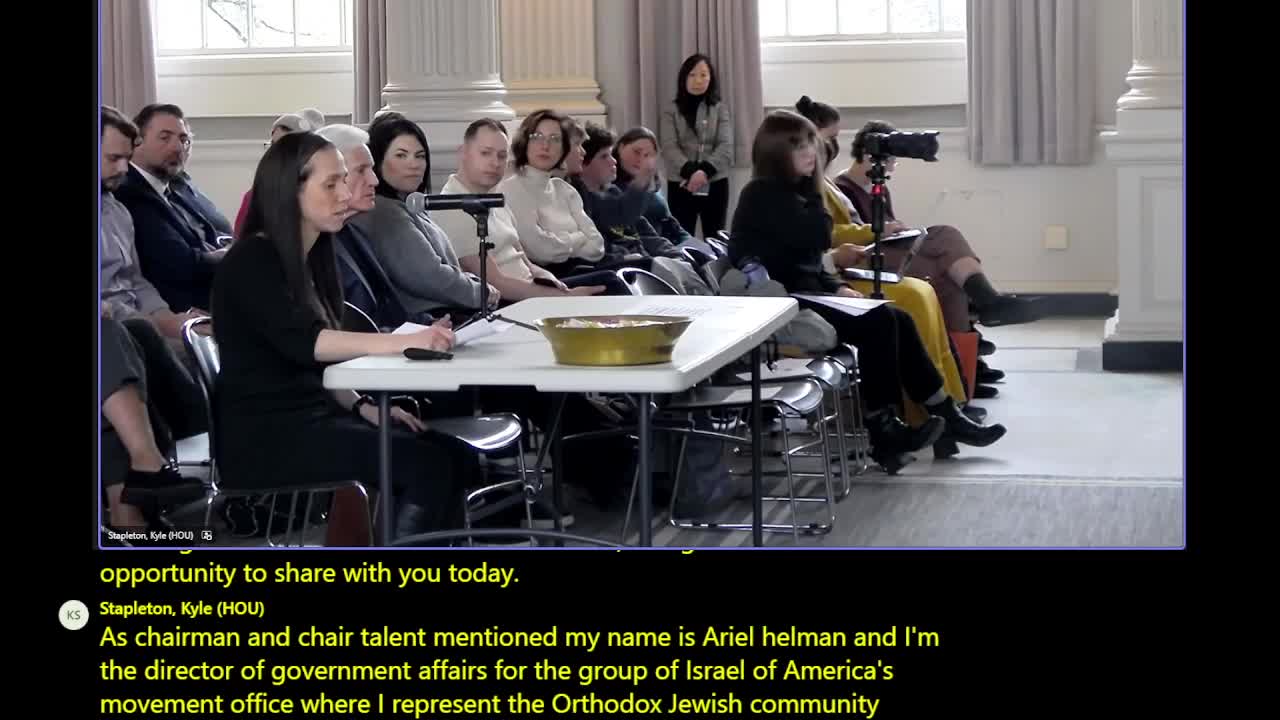
Arielle Hellman, director of government affairs for Agudath Israel of America’s Massachusetts office, told commissioners that Orthodox Jewish residents are highly visible in public and often targeted when they wear distinctive religious clothing or travel on foot to synagogues. “Orthodox Jews reported that they have experienced antisemitic incidents,” Hellman said, citing national survey data and local examples of stabbings, school harassment and vandalism she has seen in recent years.
Why it matters: Witnesses described a pattern of vandalism, assaults and threats across multiple Massachusetts communities and argued that state programs designed to protect faith‑based and nonprofit sites are lifesaving but unevenly distributed.
Hellman urged expansion of the Commonwealth’s nonprofit security grant program and the nonprofit security personnel program, emphasizing that congregations often need funding for patrols and personnel to protect children arriving at schools and synagogues. She said the state should increase support for mental‑health resources for students affected by hate incidents and keep grants accessible to smaller communities that cannot otherwise afford staffing.
Jada Cortel, chief executive officer of the Jewish Cemetery Association of Massachusetts, told the commission that Jewish cemeteries are open, often unmanned and vulnerable to vandalism and desecration. “Our cemeteries have no walls, little to no security, and are completely open to the public 24/7,” she said, asking the commission to consider cemetery protection in future funding allocations.
Speakers noted practical needs: kosher food access at hospitals and in school meal programs, short‑term police patrols after attacks, and clearer pathways for small nonprofits to access existing grant lines. Hellman and others asked the commission to study zoning barriers that make building synagogues difficult for congregations that need to be within walking distance of their members.
Commissioners and witnesses also praised the state’s existing investment: the legislature’s nonprofit security grant line and separate funds for restorative‑justice and victim supports. Still, several pleaed for more predictable funding of victim‑assistance positions in district attorneys’ offices and police departments so survivors receive regular updates during lengthy prosecutions.
The commission received multiple individual accounts of vandalized property, threats to schoolchildren and unreported incidents that community leaders described as undercounted in official statistics. Witnesses urged the commission to ensure security resources are equitably distributed across urban, suburban and smaller Jewish communities in the state.
No formal legislative action was taken during the hearing; commissioners asked staff to compile program details and outreach strategies to inform the commission’s recommendations.