Get Full Government Meeting Transcripts, Videos, & Alerts Forever!
Get email alerts on the Pharmacy Access topic
No spam. Unsubscribe anytime.
Administration proposes pharmacy assessment to bolster independent pharmacies; PBMs and 340B also under scrutiny
Summary
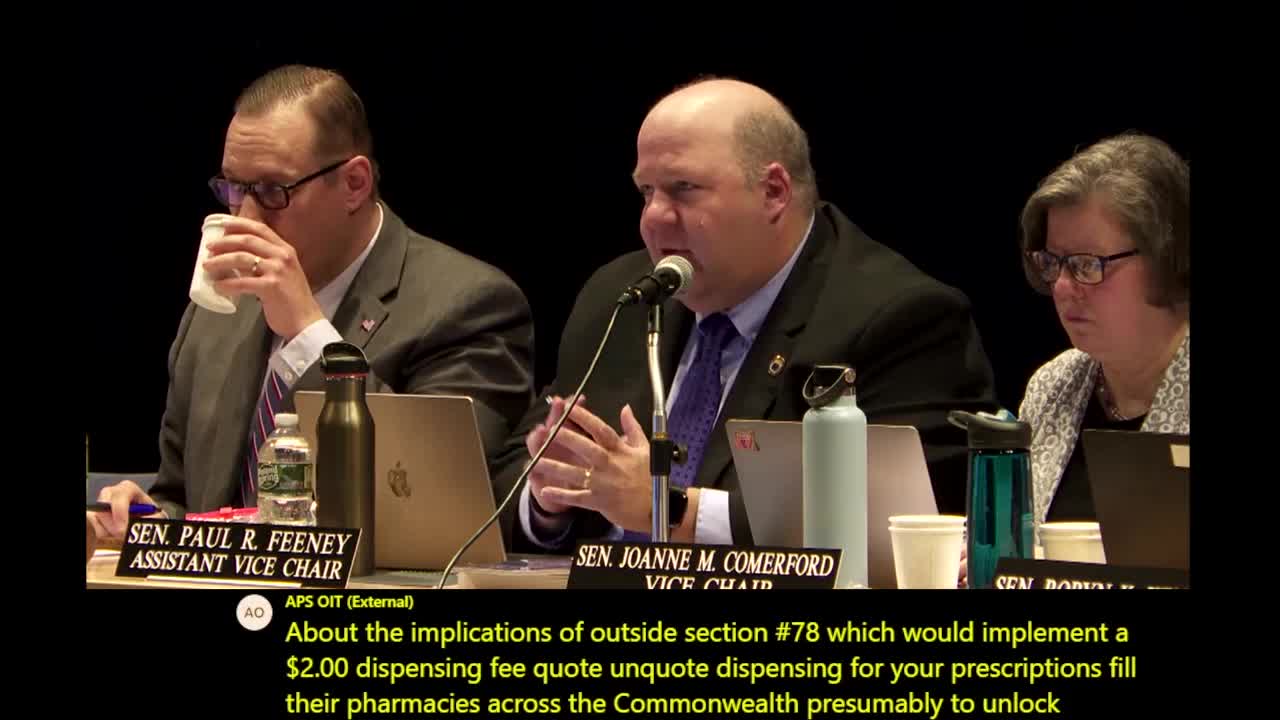
House 1 includes a pharmacy assessment and a $2 dispensing fee outside section intended to shore up pharmacy access, particularly in low‑income neighborhoods; officials said the plan would reinvest assessment proceeds into pharmacy rates while acknowledging concerns about PBMs and the complex 340B market.
Assistant Secretary Mike Levine and Secretary Kate Walsh told the panel that the House 1 proposal contains a pharmacy assessment and accompanying reimbursement changes meant to stabilize pharmacies that serve low‑income communities.
Levine described the mechanics: the assessment would levy charges on prescriptions filled in the Commonwealth and reinvest the proceeds plus $20 million into Medicaid pharmacy rates and higher dispensing fees for MassHealth. He said the net result would be a modest increase in income to pharmacies that especially support community health centers and independent pharmacies that provide extra services.
Walsh framed the proposal as a use of MassHealth’s purchasing power to sustain pharmacies in areas described in testimony as ‘‘pharmacy deserts’’ and to require managed‑care organizations to match MassHealth pharmacy rates in some cases. "That was designed to use our Medicaid purchasing dollars to try to keep pharmacies open in low income communities where we're seeing pharmacy deserts," Walsh said.
PBMs and 340B: Committee members asked about pharmacy benefit managers (PBMs) and the 340B program. Walsh and Levine acknowledged national market dynamics and said previous state actions (including anti‑spread pricing rules) and new transparency efforts are helpful but limited. Levine noted that 340B discounts sometimes generate margin for safety‑net providers while limiting the state’s ability to negotiate rebates; he said the administration is exploring ways to capture more value from manufacturer discounts and to negotiate supplemental rebates in coordination with hospitals and safety‑net providers.
Local concerns: Lawmakers from rural areas and smaller towns emphasized that small, independent pharmacies lack resources to engage in lengthy rule changes and asked how the administration will ensure those providers are consulted and preserved. Levine said the administration had been modeling impacts with pharmacy associations, chains and health centers and is prepared to share that analysis with the committee.
Bottom line: House 1 includes a pharmacy assessment intended to stabilize pharmacy access in underserved areas, but lawmakers and the administration agreed additional oversight and careful design will be needed to avoid unintended harm to independent pharmacies and to address PBMs and 340B complexities.