Get Full Government Meeting Transcripts, Videos, & Alerts Forever!
Get email alerts on the Elections Reform topic
No spam. Unsubscribe anytime.
Committee hears broad election‑reform package including ballot curing and removal of witness signature (SB64); bill set aside
Summary
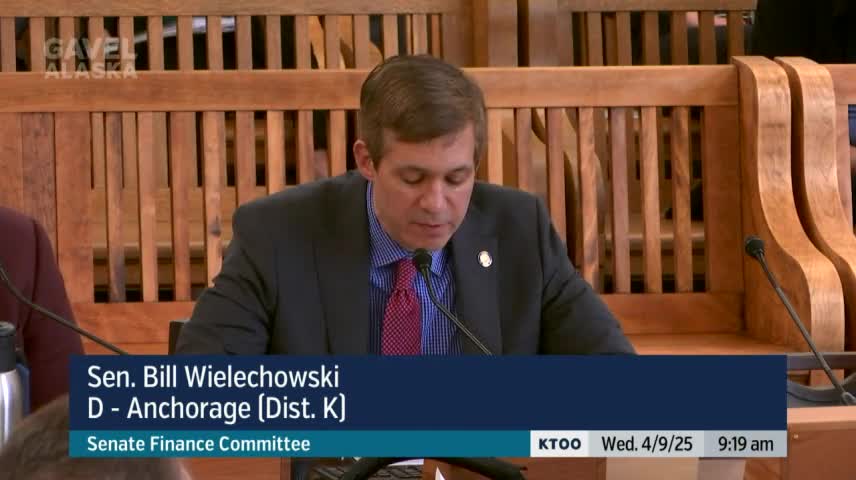
Senate Bill 64, a broad elections reform package that would add ballot curing, remove the witness signature requirement for absentee ballots, require regional drop boxes and speed reporting, was heard in the Senate Finance Committee on April 9 in Juneau.
Juneau — The Senate Finance Committee on April 9 held the first Finance hearing on Senate Bill 64, a comprehensive elections package that includes ballot curing, repeal of the absentee witness signature requirement, ballot tracking, regional ballot drop boxes, and measures intended to speed reporting of results.
"Senate Bill 64 is a comprehensive package of reforms aimed at removing barriers to voting, cleaning up our voter rolls, reporting election results faster, and making other needed changes to Alaska's election laws," State Senator Bill Wilkowski, the bill's prime sponsor, told the committee. Wilkowski said the bill combines provisions from previous proposals and the governor, and listed specific elements including a ballot‑curing process, removing the witness requirement for mail ballots and new rules to clean up the voter rolls.
Sponsor staff described several technical provisions: clarifying the definition of residency, reducing required notices for inactive voters from two notices to one in some cases, directing periodic consultant reviews of the voter roll, and exempting automatic Permanent Fund Dividend (PFD) registrations from being treated as "contacted" for roll‑cleanup purposes. Legal counsel Sonia Kawasaki told the committee the bill would require a person absent from Alaska to have a "reasonable and articulable plan to return" to preserve residency for voting purposes.
Division of Elections Director Carol Beecher told the committee that, under the bill, each of Alaska's five regions would be required to have at least one drop box. She also summarized signature verification practice: the division compares registration signatures to Department of Motor Vehicles records and, if necessary, uses other identifiers. Beecher told senators the initial purchase cost for the five drop boxes is about $23,000, with total initial and shipping/moving costs likely near $30,000; the division's fiscal note showed an FY27 cost of $338,800 (all unrestricted general funds) and a levelized annual cost of about $290,100 in out years, including one full‑time position and temporary staff in certain years.
Public and invited testimony on SB64 included election‑security and access groups who supported the measures. Tom Stewart of Secure Democracy USA praised ballot tracking and a uniform cure process as measures that "will bolster election security" while also increasing voter confidence. Kendra Foster of the Alaska Federation of Natives urged caution about repealing automatic voter registration via the PFD and said AFN supports provisions such as prepaid postage, rural liaisons, language assistance, and permanent absentee ballots. Mike Garvey of the ACLU of Alaska called the witness signature a leading reason absentee ballots are rejected and urged enactment of a cure process. Barbara Smith Warner of the National Vote at Home Institute also supported mail‑ballot practices and permanent absentee (single sign‑up) as best practices.
Not all witnesses supported the bill as written. Public testifier Randy Rudnick argued the residency language and elimination of witness signatures could disenfranchise some voters, calling the residency fix "not a solution" and warning it could force some people "off the voter rolls." Several senators asked for more data and regional breakdowns of envelope rejection rates; Kendra Foster agreed to provide a regional rejection breakdown to the committee.
Why it matters: SB64 blends access and administrative reforms: supporters say the measures will reduce rejected ballots and speed transparent reporting, while critics warned some language changes (residency definition, automatic registration treatment) could have unintended consequences for voter lists and turnout in some communities.
Next steps: Senators set SB64 aside after the hearing; staff will finalize and circulate the fiscal note and members indicated follow‑up questions for the Division of Elections and sponsor staff.