Get Full Government Meeting Transcripts, Videos, & Alerts Forever!
Get email alerts on the Foster Care Psychiatric Admissions topic
No spam. Unsubscribe anytime.
Alaska bill would require judges to review foster youths’ acute psychiatric admissions within seven days
Summary
An initial Senate hearing on House Bill 36 examined a proposal to shorten the time before a judicial hearing for foster children admitted to acute psychiatric hospitals, require attorney appointment, add reporting on out-of-state residential placements and 30-day reviews for long-term acute stays.
House Bill 36 would require that foster children admitted to acute psychiatric hospitals receive a judicial hearing within seven days, mandate appointment of counsel for children in those facilities, add data about out-of-state residential placements to an existing annual report to the Legislature and require 30-day reviews for long-term acute admissions.
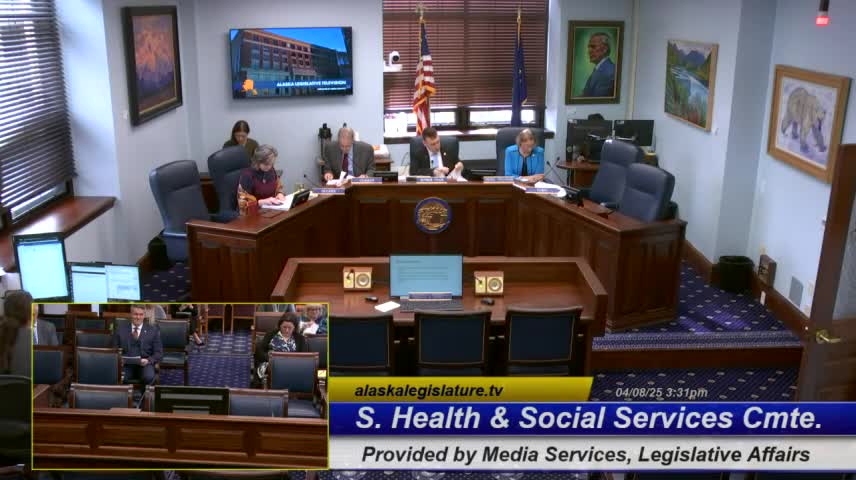
Representative Andrew Gray, the bill’s sponsor, told the Senate Health and Social Services Committee on April 8 that the measure aims to close “an incredibly dark period in Alaska history” when foster children were held in psychiatric facilities for months without prompt judicial oversight. “Due process is a basic constitutional right of every person in Alaska,” Gray said. He described the bill as ensuring that foster children admitted for acute psychiatric care have a timely judicial check on whether that placement is necessary.
The bill would require that parties be notified within 24 hours of an acute admission and that a hearing take place within seven days, with a one-time seven-day extension available if the court cannot convene the necessary participants. Staff to the sponsor, Kyle Johansen, told the committee the bill also defines “acute psychiatric hospital” and explicitly authorizes two-way video conferencing to facilitate timely hearings.
Nancy Mead, general counsel for the Alaska Court System, told the committee that the Alaska Supreme Court previously found 72 hours to be impractical for child-in-need-of-aid cases because scheduling often requires assembling many parties, including OCS staff, the assistant attorney general, public defenders, a guardian ad litem and facility representatives. Mead said courts are routinely able to meet timelines “closer to 7 days” in practice, and that the Supreme Court in February 2024 had concluded that 30 days was too long.
Advocates with lived experience urged the committee to press forward. Amanda Mativier, co‑founder of Facing Foster Care in Alaska, described the proposal as responding to requests from foster youth and argued that rapid hearings would help identify relatives, appropriate foster homes or other levels of therapeutic care sooner. “This bill strengthens the effort to get youth before a judge,” Mativier said.
Former foster youth Keila Stone described family members who say they received little or no notice when siblings were placed in acute care and urged more timely reviews and less restrictive community-based options when appropriate.
Committee members asked several practical questions. Senator Clayman and others asked why the bill uses seven days rather than the 72‑hour standard used for many adult involuntary commitments. Gray and Mead said 72 hours had been proposed but court stakeholders concluded that time frame was not workable for child‑in‑need‑of‑aid proceedings. Committee members also asked whether the bill’s definition would cover emergency-room stays; legislative counsel indicated the current draft does not include routine ER admissions but that language could be amended so the hearing clock would start at diagnosis in the emergency department.
Kim Swisher, deputy director of the Office of Children’s Services, said OCS already facilitates contact with interested foster families and that the 7‑day period allows hospitals and OCS time to evaluate the child and assemble records before making a recommendation about a higher or lower level of care.
The committee did not take final action on HB 36; Chair Dunbar set the bill aside for future consideration and invited potential amendments (for example, clarifying when the clock starts for rural ER holds). No vote was recorded.
Ending: The committee indicated it will return to HB 36 at a future meeting; sponsors and staff were asked to circulate amendment language for clarifying when the seven‑day clock should begin and which facilities the definition will encompass.