Get Full Government Meeting Transcripts, Videos, & Alerts Forever!
Get email alerts on the Prior Authorization Reform topic
No spam. Unsubscribe anytime.
Committee advances prior-authorization bill after rejecting amendment to curb self-referral expedited timeline
Summary
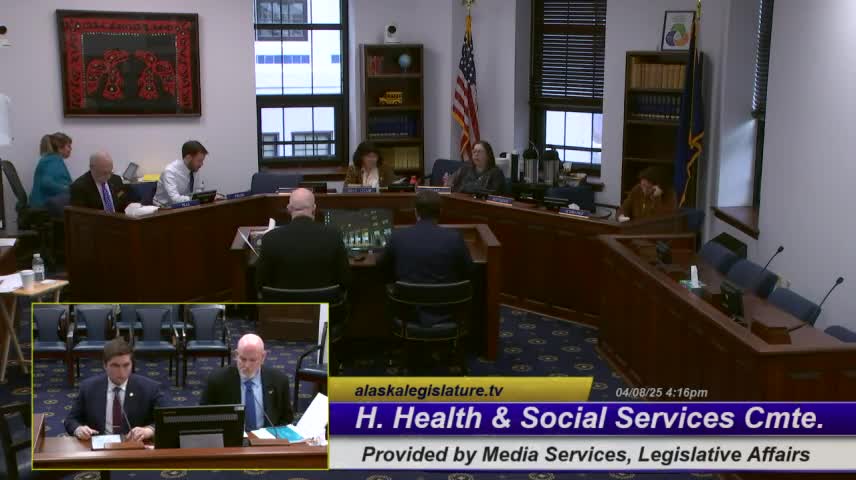
The House Health and Social Services Committee on April 8 rejected an amendment that would have barred providers from using an expedited prior‑authorization timeline for tests performed on equipment they own, then reported a committee substitute for HB 144 from committee.
The House Health and Social Services Committee on April 8 held a lengthy discussion on House Bill 144, a measure to add expedited timelines and other changes to prior authorization for certain medical services. Lawmakers debated a sponsor amendment that would deny the bill’s expedited prior‑authorization timeline to providers who would directly profit from performing the ordered test or procedure on equipment they own; that amendment failed on a 1–6 roll call. The committee later reported the committee substitute for HB 144 from committee with individual recommendations.
Rep. Justin Reffridge (bill sponsor) said HB 144 updates prior‑authorization timelines and seeks to improve patient access to care, particularly for chronic conditions and when patients change insurance coverage. He described the bill’s goals as reducing delays and the administrative burden on providers that handle repeated prior‑authorization requests.
Rep. Gray (amendment sponsor) offered Amendment No. 2 to prevent use of the expedited timeline when the ordering provider or an affiliated entity would directly profit from performing the procedure — an approach the sponsor said is intended to “disincentivize a type of self dealing that is common in Alaska.” Gray described a commonly referenced example: a cardiology group that owns an MRI used to scan its own patients and cited a 2009 study that estimated $2,500,000 in additional earnings over five years in one scenario. Gray said the amendment would not outlaw self‑referral, but would require providers who own the equipment to use the standard prior‑authorization timeline rather than the bill’s expedited pathway.
Supporters of the underlying bill, including Jared Cosen, president and CEO of the Alaska Hospital and Healthcare Association, argued the amendment would delay care for patients and create enforcement and implementation difficulties. Cosen said physician groups typically order imaging such as MRIs, CTs and other scans, and said the amendment’s language is vague enough that it could capture equipment or specialties beyond imaging. He told the committee penalizing patients because of their provider’s business model “makes no sense to us.”
Committee members raised concerns on both sides. Members representing rural areas and Federally Qualified Health Centers said access constraints in remote communities could make an exemption narrowly tailored to urban centers necessary; other members said carving out exemptions would lead to many more. Representative Mears and others expressed concern that enforcement could fall to the Division named in the bill and that the state would be put in a difficult position trying to implement a provider‑ownership test on prior‑authorization forms.
The committee took a roll call on Amendment No. 2. The transcript records the roll call responses: Representative Prox — No; Representative Reffridge — No; Representative Schwanke — No; Representative Meares — No; Representative Fields — No; Representative Gray — Yes; Chair Mina — No. The chair announced the tally as “1 yay and 6 nays,” and Amendment No. 2 failed.
After further discussion of the underlying bill and its intended administrative savings for providers and patients, a member moved to report the committee substitute for House Bill 144 (Work Order 34‑LS0780) from committee with individual recommendations; with no recorded objection, the committee passed the committee substitute from committee.
Quotes from the hearing included: “This amendment is not outlawing this conflict of interest,” Rep. Gray said, adding the amendment would allow hospitals and exempt institutions to continue using the expedited timeline. Jared Cosen said: “It makes no sense to penalize a patient and delay their time to when they're going to get health care based on whether or not their provider owns equipment.” Representative Reffridge described components of the prior‑authorization workload that the bill seeks to reduce, including duplicative authorizations when patients change insurance.
The committee scheduled its next meeting for April 10 at 3:15 p.m. and adjourned the hearing at about 5:01 p.m.