Get Full Government Meeting Transcripts, Videos, & Alerts Forever!
Get email alerts on the Residential Habilitation Centers topic
No spam. Unsubscribe anytime.
Appropriations Committee advances bill to close Rainier and Yakima Valley residential habilitation centers after contentious debate
Summary
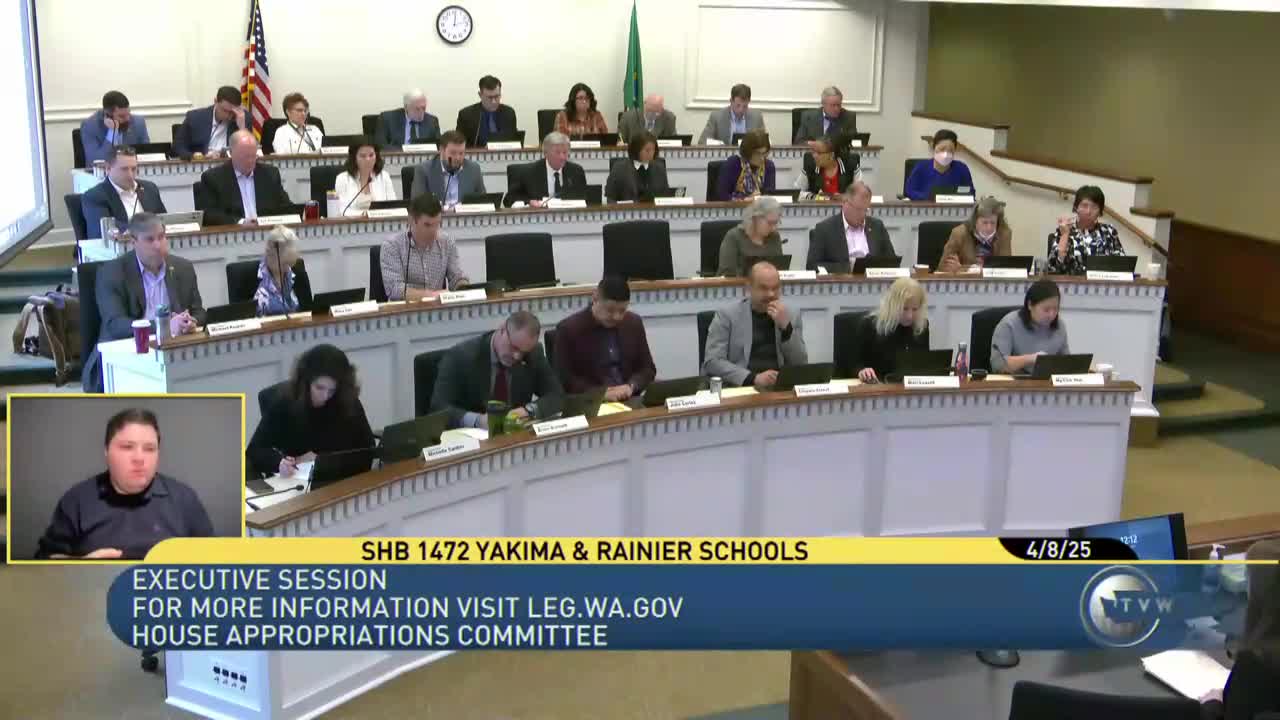
The Washington House Appropriations Committee voted 17-14 to report substitute House Bill 14-72, which would require the Department of Social and Health Services to transition residents out of Rainier School and Yakima Valley School and certify closures once safe, staffed community placements are confirmed.
The Washington House Appropriations Committee reported substitute House Bill 14-72 out of committee with a due-pass recommendation after a 17-14 vote, sending the proposal to the full House amid extended debate over whether the state is ready to close two residential habilitation centers.
The bill would require the Department of Social and Health Services (DSHS) to close Rainier School and Yakima Valley School after residents are transitioned to community settings and the agency certifies to the Legislature and governor that all residents have been safely placed. The Appropriations Committee adopted an amendment requiring individualized transition plans, coordination with other agencies, post-transition outcome monitoring and an independent annual outcome analysis.
Why it matters: The bill affects residents of the two RHCs, their families, and state employees who provide specialized care. Supporters say properly executed transitions can expand community-based services; critics say the state lacks sufficient community capacity and that premature closures risk harm to medically complex residents.
Discussion and key points
DSHS staff briefed the committee on likely implementation needs, saying the amendment’s requirements would “need 2.5 case managers, 4 HR staff, 1 project manager and $250,000 in contract support for at least 2 years,” and estimating an ongoing independent outcome contract of about $250,000 per year beginning in fiscal 2027. The staff emphasized those are unofficial estimates prepared on short notice.
Representative Bergquist, sponsor of the amendment the committee adopted, described it as procedural and protective: “This amendment focuses on making sure there are individualized transition plans, make sure there's coordination with other agencies,” she said, urging members to add oversight and monitoring rather than a bare deadline.
Representative Penner, who pressed for stronger reporting and a right-to-return safeguard, warned of risks if the state moves too quickly. “The facility should not close down without readiness,” Penner said. He urged guaranteed staffed, funded placements and post-transition reporting including numbers of failed placements and deaths that occur after transition.
Representative Caldier and others raised doubts about DSHS’s operational capacity. Caldier said the agency has a history of problematic transitions in other contexts and argued the bill needs more prescriptive protections. Representative Burnett likewise urged caution and additional clarity about what “community” placements would mean for each resident.
Opponents gave emotional testimony on the floor. Representative Tana S. Couture told the committee, “People will die as a result of this bill,” citing outcomes from other states and urging lawmakers to prioritize on-site improvements rather than closure.
What the committee did
- The committee rejected a more prescriptive amendment (referred to in committee materials as Harrington/Harrow 7-29) that would have created additional mandatory certification steps and timelines. That amendment failed on a roll call. - The committee adopted Harrington 7-28 (sponsor: Representative Bergquist), which articulates individualized transition planning, interagency coordination, funding/contracting for supports, oversight measures and regular monitoring of outcomes. - The committee approved the second substitute of House Bill 14-72 and reported it to the House floor with a due-pass recommendation by a 17-14 roll call vote.
Clarifying details from the hearing
- DSHS provided unofficial fiscal estimates tied to the adopted amendment: 2.5 case managers; 4 HR staff; one project manager; ~$250,000 in contract support for two years; and an annual independent outcome contract estimated at ~$250,000 beginning FY 2027. - The amendment removed a firm statutory closure date and instead requires certification that residents have been transitioned to safe, staffed, funded placements before final closure may be certified.
Community relevance and implementation risk
Geography: Statewide, focused on Rainier School (Pierce County area) and Yakima Valley School.
Impact groups: Residents of RHCs, families and guardians, state employees (direct support staff), community providers expected to receive transitions.
Implementation risk: High. Multiple members said final outcomes depend on workforce availability, local provider capacity, and detailed transition plans; opponents highlighted unresolved questions about clinical continuity and mortality risks.
What’s next
The bill now goes to the full House with committee-requested reporting and timetable changes reflected in the adopted amendment. Lawmakers, agency staff and stakeholders signaled the need for continued oversight and additional planning before any final facility closures.
Speakers
["name":"Yolanda Baker","role_title":"Staff, Rules and Judiciary Committee","affiliation_type":"government"],["name":"DSHS staff","role_title":"Department of Social and Health Services staff","affiliation_type":"government"],["name":"Representative Tana S. Couture","role_title":"State Representative","affiliation_type":"government"],["name":"Representative Penner","role_title":"State Representative","affiliation_type":"government"],["name":"Representative Bergquist","role_title":"State Representative","affiliation_type":"government"],["name":"Representative Caldier","role_title":"State Representative","affiliation_type":"government"],["name":"Representative Burnett","role_title":"State Representative","affiliation_type":"government"}]
Authorities
[]
Actions
[{"kind":"other","identifiers":{"agenda_item_id":"15","project_slug":"hb-14-72"},"motion":"Report second substitute House Bill 14-72 out of committee with a due pass recommendation (as amended)","mover":"Vice Chair Macri","second":null,"vote_record":null,"tally":{"yes":17,"no":14,"abstain":0},"outcome":"approved","notes":"Amendment Harrington 7-28 adopted; Harrington 7-29 failed"}]
Clarifying_details
[{"category":"DSHS implementation estimate","detail":"Unofficial estimates provided by DSHS for adopted amendment: 2.5 case managers, 4 HR staff, 1 project manager, $250,000 in contract support for at least 2 years","value":250000,"units":"USD","approximate":true,"source_speaker":"DSHS staff"},{"category":"independent evaluation cost","detail":"DSHS estimated annual independent outcome contract beginning 07/01/2027","value":250000,"units":"USD","approximate":true,"source_speaker":"DSHS staff"}]
Proper_names
[{"name":"Rainier School","type":"facility"},{"name":"Yakima Valley School","type":"facility"},{"name":"Department of Social and Health Services","type":"agency"}]
Community_relevance
{"geographies":["statewide","Pierce County","Yakima County"],"funding_sources":[],"impact_groups":["residents of RHCs","families and guardians","state direct support staff","community providers"]}
Meeting_context
{"engagement_level":{"speakers_count":10,"duration_minutes":120,"items_count":1},"implementation_risk":"high","history":[{"date":"prior sessions","note":"RHC closure discussions in previous sessions and hearings"}]}