PennDOT-funded Trumbull (Cumberland) Drive bridge set for design, borough’s share capped at 5%
Loading...
Summary
Consultants told the Green Tree Borough Council the fracture‑critical Trumbull (Cumberland) Drive bridge is inspected every six months and the project has secured PennDOT funding; construction is expected to be let in late 2026 with construction likely in 2027, and the borough’s maximum share is 5% (budgeted at $350,000).
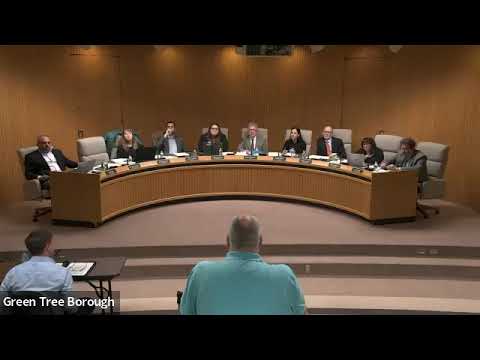
Green Tree — Consultants updated the Green Tree Borough Council on the replacement of the Trumbull (also referred to as Cumberland) Drive bridge, saying the existing structure is inspected every six months and that PennDOT has moved the project forward for full funding and design.
Chris Wilmer, project manager with Gannett Fleming, told council the bridge is a fracture‑critical, two‑girder structure and “it is inspected on a 6 month frequency,” adding the bridge’s superstructure condition rating is currently a 4 on the 10‑point scale. “It is currently not posted. It is safe and has capacity to carry legal loads without a post in. And, again, that's all monitored on a 6 month basis through the inspection process,” Wilmer said.
Why it matters: council members and residents have pressed for clarity on the bridge’s safety and the project’s cost and timing. The consultant said PennDOT is providing the bulk of construction funding under its program (approximately 80% of approved project cost), while the borough’s statutory or programmatic maximum contribution is 5% of the total construction cost. Borough staff said the borough has budgeted $350,000 in bond proceeds and has identified an additional $500,000 in grant proceeds that may be applied toward the local share.
Key facts and schedule
• Current condition and monitoring: Wilmer said the structure’s superstructure rating remains at 4 from previous inspections; PennDOT inspects the bridge twice a year because of the fracture‑critical details and closely monitors seated connections shown in inspection reports.
• Funding approval: Consultants said PennDOT’s District Program Management Committee (DPMC) and central office approvals were in progress; the project was taken to DPMC to obtain additional funds after construction and escalation estimates rose. Wilmer said the construction cost estimate has increased from prior estimates based on inflation and market conditions; consultants gave an example range that moved from roughly $5–6 million (based on earlier pricing) to approximately $6.6 million–$7 million in current 2026 dollars, and they cautioned costs could rise if construction is delayed further.
• Borough share and reimbursement: Borough staff reiterated the borough’s expected local share is 5% of the final construction cost. Council was told the program is a reimbursement mechanism: costs are paid and reimbursed through PennDOT’s ECMS/ECMS‑style reimbursement system as invoices are submitted.
• Right‑of‑way and railroad coordination: Wilmer said right‑of‑way and temporary construction easements will be required in three quadrants of the bridge footprint, and a separate agreement will be needed with the railroad for a slope easement. Railroad coordination has begun and the consultant said the railroad has been cooperative to date; the consultant added right‑of‑way acquisition typically takes 12–18 months after an approved ROW plan.
• Schedule: The consultant said notice to proceed on final design had been issued and that, because construction funding is not available until 2027, the project will be advertised (a let date) at the end of 2026 with anticipated contractor work during the 2027 season; typical construction could take one season, with partial punchlist work extending into spring 2028.
Questions from council and residents
Council members pressed for detail on the estimates and the borough’s exposure if costs rise. In response, Wilmer and borough staff said the state/federal funding program generally covers the majority of construction, but if final costs increase beyond the awarded amount PennDOT must approve any additional funding via its internal TPMC/DPMC process and the borough could be asked to confirm its share when/if that occurs. Borough staff said they were told the funding approval from central office was expected imminently.
Council also asked what would happen if the bridge condition worsened before construction. Wilmer said the next step would be an engineering analysis; that could lead to a posting (lower legal limits) or, in an extreme and unlikely case, a closure if the structure lost capacity before repairs or replacement.
Construction impacts and communications
Consultants said the project will be staged so traffic is maintained about 99% of the time; there will be up to four or five short closures, planned at night or on weekends, for removal of the existing bridge and beam setting. Wilmer said contractors will be required to notify the borough, neighboring businesses, emergency services and other stakeholders well in advance of any closures and the borough will issue public notices at major milestones.
Clarifying details
• Estimated construction cost (presented): roughly $6.6M–$7.0M (2026 dollars); consultants noted escalation risk and used a working figure of $7M in planning; council was told costs could increase if bids or market escalation move higher before letting.
• Borough maximum share: 5% of final construction cost (the borough has $350,000 budgeted plus approximately $500,000 in identified grant proceeds that could apply).
• Right‑of‑way: multiple permanent slope easements, permanent guide‑rail easements, and temporary construction easements are required; at least one railroad easement will be negotiated.
What’s next
Consultants offered to provide regular milestone updates to council. Borough staff said they will continue to monitor central office funding approval and the right‑of‑way plan; design is under way and the borough expects continued coordination with PennDOT, the railroad and affected property owners.
Ending: The council received the presentation without taking an immediate formal vote on the project itself; several council members asked staff to return with updates as the PennDOT funding authorization and right‑of‑way work progress.