Get Full Government Meeting Transcripts, Videos, & Alerts Forever!
Get email alerts on the Education topic
No spam. Unsubscribe anytime.
HEC outlines governor—s 2025-27 institutional budget: formulas, capital and workforce investments
Summary
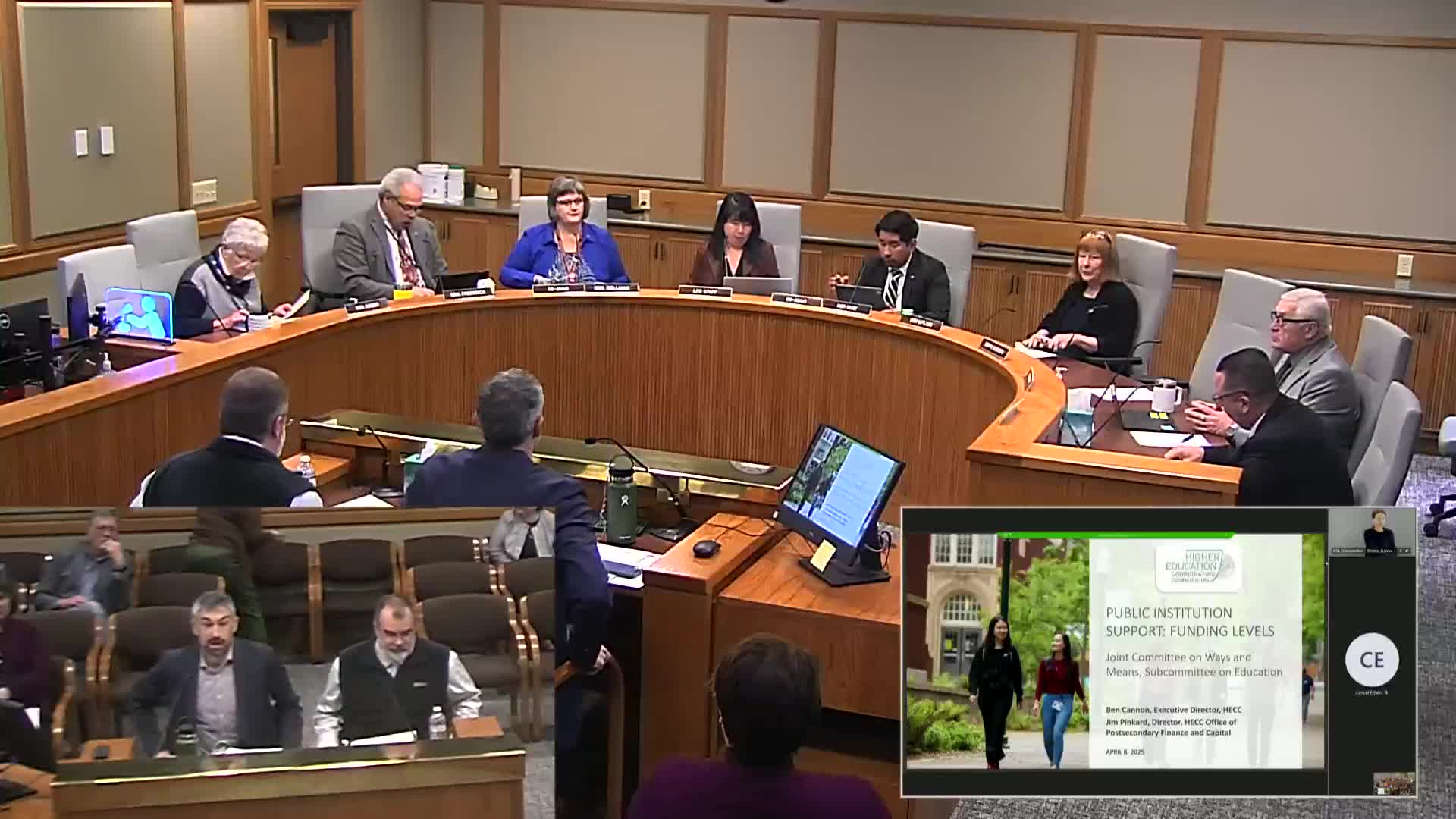
The Higher Education Coordinating Commission briefed the Ways and Means Subcommittee on Education April 8 on the governor—s 2025-27 budget recommendation for public colleges and universities, focusing on institutional operating support, capital needs and workforce investments in Senate Bill 5,525.
The Higher Education Coordinating Commission (HEC) briefed the Legislature—s Ways and Means Subcommittee on Education on April 8 on the governor—s 2025-27 budget proposal for public higher education, focusing on institutional operating support, capital needs and workforce investments contained in Senate Bill 5,525.
HEC Executive Director Ben Cannon said the presentation concentrated on the state—s investment in institutions — public universities, community colleges and local workforce boards — and how those dollars flow through the Public University Support Fund and the Community College Support Fund. "It's one of the shorthand ways we refer to colleges and universities," Cannon said, introducing the agency—s budget overview.
The nut graf: The commission told the subcommittee that sustained state funding affects affordability and student outcomes, and that recent changes to distribution formulas shift some funding from enrollment counts to outcomes and student success incentives. HEC officials said that shift is intended to promote degree completion, especially for priority populations, while capital and workforce investments are intended to address deferred maintenance and labor-market needs.
Major budget figures and structure HEC staff described the Community College Support Fund (CCSF) in the governor—s recommended budget as roughly $854,400,000 in general fund for 2025-27 and said the CCSF plus related debt service are the largest single parts of the HEC budget. Debt service for previously approved community college capital projects was listed at about $61,700,000. The Public University Support Fund (PUSF) was described as just over $1 billion in the recommendation, representing about 24.6% of HEC—s total recommended budget; previously approved university debt service for the biennium was cited at about $563,100,000 (with roughly $200,000,000 of that in other funds the universities themselves manage).
Cost drivers and funding gaps HEC noted projected cost increases from institutions: an estimated 11.6% increase for community colleges and 10.3% for public universities from one biennium to the next. Jim Pinkard, director of HEC—s Office of Postsecondary Finance and Capital, said the majority of those increases are wages and benefits. "Eighty-three percent of that cost increase is related to wages, wages and benefits," Pinkard said. By contrast, the governor—s recommended general fund growth rate HEC showed was about 7.3% (HEC staff said that difference creates a budget gap of tens of millions of dollars for each sector).
Formulas and outcomes-based funding HEC emphasized recent changes to funding distribution. Pinkard explained the public university funding formula (the student success and completion model) divides funds into base mission support and activity/outcomes components; the outcomes-based portion is designed to reward degree completions and additional weights for priority populations and high-cost fields such as engineering and health care. "An undergraduate resident degree completed by a student who started and finished at the same institution is worth this fiscal year $11,102 under this formula," Pinkard told the committee. HEC staff said about 76% of PUSF formula dollars flow to the three largest universities (University of Oregon, Oregon State and Portland State) and the remainder to regional technical universities.
Community college formula changes HEC described a multi-year formula review that added two set-asides for student support and student success in the CCSF distribution. Staff said the implementation path will increase the share of CCSF dedicated to student support and success to about 10% of the total over time. HEC also noted the CCSF now funds applied baccalaureate nursing degrees after passage of Senate Bill 15 52 (2024): 10 programs at eight colleges with a maximum anticipated enrollment of 237 students; HEC estimated that, at full enrollment, the change could reallocate roughly $1.5 million (about four-tenths of one percentage point) within the CCSF.
Regional University Planning and Support Fund and one-time items Staff described a $24.9 million Regional University Planning and Support Fund created in the current biennium; $6.2 million was automatically distributed through the PUSF formula and the remainder awarded through grants to several institutions. HEC said the grants are reimbursement-based contracts and that it has requested reappropriation of about $11.5 million in general fund in the 2025-27 budget to finish projects that HEC estimates could yield about $88 million in savings over time.
Capital and deferred maintenance HEC staff outlined capital priorities and the capital improvement and renewal (CIR) program, noting the state-funded investments of recent biennia have reduced the facility-condition index for public universities from about 20% (15 years ago) to roughly 10% today. HEC included summary information on Article XI-F and Article XI-Q bond proposals and said the governor—s request includes a $200 million CIR allocation as a top priority for public universities. For community colleges the governor—s request included about $20 million in other funds limitation for three projects (classroom and lab renovations and ADA remediation) and noted those community college projects require local matches.
Workforce investments HEC described workforce funding history and recent state investments that supplement fairly flat federal WIOA allocations. The commission summarized that the HEC-administered workforce budget was just over $300 million in the 2023-25 legislatively approved budget and the governor's recommended budget shows it just under $300 million for 2025-27. The governor—s proposed new investments highlighted by HEC include $25.7 million for behavioral health workforce development (split as $5 million for scholarships and $20 million for grants to training providers) and $5 million for pre-apprenticeship support in construction and housing fields.
Corrections and data tools Cannon corrected an earlier figure in materials: "It's 45,000, not 4,500," he said, referring to the number of Oregonians served by the Future Ready Oregon initiative shown on a slide. HEC also promoted a postsecondary employment outcomes tool developed with the U.S. Census Bureau that links education records to tax/census data to show wage and geographic outcomes for graduates.
Next steps HEC staff told the subcommittee that community colleges, public universities and local workforce boards will provide additional hearings and public testimony in coming days and weeks. The presentation concluded with staff offering to provide more detail on request, including federal research-grant funding levels for universities and specifics behind newly identified unfunded requirements for community colleges.
Ending: The subcommittee adjourned after HEC concluded its scheduled briefing and announced additional public testimony dates.