Get Full Government Meeting Transcripts, Videos, & Alerts Forever!
Get email alerts on the Water Quality topic
No spam. Unsubscribe anytime.
DEQ summarizes water‑quality programs, monitoring and TMDL work; flags federal shortfall
Summary
Jennifer Weigel, DEQ water quality administrator, told the Natural Resources Subcommittee on April 8 that water quality work spans monitoring, standards, permits and TMDLs, that monitoring informs a biennial integrated report, and that DEQ faces a small federal grant shortfall equal to roughly one FTE for the coming biennium.
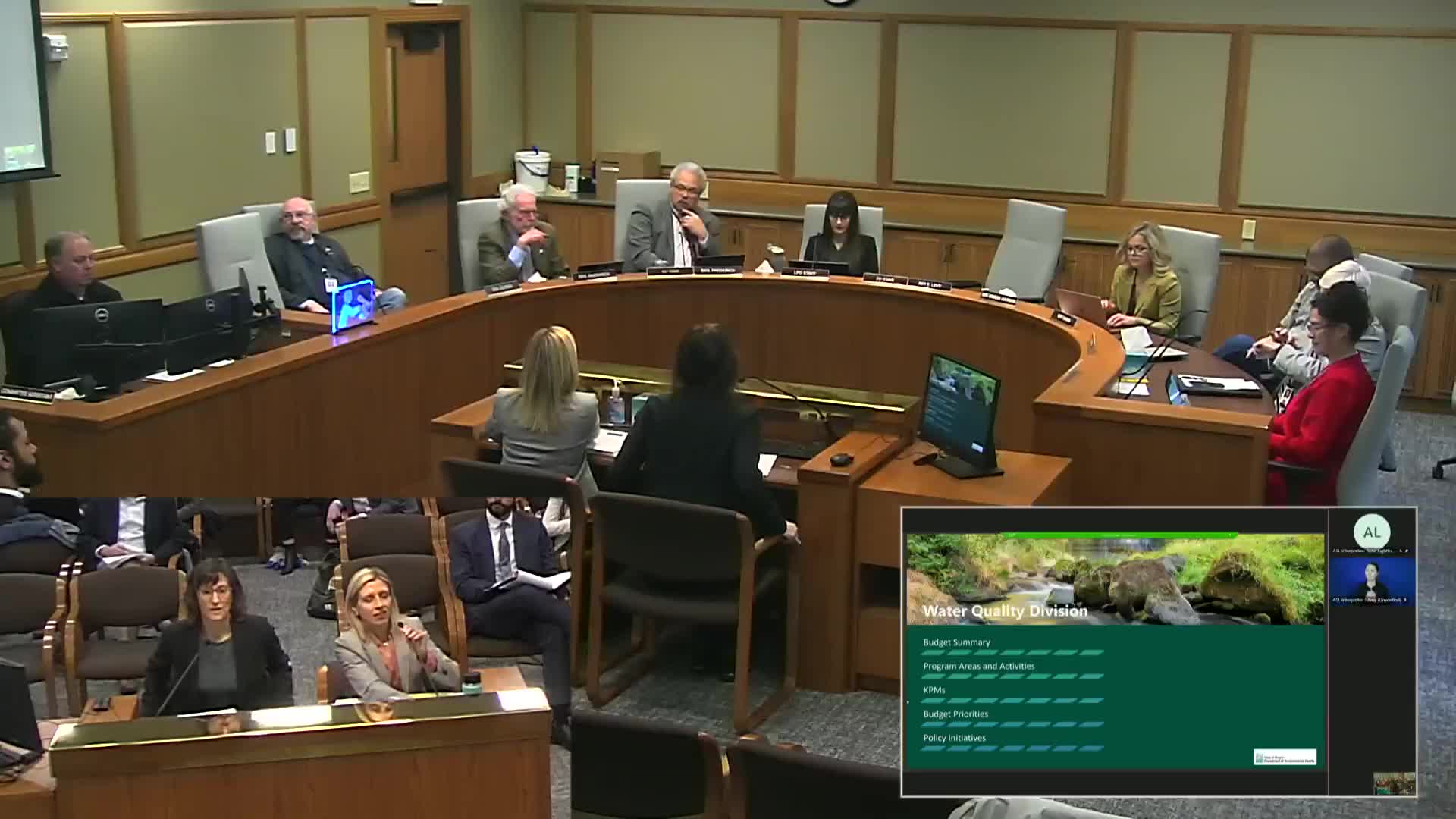
Jennifer Weigel, water quality administrator at the Oregon Department of Environmental Quality, briefed the Natural Resources Subcommittee on April 8 on the scope of DEQ’s water quality work, the agency’s funding mix and monitoring‑based decisions that lead to total maximum daily loads (TMDLs).
"For the record, my name is Jennifer Weigel," she said when introducing the overview. Weigel told lawmakers that water quality has many subprograms working to protect surface water and groundwater, and that DEQ uses monitoring, assessments and permitting to identify and address impairments.
DEQ said water quality’s budget differs from Land Quality: general funds make up roughly 42% of the water budget, federal funds about 17% and lottery funds about 6.5%; other funds (largely permitting fees) support much of wastewater permitting. The agency also cited ORS 468B.051 as the statute authorizing up to 3% annual fee increases for many water quality permitting, certification and licensing fees.
Weigel described the department’s biennial integrated report, which aggregates millions of monitoring data points to map statewide conditions and identify waters that do not meet water quality standards. Where standards are not met, DEQ develops clean water plans (TMDLs) that allocate pollutant loads across sources and responsible entities. "This plan is essentially a pollution diet that describes the maximum amount of pollutants from all contributing sources that can enter the river or stream without exceeding water quality standards," Weigel said.
Lawmakers asked how often standards are updated and how DEQ adapts to climate and seasonal variability. Weigel said the state is required to review standards every three years and that restoration work, particularly for temperature TMDLs, is often long and costly because it can require riparian restoration and years for vegetation to mature.
On temperature specifically, committee members raised concerns about natural conditions and seasonal timing for measurements in arid parts of eastern Oregon. Weigel said DEQ collects year‑round temperature data and focuses on protecting streams during the warmest, lowest‑flow months; she noted litigation has constrained some regulatory flexibility on natural condition adjustments and said DEQ tries to focus allocations on the anthropogenic increment of warming rather than natural background.
Weigel also told the committee that the Clean Water Act program faces a federal fund shortfall roughly equivalent to one FTE in the upcoming biennium because federal grant amounts have not kept pace with inflation. The department said EPA grant levels have been flat for years, putting pressure on staffing funded by those grants.
Ending: Weigel told the committee DEQ would continue the water program the next day and requested the subcommittee’s attention to monitoring, TMDL priorities and the federal funding shortfall as the agency finalizes budget requests.