Get Full Government Meeting Transcripts, Videos, & Alerts Forever!
Get email alerts on the Groundwater Quality topic
No spam. Unsubscribe anytime.
Senate committee advances overhaul of groundwater-quality law after hours of testimony
Summary
The Senate Committee on Natural Resources and Wildfire adopted an amendment to Senate Bill 11‑54 and moved the measure to the Rules Committee after a lengthy public hearing featuring farmers, county officials, environmental groups and rural residents who disagreed over private‑property protections and agency authority.
Salem, Ore. — The Senate Committee on Natural Resources and Wildfire voted Wednesday to adopt an amendment to Senate Bill 11‑54 and moved the bill, as amended, to the Rules Committee without a recommendation, after more than three hours of invited testimony and public comment.
The bill would revise the Oregon Groundwater Quality Protection Act to create a new “area of concern” designation intended to allow earlier, more targeted responses to contamination; require an interagency team to develop action plans when contamination reaches trigger levels; and shift certain designation authority from the Department of Environmental Quality to the Environmental Quality Commission, the bill’s supporters said.
The proposals aim to address what the Governor’s office and agency staff described as long‑standing gaps in the state’s groundwater protection framework. “SB 11‑54 represents very important subjects that are long overdue for conversation and action,” Chandra Ferrari, a natural resources policy adviser in the Governor’s office, told the committee.
Why it matters
The committee heard competing appeals about who should control monitoring and response. Supporters said the current Groundwater Quality Protection Act (1989) lacks tools to intervene early and coordinate agencies when wells and aquifers show early signs of contamination. Opponents, including many private well owners and some agricultural groups, urged the Legislature to protect property rights and guard against what they described as intrusive agency access to private land.
What the bill would do
Supporters highlighted three broad functions in the amended bill: 1) a clearer, more useful “area of concern” designation so communities can act before reaching critical contamination thresholds; 2) a prescribed, interagency response and an “all‑hands” toolbox for remediation when designations occur; and 3) enhanced accountability, including public reporting and a requirement that agencies return to the Governor and Legislature with resource requests to implement action plans. Ferrari said the amendment also clarifies that the measure does not require measurement or reporting of exempt domestic wells and that some controversial provisions will be reworked in a future dash‑2 amendment.
Testimony and concerns
Local elected officials and county commissioners urged additional time and resources for implementation. Deschutes County Commissioner Phil Chang told the committee that the La Pine subbasin faces a rising nitrate threat and that past local efforts — monitoring, incentives and permitting changes — have not kept pace: “By the time DEQ designates a groundwater management area, water quality is so degraded that recovery will be a very long, expensive, demanding and uncertain process,” Chang said.
Supporters from community groups emphasized public‑health and environmental‑justice stakes. Caleb Lay of Oregon Rural Action said residents in the Lower Umatilla Basin have suffered for decades and that “we have seen firsthand the almost indescribable human costs of the failures of the Groundwater Quality Protection Act.” Cheyenne Holiday of Verde said the bill strengthens local advisory committees and brings community voices into response planning: “When local knowledge and lived experience are brought into the process early, outcomes are better, more equitable, and longer lasting.”
Opponents — including a string of private well owners, irrigators and trade groups — called the bill overly broad and warned that several provisions in the dash‑1 amendment could erode private property rights. Many speakers objected to language they said could permit agency inspection of on‑site septic systems and to mandatory monitoring or metering of private wells. Several commenters described the proposal as an overreach and asked for safeguards, clearer limits on agency access and financial assistance for compliance or remediation.
Committee action and next steps
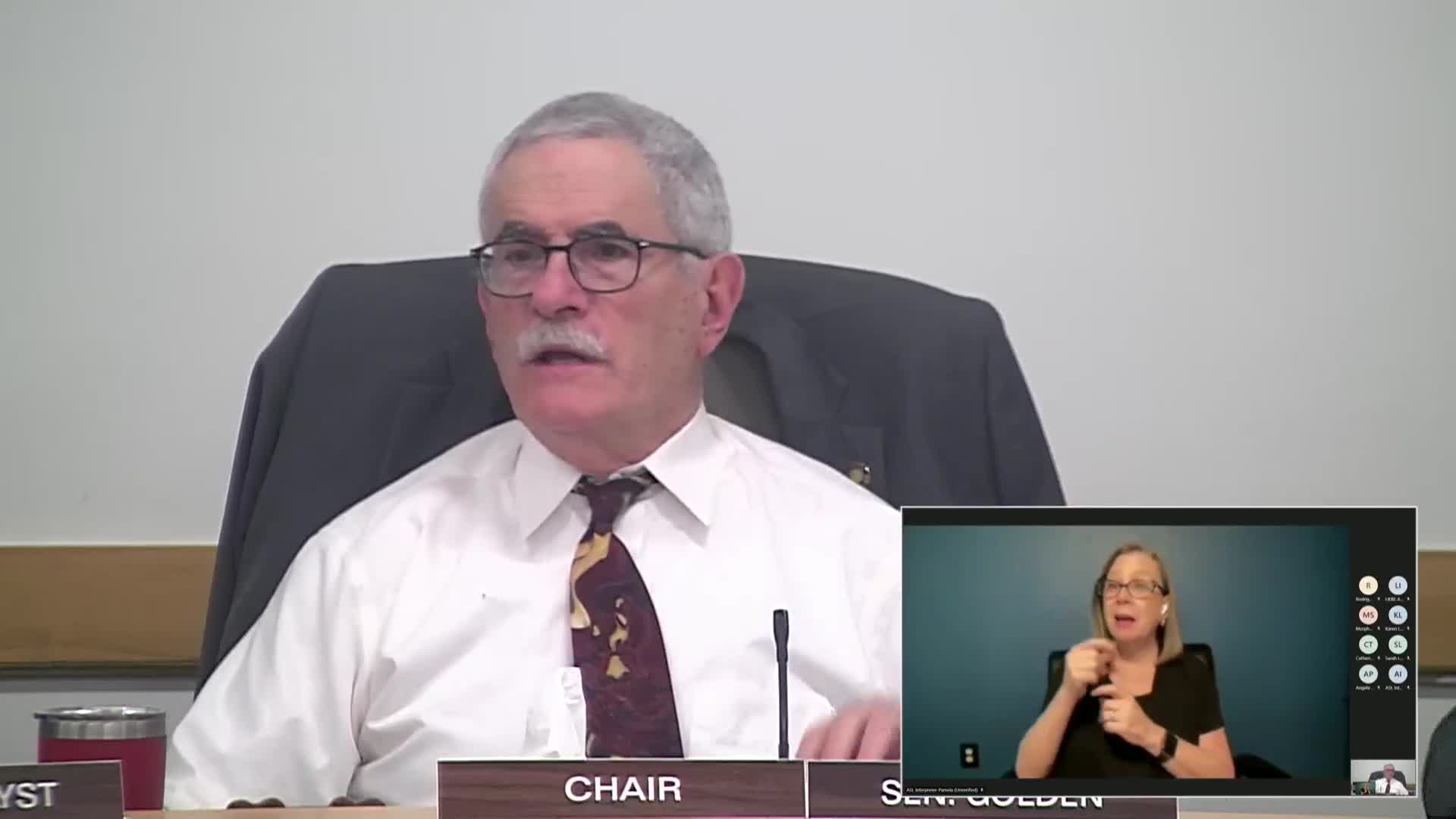
The committee first adopted the dash‑1 amendment by roll call. It then voted to move SB 11‑54 as amended to the Rules Committee without recommendation. Chair Golden and Vice Chair Nash both indicated the bill will proceed to further stakeholder work; the Governor’s office said it expects additional revisions (a dash‑2) to address remaining concerns. Several legislators on both sides asked that co‑chairs of the bicameral water caucus be kept closely involved as the measure moves forward.
Votes at a glance (work‑session outcomes reported to the committee)
- SB 11‑54 (groundwater quality; dash‑1 amendment): amendment adopted; SB 11‑54 as amended moved without recommendation to Rules (final roll call: majority yes; Senator Brown recorded as no). - SB 427 (prohibits transfers that diminish stream flow): moved without recommendation to Rules (adopted by roll call). - SB 1153 (limits water‑right transfers that harm habitat or water quality; tribal review option): moved to Rules with recommendation. - SB 83 (wildfire map and related provisions; dash‑9 amendment): amendment adopted; bill as amended moved to the Senate floor with a due‑pass recommendation; referral to Joint Ways and Means rescinded. - SB 85 (community wildfire risk mitigation; dash‑2): amendment adopted; bill as amended moved to floor with due‑pass; referral to Joint Ways and Means rescinded. - SB 1019 (brand inspection fee changes; dash‑6): amendment adopted; bill as amended moved to floor and referred to Joint Ways and Means. - SB 147 (renames Elliott State Forest; dash‑3): amendment adopted; bill as amended moved to Joint Ways and Means. - SB 74 (Department of State Lands navigability rules; dash‑6): amendment adopted; bill as amended moved to the floor with due‑pass recommendation. - SB 1076 (animal breeder licensing; dash‑1): amendment adopted; bill as amended moved to Joint Ways and Means.
Sources and clarifying details
- The Governor’s office and staff repeatedly referenced the Oregon Groundwater Quality Protection Act (1989) as the statute the bill would update. (Chandra Ferrari) - The presentation cited several statewide context figures: groundwater provides roughly 95% of Oregon’s freshwater resources; about 80% of withdrawn groundwater is used for agriculture; approximately 80% of Oregonians rely on groundwater in whole or part and about 23% rely on private wells (roughly 1,000,000 residents). The Governor’s office said the state spent more than $8 million in the last biennium to provide clean drinking water in impacted areas. (Chandra Ferrari) - The bill creates a lower‑threshold “area of concern” designation (a “yellow light”) aimed at encouraging voluntary local plans and monitoring before a formal “groundwater management area” designation (a “red light”). (Governor’s office testimony)
Ending
Committee members and witnesses agreed on the importance of protecting groundwater; they sharply disagreed on how much authority to give state agencies and what procedural protections and financial support should accompany any new powers. The committee’s referral sends the amended bill to Rules, where sponsors and stakeholders expect further revisions and extended negotiations before any final floor action.
(Reporting here is limited to statements made on the record at the April 7–8, 2025 meeting of the Senate Committee on Natural Resources and Wildfire.)