Get Full Government Meeting Transcripts, Videos, & Alerts Forever!
Get email alerts on the Land Quality topic
No spam. Unsubscribe anytime.
DEQ outlines land-quality budget, staffing requests and cleanup priorities
Summary
The Oregon Department of Environmental Quality told the Natural Resources Subcommittee on April 8 that the Land Quality Division’s work is largely fee-funded, that several policy option packages would add or make permanent staff, and that cleanup and recycling programs face performance gaps and multi-year projects.
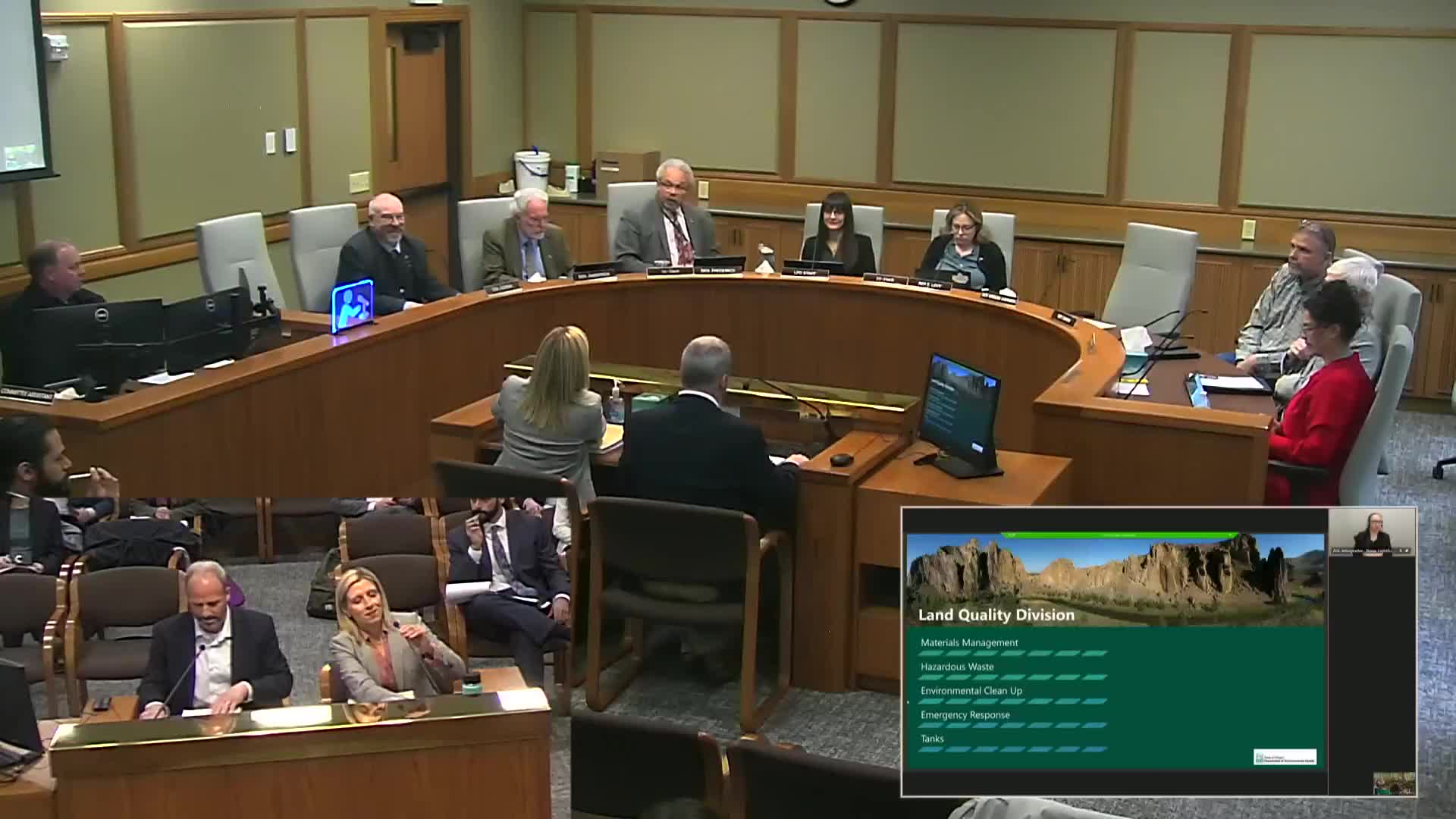
Leah Feldon, director of the Oregon Department of Environmental Quality, told the Natural Resources Subcommittee on April 8 that the department’s Land Quality Division oversees materials management, hazardous waste, environmental cleanup, emergency response and tanks programs and is asking for position authority to carry out several multi‑year projects.
The request matters because most of Land Quality’s budget is supported by dedicated fees rather than general fund dollars, the division said, and several cleanups and program rollouts will require staff and multi‑year oversight. "Land quality is a coordinated group of programs encompassing these 5 areas," interim Land Quality Administrator Mike Kuczynski said during the presentation.
DEQ officials walked lawmakers through the division’s budget makeup and several policy option packages that would add or convert positions to support ongoing work. Land Quality’s budget is funded roughly 91% by other funds (about $133,000,000), 7% by federal grants (about $10,000,000) and roughly 2% by general funds (about $3,500,000), the agency said. About half of the division’s limitation pays for staff salaries and benefits; service and supply contracts also make up a large share of spending because DEQ relies on contractors for cleanup work.
The materials management program implements Oregon’s 2050 vision for materials management and the Plastic Pollution and Recycling Modernization Act (Senate Bill 582). DEQ said the Recycling Modernization Act will begin rolling out July 1 and will create a uniform statewide recycling list and require producers to participate in and fund producer responsibility programs. "A uniform collection list will provide clarity to households and businesses about what can be recycled," the interim administrator said.
DEQ presented performance metrics that show gaps between legislative targets and recent results. For example, the division’s 2024 waste generation target was 4.5 million tons; DEQ reported more than 6 million tons generated. The 2024 waste recovery target was 50%; actual recovery was slightly above 39%. Agency staff pointed to changes in international recycling markets starting in 2017 and said the Recycling Modernization Act is expected to improve recovery rates.
On environmental cleanup, DEQ described three cleanup pathways: voluntary cleanups (usually tied to property sales), the Industrial Orphans Program (sites where responsible parties are unknown or unable to pay), and brownfields assistance supported in part by federal funds and partner agencies. The department described two large, high‑priority cleanup sites — Columbia Slough and Armstrong World Industries near St. Helens — and said one policy option package (POP 131) would add three positions to oversee work at those sites. The department said the positions would be funded by other‑fund revenue arising from legal settlements for those specific sites and that the positions are necessary to complete the cleanups.
DEQ also discussed the orphan site program and said it needs expenditure limitation for $10,000,000 secured in the 2023 legislative session (POP 134) to continue orphan site cleanup work funded by bond sales.
Emergency response staff described routine spill work and preparedness. DEQ said duty officers handle reports 24/7 and that the agency responds to more than 1,500 incidents a year. The department noted the 2019 Mosier train derailment and a recent mystery oily event that required 113 responders from 14 agencies and companies.
Tanks programs include the fuel tank seismic stability program (established by Senate Bill 1567 in 2022), a residential heating oil tank decommissioning program and an underground storage tank program (about 1,600 facilities and more than 5,200 regulated tanks). DEQ said it is implementing rulemaking to increase testing and oversight of newer fiberglass double‑walled tanks and is seeking to make some limited‑duration positions permanent to sustain cleanup obligations.
Lawmakers asked whether fee revenue will cover the requested positions. DEQ told the committee that most requested positions would be funded with existing other‑fund revenue and legal settlement proceeds, and that the agency is not projecting fee increases in this biennium to cover the additions. Lawmakers pressed on whether positions are new or conversions from limited‑duration status; DEQ said some requested positions would make limited‑duration roles permanent and others are new, site‑specific oversight positions tied to settlements.
DEQ flagged that materials management has a single policy option package (POP 133) to provide staffing to carry out existing work under the 2050 vision and that without that package, the agency said it would be limited in its ability to meet the vision’s outcomes. The agency also pointed to successes using the prospective purchaser agreement program to encourage brownfields redevelopment.
Ending: DEQ told the subcommittee that several of the package requests are funded from existing other funds or settlement proceeds and emphasized that cleanup and contractor‑heavy work are multi‑year efforts requiring ongoing oversight. The committee paused the water program for continuation the following day.