Get Full Government Meeting Transcripts, Videos, & Alerts Forever!
Get email alerts on the Foreclosure Surplus Proceeds topic
No spam. Unsubscribe anytime.
Lawmakers weigh bill to create claims path for foreclosure surplus after Tyler v. Hennepin
Summary
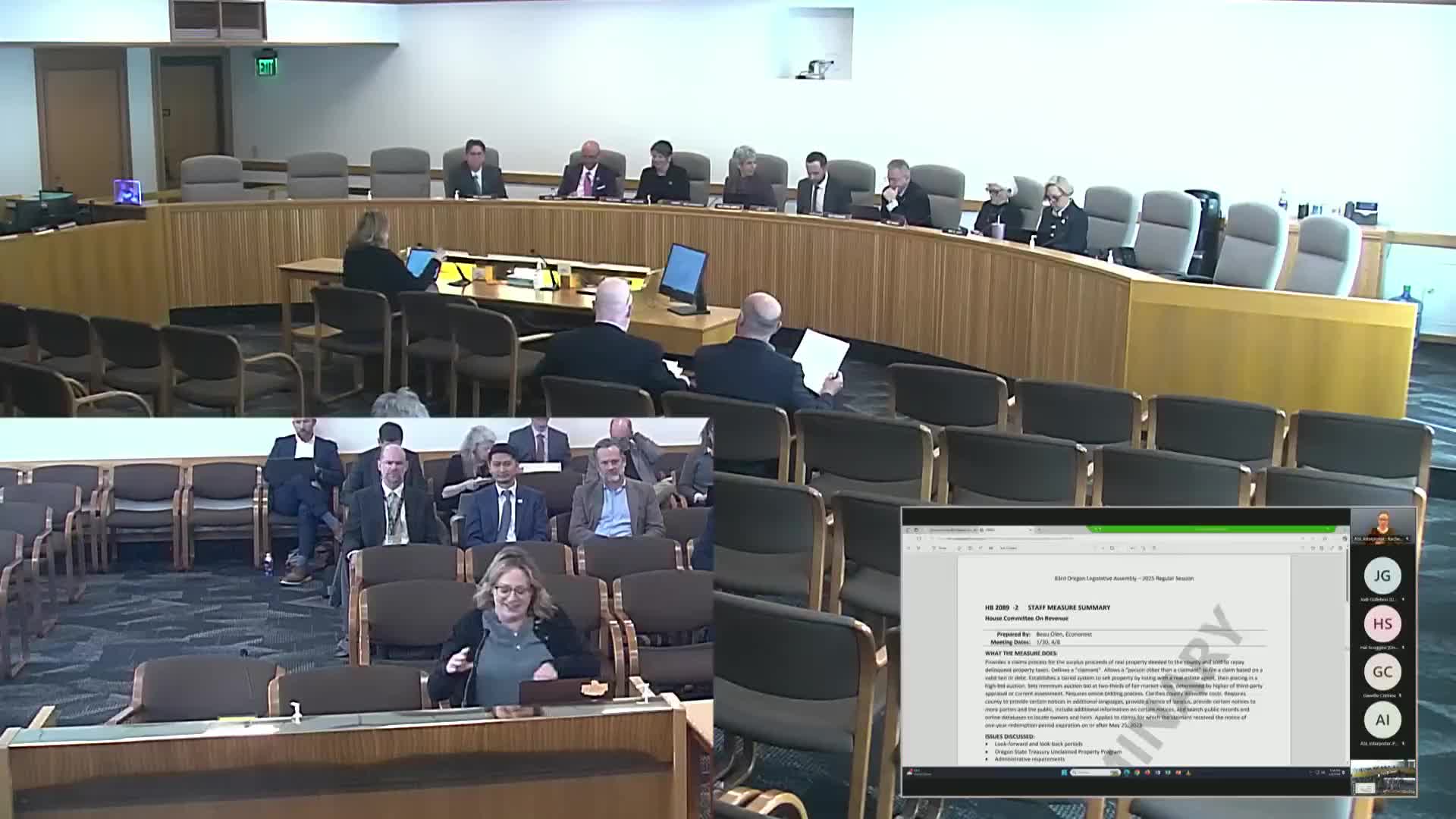
House Committee on Revenue members heard extended testimony on House Bill 2,089, a measure the sponsor said responds to the U.S. Supreme Court's decision in Tyler v. Hennepin County by creating a statutory pathway for owners to claim surplus proceeds from tax-foreclosure sales.
House Committee on Revenue members heard extended testimony on House Bill 2,089, a measure the sponsor said responds to the U.S. Supreme Court's decision in Tyler v. Hennepin County by creating a statutory pathway for owners to claim surplus proceeds from tax-foreclosure sales.
Representative Emerson Levy, sponsor, said the bill provides a claims process through the Oregon State Treasury's unclaimed property program for surplus proceeds when a county sells real property to satisfy delinquent property taxes. The bill applies to claims for which the claimant received notice that the statutory one-year redemption period expired on or after May 25, 2023, Levy said; dash 2 and dash 3 amendments address technical and court-suggested refinements.
County representatives generally said they supported the stakeholder-driven revisions but outlined administrative and fiscal concerns. Justin Lowe of the Association of Oregon Counties (AOC) said his group opposed the introduced version but was neutral on the dash-2 amendment and appreciated the sponsor's work to incorporate county feedback. Lowe warned that added notice and procedural requirements could raise county costs and that counties may have to absorb expenses if property does not sell.
Marion County assistant legal counsel Scott Norris and Seminole County assistant county counsel Jody Golahon asked for specific changes. Norris said the bill requires counties to attempt to retain a real estate agent at least three times before auction and asked for an exemption from public contracting rules to avoid repeated procurement processes; Golahon objected to three provisions that require third-party appraisals, citing administrative cost, potential depletion of surplus proceeds for claimants and legal complications with property revaluation and post-sale appeals under ORS 305.288 if appraisals differ significantly.
Advocates for homeowners and older adults urged strong notice and sale procedures. Jim Manley, state policy chief for Pacific Legal Foundation (which represented Ms. Tyler in the Supreme Court case), said robust notice and a requirement that counties attempt to sell through a real estate agent are important to maximize recovery for owners; he noted that Maine uses a similar approach and that agents are paid by commission only if the property sells. Andrea Meyer, director of government relations at AARP Oregon, emphasized older homeowners' vulnerability and supported protections including a realtor requirement and translations of notices into multiple languages; witnesses agreed to accept 14-point font after debate on font size.
Lenders and lienholders warned of constitutional and practical concerns. Harold Scoggins, an attorney representing GoWest Credit Union Association, and John Powell of the Oregon Bankers Association said lenders could have legitimate claims to surplus proceeds in rare cases and urged the Legislature to consider whether lienholders should be able to assert claims to avoid future litigation. Both groups said the bill, as drafted, could invite takings or other constitutional litigation if lienholders lack a clear statutory path.
Oregon State Treasury staff described operational plans. Claudia Chobanu, trust property director at the Oregon State Treasury, said the unclaimed property program has longstanding systems to list and reunite owners with unclaimed funds, and the bill's approach would allow surplus proceeds to be posted and claimed for free; Treasury supports dash-2 and dash-3 changes that let counties report funds earlier than the usual October reporting window.
County assessors and tax collectors, represented by Eric Chancellor, described remaining concerns and labeled their position as neutral/no position on the dash-2; they said some requested changes would require significant staff time and resources and asked for further dialogue with sponsors to limit open-ended new requirements.
The hearing included detailed discussion of specific provisions: how "residential" and "occupied" are defined for the realtor requirement (counties asked for "single-family dwelling" language), whether counties must obtain multiple appraisals and who bears appraisal costs, and whether lenders should have priority or a statutory claims path. Representative Levy and witnesses noted the tradeoffs between ensuring claimants notice and preserving existing foreclosure and tax-collection structures. The record shows the bill is still being refined with stakeholder input and that several implementation complexities remain.