Get Full Government Meeting Transcripts, Videos, & Alerts Forever!
Get email alerts on the Behavioral Health Housing topic
No spam. Unsubscribe anytime.
Committee reviews $3.5 million housing proposal to ease state hospital backlog
Summary
Oregon Housing and Community Services and Oregon Health Authority officials briefed the Transportation and Economic Development Subcommittee on a $3.5 million governor-recommended package to create short-term housing and supports aimed at moving people out of Oregon State Hospital and into community housing as part of a federal court order.
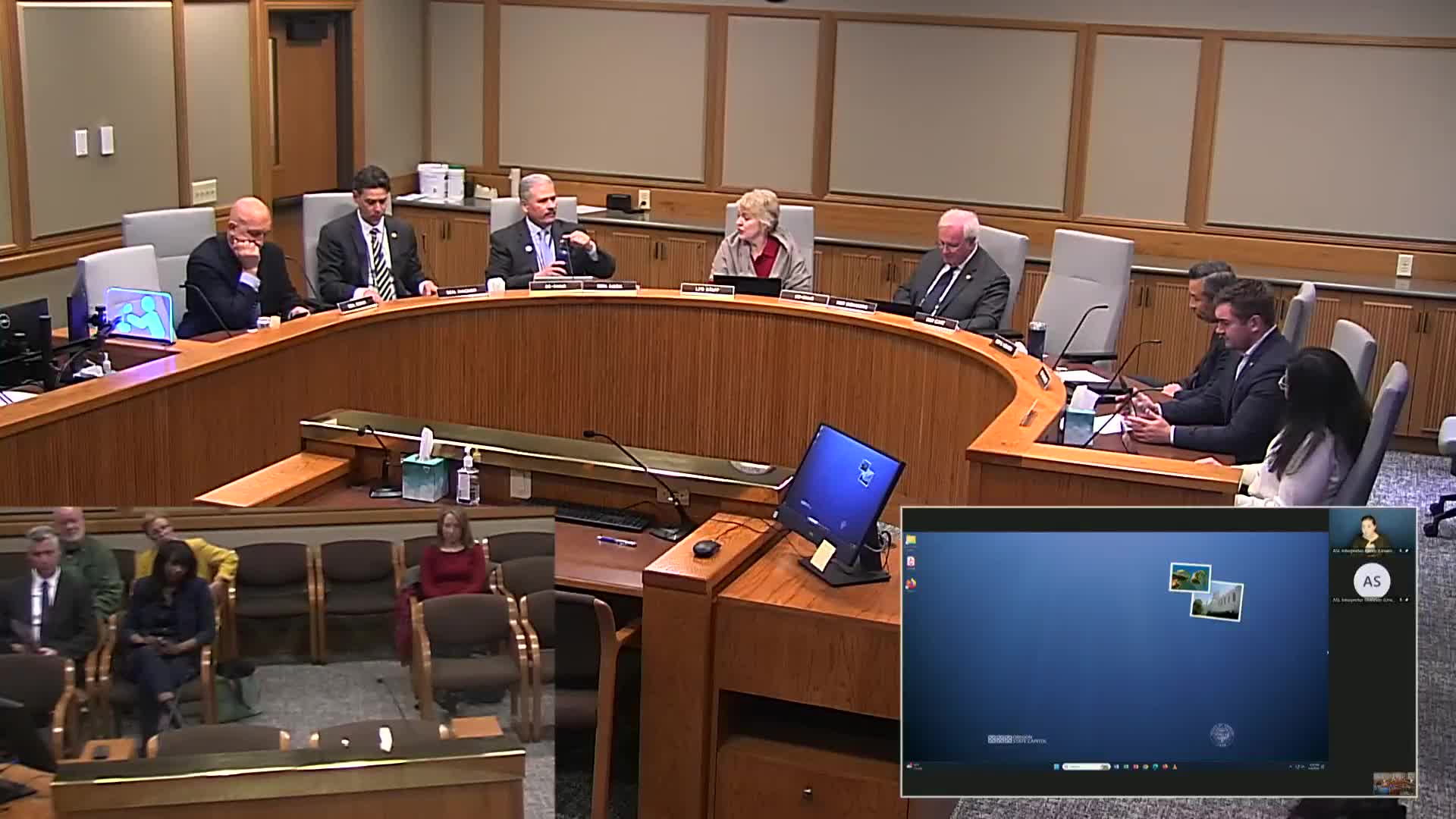
The Transportation and Economic Development Subcommittee held an informational hearing Thursday to review House Bill 50 11, policy option package 90, a $3,500,000 general-fund proposal intended to create short-term housing, rental assistance and supportive services to help move people from the Oregon State Hospital into community housing.
The proposal was presented by Andrea Bell, executive director of Oregon Housing and Community Services (OHCS), and Caleb Yant, OHCS deputy director. Dr. Krista Jones, deputy director for behavioral health at the Oregon Health Authority (OHA), answered committee questions on system capacity and the court-ordered timeline that underlies the recommendation.
OHCS officials said the package is one of several actions prompted by a federal court order, issued in 2022, that requires the state to reduce wait times for “aid and assist” commitments so people in county jails who have been found unable to assist in their own defense gain admission to the state hospital within seven days. Andrea Bell said the proposed program is intended to help people who are ready to step down from licensed mental-health facilities into community living by ensuring there is housing and supports available. "I can attest that people are transitioning into homelessness," Bell said, describing housing barriers that delay transitions out of higher-level care.
Dr. Krista Jones described the pipeline the court order targets: individuals who are assessed as unable to aid and assist, are sent from jail to the Oregon State Hospital, then — depending on clinical need — to licensed residential treatment facilities or community-based settings. "The compliance issue is that they need to go to the state hospital within 7 days," Jones said, explaining that delays have grown because downstream capacity is constrained.
OHCS officials said the $3.5 million would fund a short-term program for rental assistance, case management and related supports, designed to be used alongside existing funding streams such as Medicaid and the Oregon Rehousing Initiative (ORI). Using ORI program averages (12 months of rental assistance at roughly $3,000 per month including services), OHCS estimated the package could serve about 96 households, though staff said that outcome depends on local operational plans and that some assumptions remain to be validated with local providers.
Committee members pressed for more detail on several points: whether people exiting licensed facilities would qualify for typical housing (background checks, readiness), how much of the amount is for administration and planning, what portion of the court-ordered need 96 households would meet, and what the longer-term plan is after temporary assistance ends. OHCS said administrative and overhead details have not been finalized and will be determined after further planning with OHA and local partners; officials acknowledged they have not yet produced a full inventory of all actions under the court order and offered to supply that overview.
Several members raised broader questions about whether the state should instead invest more in expanding licensed behavioral-health capacity versus funding short-term housing steps to free existing beds. Committee members repeatedly asked for follow-up data on how many people are awaiting hospital admission, recidivism or return-to-system rates after housing interventions, and which parts of the system must change to meet the court timeline.
OHCS and OHA described the package as a targeted, short-term intervention intended to create vacancies in facilities (licensed residential treatment and state hospital beds) by moving people who no longer meet medical-necessity criteria into supported housing. Staff repeatedly emphasized that the program is one of several measures intended to address system-wide capacity constraints and that success metrics would include creating hospital vacancies, proactive identification of people ready to transition, and the ability to sustain long-term tenancy through wraparound supports and referrals to other funding sources.
No formal vote or committee action was taken; the item was an informational briefing on the governor’s recommended budget and the presentation closed with an agreement to provide additional data and operational details to the committee.