Get Full Government Meeting Transcripts, Videos, & Alerts Forever!
Get email alerts on the Youth Prevention Adac topic
No spam. Unsubscribe anytime.
County ADAC outlines prevention services, Clyde youth survey and Valley Central impact specialist
Summary
Representatives from the Alcohol and Drug Awareness Council (ADAC) described countywide prevention services funded with opioid settlement dollars, the Clyde youth survey being rolled out in 10 Orange County districts, and introduced Valley Central’s prevention specialist, Natalie Gatto.
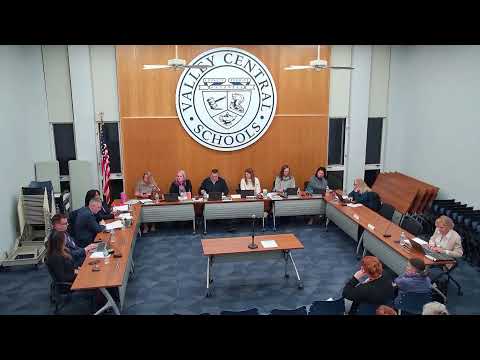
Cynthia Lardy, Impact supervisor for the Alcohol and Drug Awareness Council (ADAC) of Orange County, presented the ADAC Impact program to the Valley Central Board of Education on April 7 and introduced Natalie Gatto as Valley Central’s ADAC prevention specialist. Lardy told the board ADAC has operated in Orange County since 1972 and that the Impact program places trained prevention specialists in school districts to provide universal substance-use prevention messaging and targeted brief interventions.
Lardy said ADAC’s Clyde survey — a validated, anonymous youth survey measuring recent use, lifetime use and perceived harm — is being rolled out in 10 Orange County school districts and will survey eighth, tenth and twelfth graders. She said ADAC is funding the survey with opioid settlement funds and expected the district surveys to be completed by April 30; the goal is to repeat the assessment in two years to track changes over time.
Lardy outlined ADAC programming that Valley Central students have received: “Too Good for Drugs and Too Good for Violence” (a universal, evidence‑based curriculum) and Teen Intervene (a three-session SBIRT — screening, brief intervention and referral to treatment — model for adolescents with mild to moderate substance use). She said Valley Central has received the Too Good series in kindergarten through fourth grade districtwide since 2016 and that the Impact program has delivered hundreds of presentations and tabling events reaching thousands of students.
Lardy said ADAC has provided 1,016 Teen Intervene referrals in Valley Central since Impact started in January 2024 through March 3, 2025 (transcript numbers). She also said ADAC conducts teen‑focused peer services, family support navigation, workplace programs, senior wellness (WISE), and collaborates with Stop DWI and TASC for justice‑involved interventions.
Natalie Gatto, presented as Valley Central’s prevention specialist and a district alumna, described her school work: delivering classroom lessons (vaping, alcohol, social media and mental health), running a journaling club, coordinating lunchroom tabling events (“spin the wheel”) that reach students with brief education and prizes, leading Teen Intervene sessions with parental permission, collaborating with counselors and behavioral specialists, and assisting at prom and other events. Gatto said the approach is to be a consistent, trusted adult across grade levels so students know where to go for confidential help.
Gatto said Teen Intervene is typically three one‑hour sessions that use motivational interviewing and that parental permission is required; most students she worked with did not require referral to higher‑level treatment, though some were referred for outpatient or inpatient services when appropriate. Lardy and Gatto emphasized that Teen Intervene protects confidentiality except when there is imminent risk to self or others.
Board members and ADAC representatives discussed outreach to parents; Lardy said parent turnout for presentations could be low and requested board help getting parents engaged. Lardy and Gatto also described a recent local trend ADAC tracked — misuse of smelling salts — and said ADAC keeps materials on current drug trends.
The presentation closed with an offer to bring parent sessions to the district and with board members thanking ADAC for the work.