Get Full Government Meeting Transcripts, Videos, & Alerts Forever!
Get email alerts on the Education Trout Project topic
No spam. Unsubscribe anytime.
Walden Elementary students describe year-long trout-raising project and Thursday release
Summary
Students and a fifth-grade teacher at Walden Elementary described a year-long Trout in the Classroom project that raised trout from eggs for a planned release at Tin Brook, Wooster Grove Park, on Thursday; they explained classroom procedures, equipment and safety measures used to care for the fish.
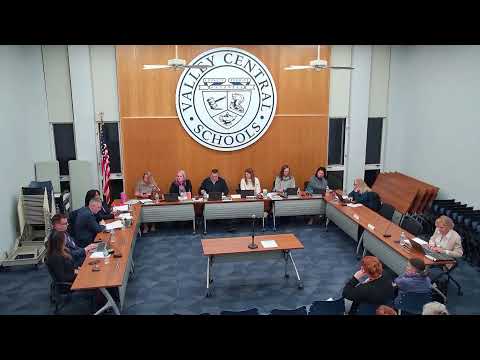
Walden Elementary fifth-graders and their teacher described a hands-on Trout in the Classroom project during the Valley Central School District Board of Education meeting on April 7. The students and their teacher said they raised trout from eggs in a 55-gallon tank at Walden and planned to release the surviving trout at Tin Brook in Wooster Grove Park on Thursday.
The project, led by the classroom teacher, aimed to meet science standards and give students a practical experience with ecosystems and water quality. The teacher told the board he had been a principal for 15 years and that the trout project became “one of the coolest hands-on, engaging learning” experiences at Walden.
Students described daily duties and equipment: a chiller to keep water in the low 50s, an aerator for oxygen, a filter, a webcam for remote observation, gravel siphons for cleaning, five‑gallon buckets for treated water, and a quarantine net for sick fish. Classroom responsibilities included regular water testing, partial water changes of about 5 gallons, monitoring for fungus on eggs, and removing visibly ill fish to quarantine to prevent disease spread. They said most water was stored in a closet sink to allow chlorine to dissipate before adding it to the tank.
Students explained trout life stages encountered in class — egg, embryo, alevin (with yolk sac), fry, fingerling — and said they removed white eggs (a sign of fungus) and sometimes used turkey basters to transfer eggs or sick fish to quarantine. They described losses: two malformed two-headed alevins and other mortalities, and noted that “in the wild, the survival rate is around 1 percent.” Students said they do not know the final number of fish that will be released until release day but reported the most recent loss before the meeting had occurred on April 2 (and another earlier loss on April 10).
The classroom credited community donors and helpers: materials were obtained via donations and a used tank; Logan Heaney and Berry’s Grove (a local nonprofit) were named for donating materials; Thruway Sporting Goods was cited as providing prizes for a volunteer raffle; and custodial and technology staff were acknowledged for support with feeding and livestream setup. Students said they used a raffle-ticket system to encourage volunteering so more students could participate on release day.
Teacher and students said the work addressed curriculum topics including matter and movement, water scarcity and quality, and identifying living things in an ecosystem. The teacher said the classroom’s goal is ambitious — eventually aiming to release 1,000 fish in a year if the program is scaled districtwide — but that initial start‑up costs are “decently high” while annual costs would be lower for consumables.
The release was scheduled for Thursday at Tin Brook in Wooster Grove Park; students also said they planned to learn about fly fishing, stream flow rates and other ecosystem topics as part of the release activities.
The presentation closed with students and the teacher thanking the district, community partners, and classmates for support.