Get Full Government Meeting Transcripts, Videos, & Alerts Forever!
Get email alerts on the Military Pension Tax topic
No spam. Unsubscribe anytime.
Legislative briefing reviews tax treatment and revenue effects of military retirement pay
Summary
Legislative Revenue Office analysts outlined categories of military retirement pay, existing exemptions for pre‑1991 federal pensions and rough revenue estimates for proposals ranging from partial exclusions to full exemptions.
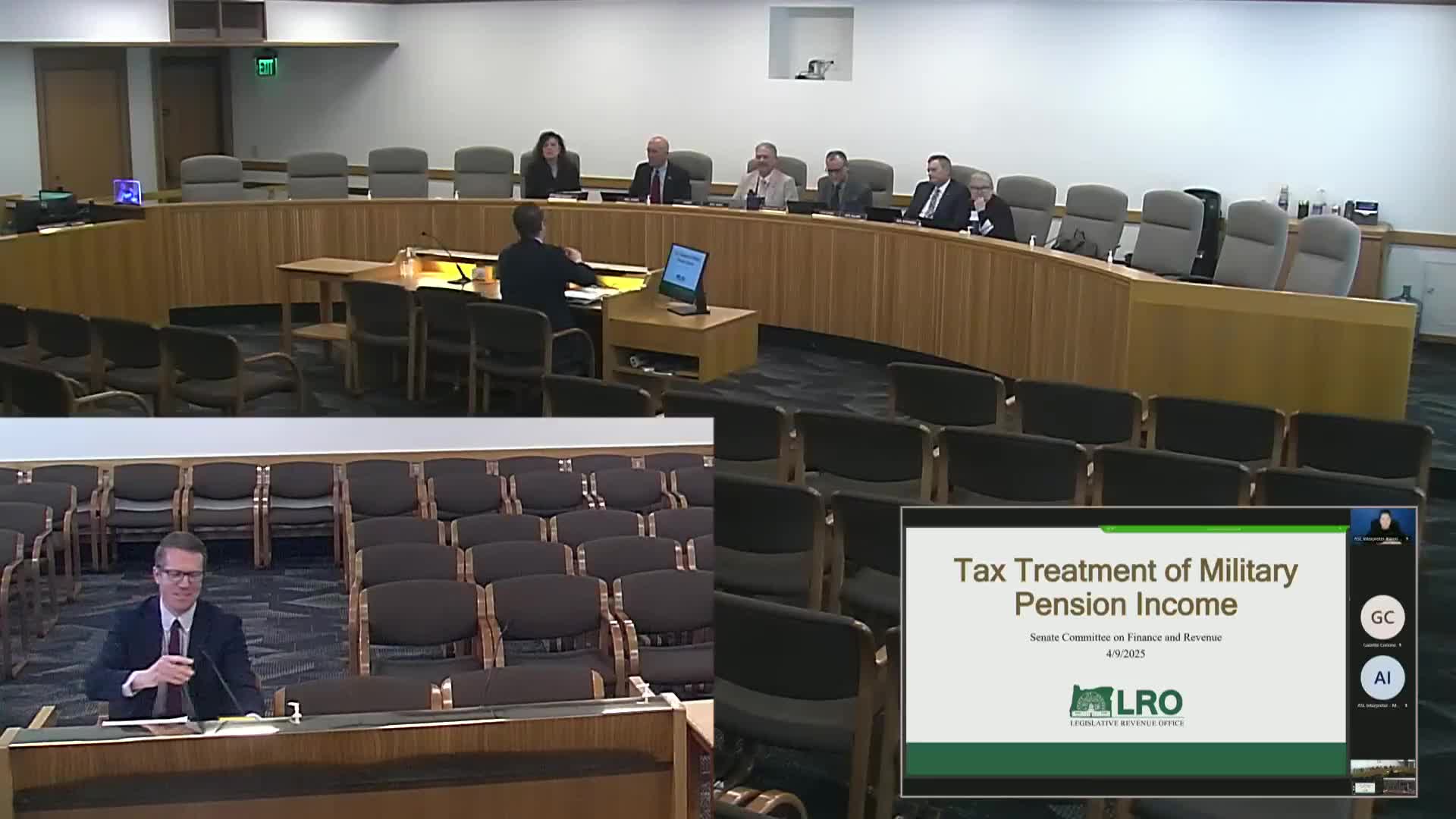
Legislative staff briefed the Senate Committee on Finance and Revenue Wednesday on the tax treatment of military retirement pay and presented preliminary revenue estimates for several policy options under discussion.
Kyle Easton of the Legislative Revenue Office said military retirement pay falls into three primary categories for tax purposes: non‑disability active‑duty retired pay (typically earned after 20 years of service), reserve retirement (usually payable beginning at age 60) and disability retired pay. Easton emphasized that Veterans Affairs disability benefits are already exempt from Oregon taxation; the briefing covered taxable retirement pay.
Easton summarized distribution and dollar totals from federal data: about 18,000 military retirees received Department of Defense retirement pay in federal fiscal 2023, totaling roughly $509,000,000 (an average of about $28,000 per recipient). He said more retirees are likely to be fully taxable because an existing Oregon exemption applies only to federal pension income earned for service before 1991.
On revenue impacts, Easton presented preliminary estimates under multiple options. He reported a full exclusion of all military retirement pay would reduce general‑fund revenue by roughly $33 million in the modeled year. Excluding a fixed amount — for example, subtracting the first $17,500 of retirement pay per filer — would have a smaller effect: Easton cited earlier committee discussion showing the $17,500 carve‑out at prior proposal scale would reduce revenue by about $5.4 million. He noted many retirees receive modest amounts and that less than 4% of military retirement pay recipients reported more than $70,000.
Committee members asked about age cutoffs, interactions with spouse income and how reserve retirement timing affects age distributions. Easton reiterated the data showed a concentration of recipients under older ages for reserve retirement, and that detailed fiscal notes would be needed to model specific eligibility criteria such as age thresholds or income caps. Senator Kim Thatcher and others said they would continue seeking options to support veterans while assessing fiscal capacity.
The briefing closed without a committee vote; staff said the material will inform future bill work this session.