Get Full Government Meeting Transcripts, Videos, & Alerts Forever!
Get email alerts on the Brownfield Property Tax Incentive topic
No spam. Unsubscribe anytime.
Informational briefing: brownfield property‑tax incentive rarely used; threshold and awareness cited as barriers
Summary
Legislative staff and stakeholders briefed the Senate committee on a local brownfield property‑tax exemption scheduled for review; staff said use has been limited, noted a 75% taxing‑district approval threshold and low revenue impact, and private consultants and local officials urged lowering thresholds and improving outreach.
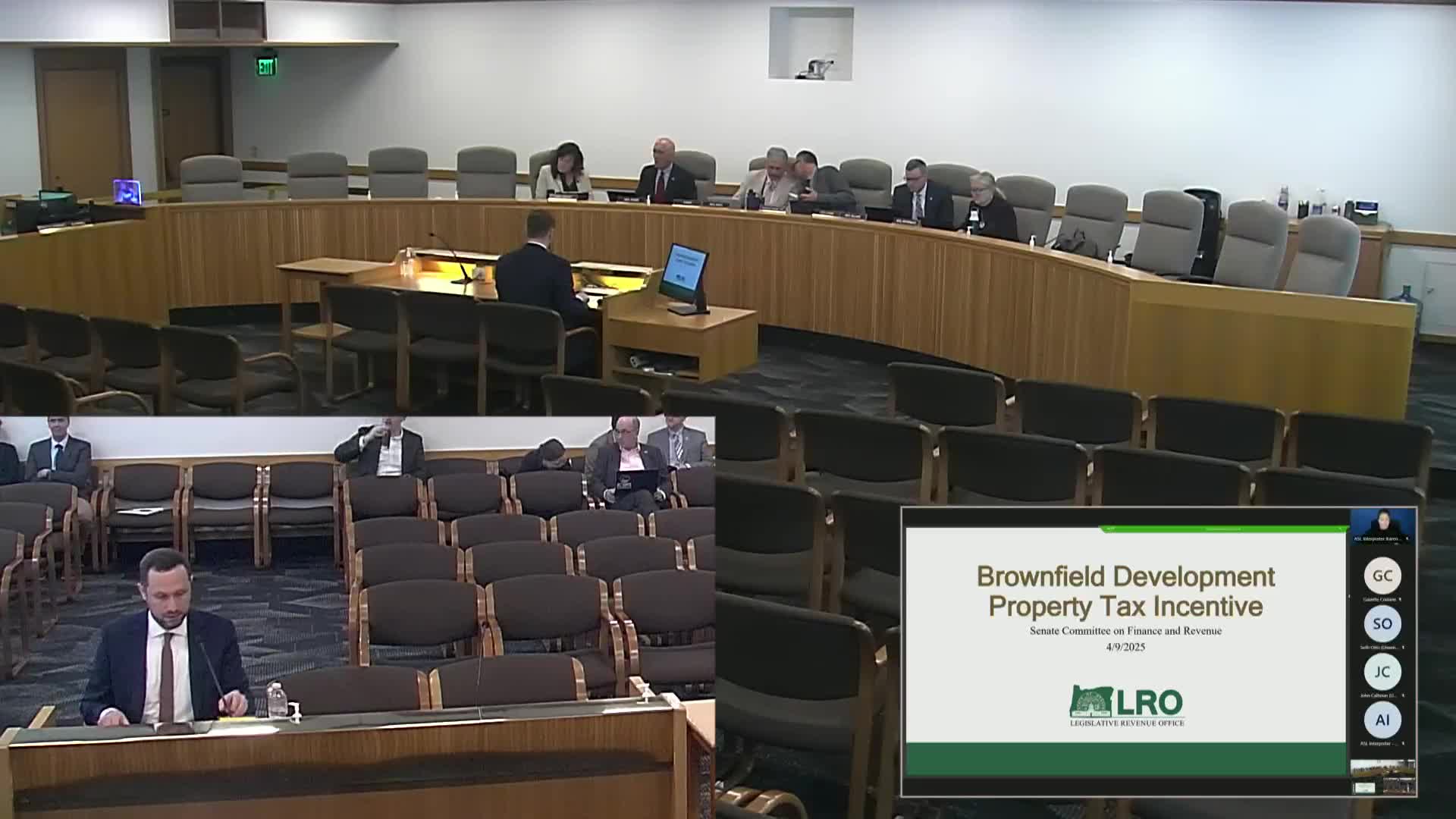
Legislative staff briefed the Senate Committee on Finance and Revenue on the state’s brownfield property‑tax incentive and presented data showing limited local use and modest projected fiscal impacts if the exemption’s sunset is extended.
Bo Olen of the Legislative Revenue Office described the program’s mechanics: cities, counties or ports may adopt an ordinance granting a special assessment for brownfield land and a full or partial exemption for improvements and personal property. Adoption requires approval by districts representing at least 75% of the combined tax rate. Olen said the program’s term is typically 10 years, extendable up to 15 years, and that owners stop receiving benefits when eligible costs have been recouped, the benefit period expires, or the owner is found noncompliant.
Olen told senators the program’s use has been limited across Oregon and the Legislative Revenue Office estimated that extending the exemption would have a revenue impact of less than $100,000 per biennium. He said the city of Portland’s 2019 review estimated brownfields constituted about one‑third of developable industrial land within the urban growth boundary—roughly 900 acres—with an estimated cleanup cost of $240 million for those parcels.
Seth Otto, a principal with consultant firm Moll Foster + Long, said the Department of Environmental Quality’s cleanup database showed brownfields across the state and noted the number of sites in the DEQ database rose from about 13,000 in 2015 to about 15,282 in 2024, with only about 35% holding a letter of no further action. Otto said cleanup costs vary widely; high‑cost cleanup and long monitoring timelines can make sites financially “underwater” and deter private redevelopment absent grants, low‑interest loans or tax incentives.
City and economic development representatives recommended changes to improve the exemption’s usability. Jenna Jones (representing League of Oregon Cities) and Rocky Dallum (Oregon Economic Development Association) said the 75% taxing‑district threshold and limited public awareness were key impediments; they noted a 2019 change allowing stacking of brownfield remediation incentives with some affordable‑housing property‑tax exemptions had not been widely publicized and that the pandemic interrupted outreach and implementation.
Committee members asked whether lowering the 75% threshold or improving outreach would increase uptake; staff and witnesses recommended continuing to examine threshold changes and targeted education to taxing districts, local governments and developers. The briefing closed with staff requesting feedback and offering to work with stakeholders on possible statutory adjustments.