Get Full Government Meeting Transcripts, Videos, & Alerts Forever!
Get email alerts on the Tax Reconnect Conformity topic
No spam. Unsubscribe anytime.
Lawmakers debate pausing "rolling" federal tax conformity for one year
Summary
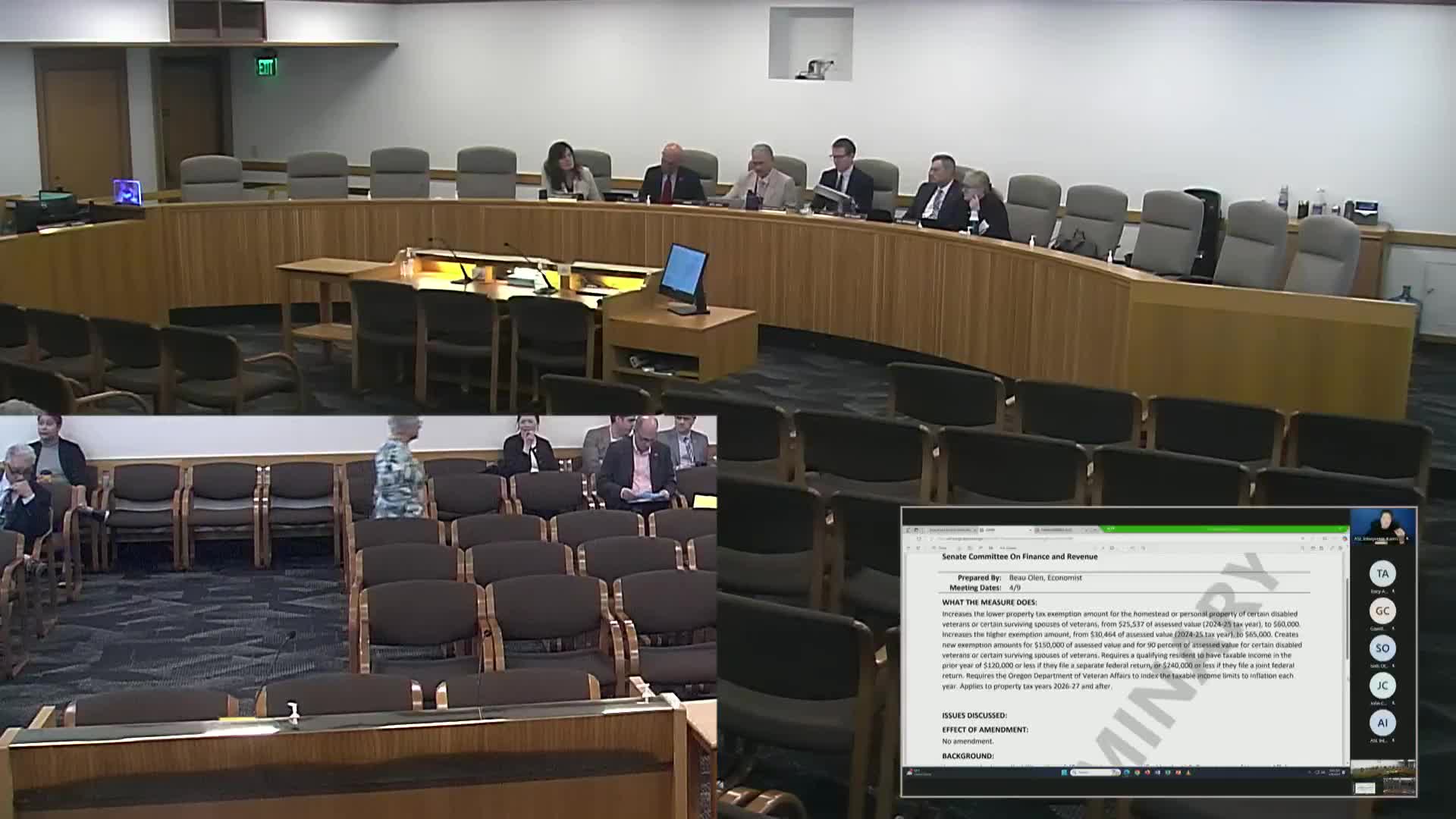
The Senate Committee on Finance and Revenue heard competing testimony Wednesday on House Bill 2092A, which would suspend Oregon’s automatic "rolling" conformity to federal taxable‑income rules for tax year 2025 and fix the federal reference date at Dec. 31, 2024.
The Senate Committee on Finance and Revenue held a public hearing Wednesday on House Bill 2092A, a biennial "reconnect" bill that would suspend Oregon’s automatic, rolling conformity to the federal definition of taxable income for tax year 2025 and instead fix Oregon’s federal reference date at Dec. 31, 2024.
A committee staff summary described the bill as a routine but consequential technical measure that updates Oregon’s linkage to federal tax law. The bill would maintain annual updates to definitional connections while suspending the automatic tie to federal taxable‑income changes for 2025; automatic connection would resume Jan. 1, 2026. Legislative staff told senators the pause reduces the risk that late federal changes with retroactive application would alter Oregon revenue unexpectedly.
Multiple witnesses from the tax and business community opposed the one‑year freeze. John Hawkins and Heather Jackson of the Oregon Society of Certified Public Accountants said the society supports reconnect generally but warned static conformity creates taxpayer complexity. “Static conformity would upend that, requiring taxpayers to track and reconcile separate sets of rules for state and federal purposes,” Hawkins said. Jeff Newgarden of the Smart Growth Coalition said static conformity increases cost and compliance risk for taxpayers and the Department of Revenue. Derek Sangston of Oregon Business and Industry said employers and their tax advisers rely on rolling conformity for administrative simplicity and predictability.
Opponents emphasized specific technical consequences: firms could face separate depreciation schedules, deferred‑depreciation reconciling and the need to maintain multiple books if Oregon froze conformity while federal law later changed. Tracy Allen of the Associated General Contractors said construction firms already face tightening business conditions and that an additional state/federal divergence would raise costs and complexity for private employers.
Supporters of the bill framed it as a limited, prudent pause to provide short‑term predictability while federal tax law remains uncertain. Witnesses favoring the bill argued that fixing the federal reference date would help taxpayers know their filing rules for the April 2026 filing season and allow the state to better forecast revenue. Legislative and tax preparer witnesses said a one‑year static date is a compromise between full rolling conformity and a permanent disconnect.
The committee took testimony from agency staff, CPAs, business groups and contractors; no committee vote or formal action was recorded at the hearing.