Get Full Government Meeting Transcripts, Videos, & Alerts Forever!
Get email alerts on the Gaming Commission topic
No spam. Unsubscribe anytime.
House Judiciary weighs restoring Gaming Commission, adds subcommittee to reconcile hearing, appeal rules
Summary
The House Judiciary Committee on April 7 considered three amendments to Senate Bill 22-24 that would re-establish and revise oversight for charitable gaming, including per-diem compensation, quarterly meetings, executive-session authority, a $25,000 appropriation and new hearing and appeal procedures for the Attorney General’s enforcement actions.
The House Judiciary Committee on April 7 considered three amendments to Senate Bill 22-24 that would re-establish and revise oversight for charitable gaming, including per-diem compensation, quarterly meetings, executive-session authority, a $25,000 appropriation and new hearing and appeal procedures for the Attorney General’s enforcement actions.
Senator Yana Merdahl, the prime sponsor of SB 22-24, told the committee the amendment before members is a “hog house amendment” that largely restores the commission’s prior structure and adds a per-diem and an appropriation. She said the governor plans to nominate two commission members within about a week to 10 days and that the new administration is prepared to staff the commission. She also presented statewide figures for charitable-gaming proceeds, saying they rose from about $268 million in 2018 to roughly $2.37 billion in 2024 (she later restated the larger number as $2.67 billion during remarks).
Representative Christiansen presented a narrow amendment to add a state gaming stamp specifically for paper pull tabs and to exclude electronic pull-tab devices from that stamping requirement, saying the change had been agreed to by interested parties when it appeared in another bill that did not pass. Deb McDaniel, director of the Gaming Division in the Office of the Attorney General, said her office supported Representative Christiansen’s amendment and that removing the stamp requirement for electronic devices would ease administrative burdens for charities and distributors.
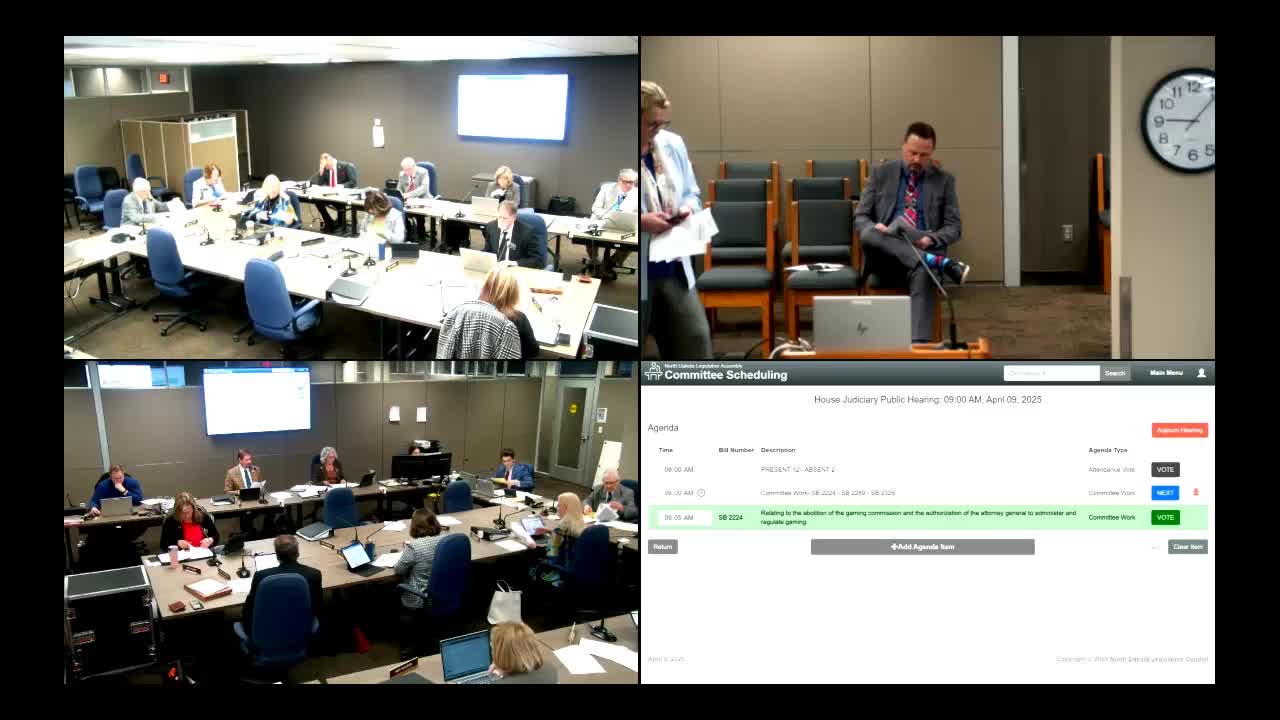
Representative Ben Koppelman outlined a broader hog-house amendment that overlaps with the sponsor’s proposal and added two contested elements: (1) a requirement that the Attorney General hold an open, recorded hearing before imposing major sanctions (revocation, suspension or fines of $1,000 or more) and broadcast that hearing; and (2) a guaranteed appeal to an Administrative Law Judge (ALJ) with a stay of the sanction pending the appeal. Koppelman described the measures as intended to increase transparency and to limit economic harm to charities while enforcement and appeals proceed. He said the hearing would provide a video record “much like this meeting we’re in right now,” and that ALJ review would be available “within 30 days” under his draft language.
Committee members raised concerns about procedure and cost. Several lawmakers and legislative counsel participants observed that the Administrative Agencies Practices Act already sets out a multi-step process for administrative appeals and that creating a new “appellate ALJ” role would add an extra adjudicative step, duplicate hearings (agency + ALJ), and increase transcript and reporter expenses. Members discussed alternatives including: (a) keeping the Administrative Agencies Practices Act pathway intact but adding a guaranteed time frame for agency action or a statutory stay pending review; (b) directing the Attorney General to record and make transcripts available for any formal sanction hearing so courts would have a record; or (c) permitting direct appeal to district court in specified circumstances.
Chairman Clamine appointed a subcommittee—Representative McLeod as chair, with Representatives Schneider and Henderson—to reconcile the three amendments, align proposed hearing and appeal timing with existing Administrative Agencies Practices Act requirements, and work with Legislative Council staff. The subcommittee is to report back to the full committee no later than the next Tuesday. The committee did not take a final vote on SB 22-24 at the April 7 meeting.
Committee discussion also touched on scope: members asked whether the proposed open-hearing requirement would apply only to charities or to other regulated parties such as distributors and liquor establishments; Koppelman said the language was limited to violations of the gaming chapter and any person subject to sanctions under those gaming rules. The Gaming Division director told the committee her office rarely proceeds to an adjudicated hearing and typically works with organizations to correct violations, and that she has not pursued administrative adjudication in her 29 years at the office.
The committee left unresolved: whether commission members should receive per diem under the cited statutory authority, whether the $25,000 appropriation should remain, whether the paper-pull-tab stamp amendment should be included, and how to structure an appeal process that both protects charities from ongoing economic harm and preserves the Attorney General’s enforcement authority. The assigned subcommittee will draft harmonized language for committee consideration.